A hospital bill can be difficult to decode even when every charge is technically listed. For families already dealing with the stress of an illness, a bill running into lakhs can bring a second worry: what exactly are they being charged for, and which of those costs will their insurance actually cover?
The problem is not always an obviously inflated bill. It can be smaller discrepancies scattered across dozens of line items — a doctor’s fee without the doctor’s name, a consumable charged at full price, nursing charges billed separately from room rent, or diagnostic tests for which the patient is not given the expected reports or films. A recent hospital bill posted on X, for instance, raised questions over several such charges. It included RMO (Resident Medical Officer) fees without naming the doctor, a full charge for a hand sanitiser bottle that the patient said was already half-empty, and separate nursing charges despite the room rent. MRI and CT scan charges appeared on the bill even though the hospital did not provide the films, while diet charges were levied although the patient was eating food brought from home.

Such discrepancies can be difficult to challenge at discharge, when families are often focused on getting the patient home and settling the bill. By then, it may also be difficult to remember which medicines were administered, which procedures were performed or which services were actually provided.
So, how should patients and families read a hospital bill, and what can they do when something does not add up? The Indian Express posed these questions to Shashank Rai, co-founder of health-tech platform Docpharma, and Advocate Shashi Shankar, who specialises in consumer redressal cases.
What are the “hidden” charges families should watch for in a bill?
“Hidden” isn’t quite the right word, says Rai. The problem isn’t necessarily concealment; it is that families often aren’t looking closely at the different components of the bill while treatment is still under way.
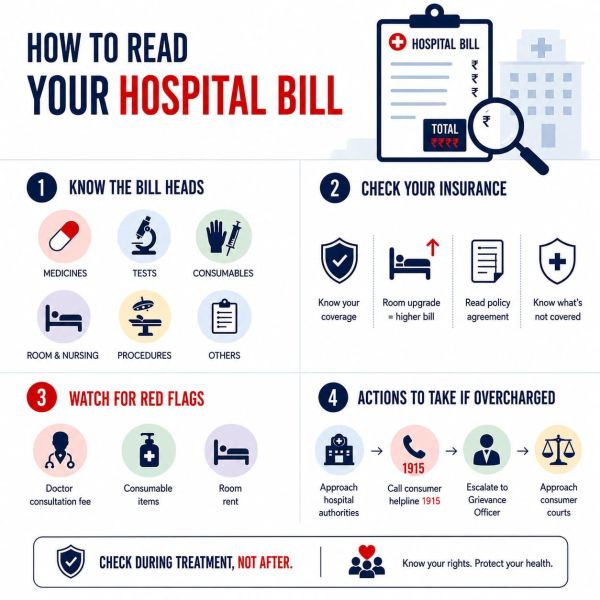
He lists the heads every family should be tracking in real time. “Look at medicines, diagnostics, consumables and disposables, doctor and specialist visits, room rent, bedside and nursing procedures, operation theatre or procedure charges, registration and biomedical waste handling,” says Rai. Since a bill has too many moving parts to make sense of all at once at discharge, he advises families to get into the habit of reviewing these heads regularly. “This way they will understand their expenses far better and can raise questions while treatment is still under way rather than trying to reconstruct the whole thing after discharge,” he adds.
“Ask for an itemised bill, in which every item charged is mentioned separately, like medication and tests. The date and quantity are also mentioned in it,” says Advocate Shashi Shankar.
How exactly do hospitals structure the charges, and under what headings?
The same heads recur across most private hospital bills. What matters, says Rai, is not just knowing the heads but reading the line items under each one. “They can cross-check consumables and procedures against the nursing station’s daily records, and seek clarification on mismatches.”
The items and heads where discrepancies are most likely to arise include consumables, room rent and doctor consultation fees, though the scope for discrepancies can depend on whether the admission is for an emergency, a surgery or long-term treatment. “Another metric hospitals track is the average revenue per occupied bed, or ARPOB. For large private hospital chains, this is around Rs 50,000 per occupied bed per day, and they have to maintain that average, regardless of the patient count,” says Rai.
Shankar adds, “If asked for the proof of charges, the hospital has the obligation to provide it. And if a clear answer is not given, then one can write an email or a letter to the higher hospital authorities regarding clarity in the bill.”
A simple habit of matching the bill against the relevant department’s records is often the fastest way to catch a charge that does not correspond to anything that actually happened — a fee for a doctor’s visit with no doctor named, for instance, or a procedure billed twice under two different heads.
How much of the bill does a health insurance policy actually cover?
This is where families can lose money without realising it, Shankar says, because some of the checking needs to happen before admission, not after.
“Whatever health insurance one takes, it’s important to check before going to the hospital which charges are covered,” Shankar says. Often, ICU charges are not covered, or room charges for a normal room are covered, but the hospital gives you a luxury room. “One can also ask for the agreement between the hospital and the insurance company to get more clarity.”
Rai cautions against room upgrades, saying they are a trap that many families walk into. “If you take a room above the covered category, the doctor’s fee and nursing charge will be charged proportionately to that room. So, a 2,000-rupee room rent upgrade can snowball into thousands of rupees in additional charges.”
Every policy also carries a list of non-payable items — things insurers simply won’t cover, whether the claim is cashless or reimbursed. These can include registration fees, administrative charges, certain consumables, attendant charges and, in some cases, items such as syringes and gloves.
“It’s smart to ask the hospital before admission, what is covered and what is not?”, says Shankar.
If you find you’ve been overcharged, what can you actually do? What are your rights as a patient?
“Start with the hospital itself,” says Shankar. Raise the discrepancy directly and ask for clarification, preferably with the relevant documentation in hand. Patients should request an itemised bill and cross-check it against the treatment as it progresses, rather than waiting until discharge.
If it turns out to be a genuine error or an overcharge, the complaint can be escalated to the hospital’s Internal Grievance Redressal Officer. “A written complaint needs to be acknowledged within 24 hours and given a tracking number,” Shankar says.
Patients also have rights on paper under the Charter of Patients’ Rights. This involves access to information about diagnosis and proposed treatment, access to case papers and investigation reports, an itemised bill at the time of payment, visibility into hospital rates, and the right to source medicines and diagnostic tests from outside the hospital.
“The charter is currently just a recommendation that states have been invited to adopt,” says Shankar. How much these recommendations are translated into practice varies from state to state, and from hospital to hospital.
For overcharging on scheduled drugs or medical devices specifically, patients can approach the National Pharmaceutical Pricing Authority (NPPA).
Hospitals are treated as service providers under the Consumer Protection Act. If the hospital’s own grievance process does not resolve the issue, patients can take the dispute to the Consumer Disputes Redressal Commission. They can also call 1915, the National Consumer Helpline number.
“In Delhi’s consumer courts alone, we see over a hundred cases a month involving inflated hospital bills,” Shankar says. “The government runs the Jaago Grahak Jaago programme but awareness campaigns don’t mean much without an act or a regulation backing them. On billing disputes, the government has largely been a mute spectator. Once in a blue moon you’ll see action — a penalty imposed on a hospital, some redressal granted, while others languish, awaiting justice.”
Unless there is greater awareness of consumer rights — and hospitals are held accountable for what they bill — confusion and anxiety over hospital bills will remain unresolved.

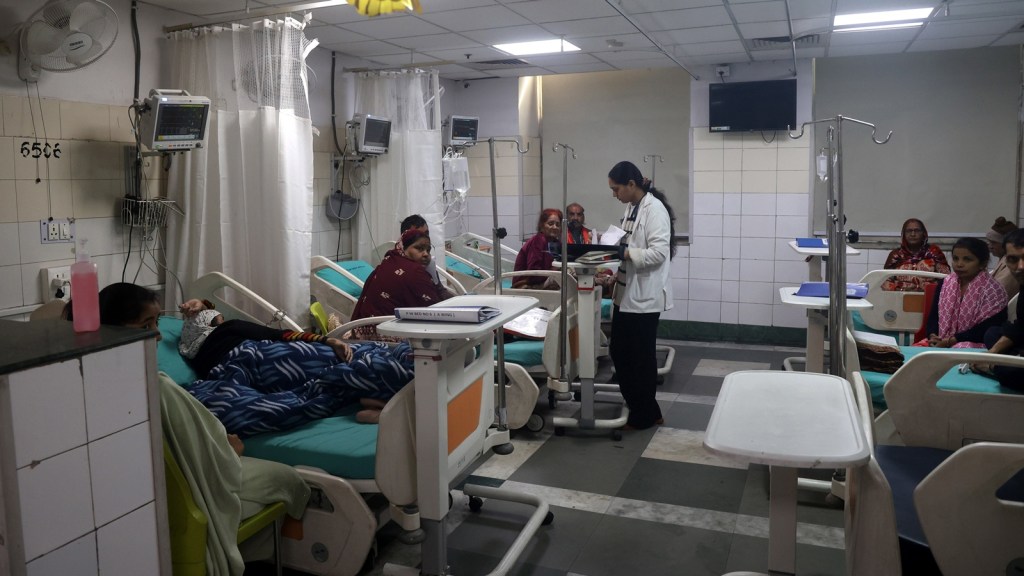 Every policy also carries a list of non-payable items — things insurers simply won’t cover, whether the claim is cashless or reimbursed. (Express Photo by Amit Mehra)



 Share


