At 87, Tara Pal was losing herself. As Alzheimer’s disease steadily chipped away at the memories that had held together a lifetime of names, places, routines and her identity, words began to slip away and even the simplest tasks became difficult. The woman who had once carried a lifetime of knowledge in her head could no longer always find her way back to it.
Then, almost playfully, she began again. Sitting with her grandchild’s alphabet blocks, Tara started forming words with her. At first, the letters made no sense. Then, one afternoon, they came together to spell her own name: TARA. She smiled as she struggled to put the letters in a row, her frail fingers losing grip every time. Then she went on to spell her daughter’s name, pronounce her husband’s name, call out to him and, eventually, memorise her own address. Tara had not suddenly “recovered” from advanced Alzheimer’s disease. What had changed was her ability to engage with a familiar task, learn through repetition and respond to cues. “With supportive care mechanisms, you can improve the quality of life for an Alzheimer’s patient,” says Dr Prasun Chatterjee, geriatrician and researcher, whose work has explored cognition, ageing and Alzheimer’s disease.

Her story points to a less obvious truth about dementia: the loss of memory is not necessarily the loss of every capacity to learn. “Alzheimer’s does not destroy all types of memory and learning at the same rate,” explains Dr Chatterjee. “Different memory systems rely on different brain networks. Alzheimer’s particularly affects the hippocampus and related medial temporal-lobe networks, which are important for forming new memories. Late-stage Alzheimer’s can leave some forms of learning relatively intact, particularly learning based on repetition, habit and emotional familiarity, even when conscious memory and the ability to learn new facts are severely impaired.”
Currently toggling roles as the WHO TAG Member for Healthy Ageing, president of the Indian Academy of Geriatrics, and Group Clinical Lead, Geriatric Medicine and Longevity Science, Apollo Hospital Delhi, he has examined Alzheimer’s and cognitive decline from several directions. From interventions that may support cognition before dementia develops, to behavioural changes that may precede Alzheimer’s, and to biological markers that could eventually help identify the disease earlier.
“Alzheimer’s disease is a neurodegenerative disorder in which abnormal protein clumps called amyloid (plaques) and tau (twisted tangles) build up in the brain and destroy the patient’s memory, thinking skills and the ability to carry out simple daily tasks,” he says. It is the most common cause of dementia, but the two terms are not interchangeable.
Dementia is a clinical syndrome; Alzheimer’s is a disease. Dementia refers to a decline in memory, thinking, behaviour or other cognitive abilities severe enough to interfere with everyday life. Alzheimer’s disease is one specific neurodegenerative disease —and the most common cause of dementia. The distinction matters because the underlying cause can influence investigation, treatment and care. “India is looking at an old age pandemic as its ageing population increases,” he adds.
How to look for early signs
One of Dr Chatterjee’s patients is 78-year-old Kamla Mehra* from Noida. Her warning sign was deceptively ordinary: she began asking her son the same question —“Did you go to the market?”— again and again, sometimes five times within an hour. Soon she struggled to name everyday objects and would repeat questions just minutes after receiving an answer. “The family could have dismissed it as normal ageing. Instead, they sought help. A comprehensive assessment identified mild cognitive impairment (MCI), a stage in which cognitive abilities have begun to decline but substantial independence may still be preserved. Unlike Tara, Kamla came to us at a much earlier point in her cognitive journey and opened a very different window for intervention,” says Dr Chatterjee.
For generations, memory loss in an older person has often been treated as an inevitable consequence of getting old. But Alzheimer’s is not a normal or inevitable consequence of ageing. “India’s ageing population means that this casual dismissal is becoming increasingly consequential,” he adds. The nationally representative research from the Longitudinal Ageing Study in India estimated that about 7.4 per cent of Indians aged 60 and above — roughly 8.8 million people — were living with dementia based on data collected during 2017–2020.
The more detailed LASI-DAD research has highlighted an even larger population living with milder forms of cognitive impairment. Researchers estimated the prevalence of major neurocognitive disorder at 7.2 per cent and mild neurocognitive disorder at 17.6 per cent. Among people aged 80 and above, the estimated prevalence of major neurocognitive disorder was 15.2 per cent.
And as India’s population over 80 grows, Alzheimer’s will increasingly intersect with another major problem: who will provide the care? “That’s why diagnosing mild cognitive impairment is important. Some people remain stable; others improve when reversible or contributing factors are identified and treated. The signs are many — losing your train of thought, struggling to follow a book or movie plot, or getting easily distracted. Taking longer to find the right word during a conversation. Finding it harder to make decisions, finish multi-step tasks, or pay bills on time. Some could feel disoriented even in familiar places. Irritability, anxiety, depression, acting out of character are all signs of a person losing control over their familiar self,” explains Dr Chatterjee.
What happens when we look beyond memory?
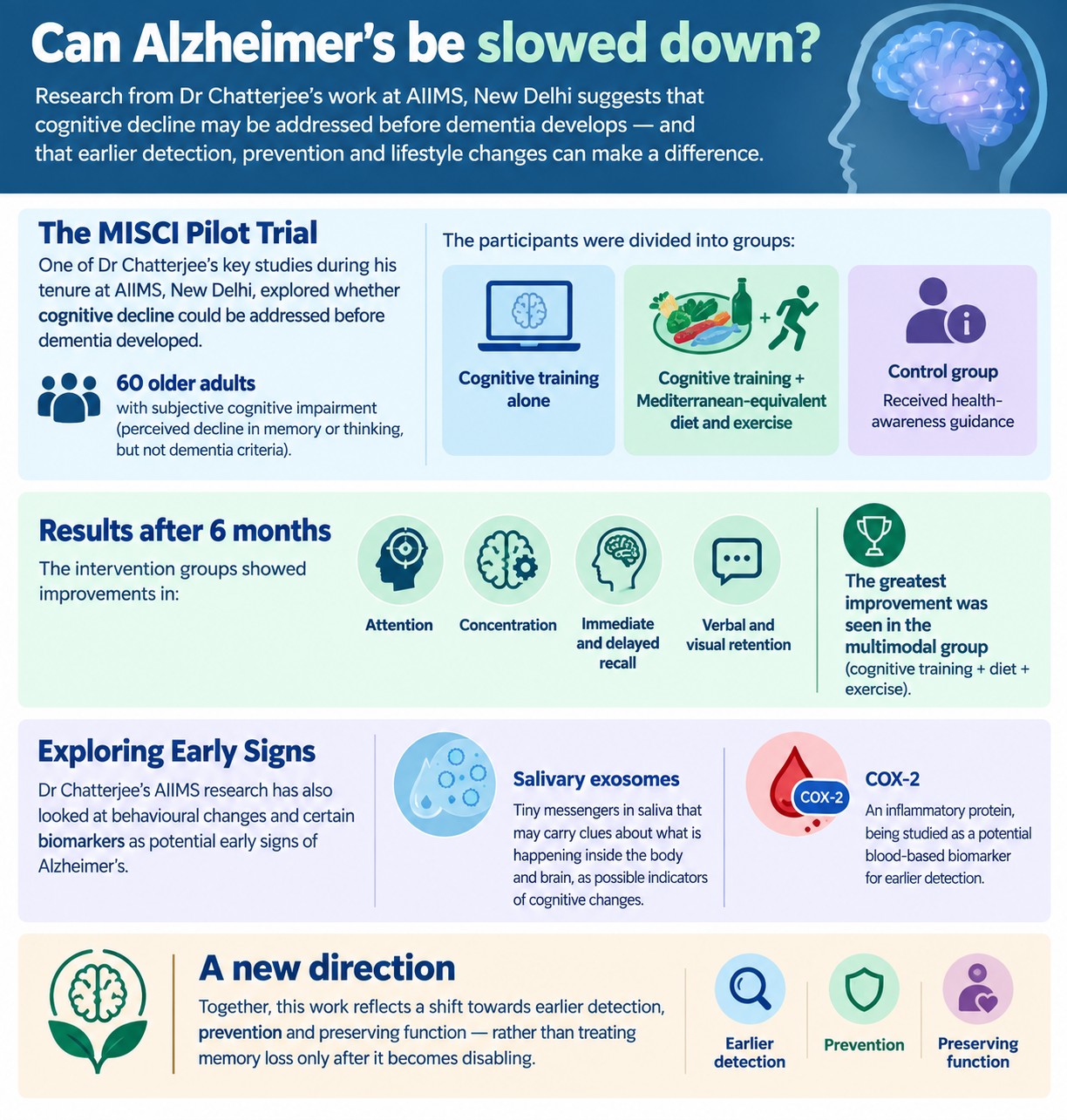
Kamla’s assessment went beyond asking whether she could remember a list of words. “The six core areas used in medicine to evaluate cognitive impairment are learning and memory, executive function, language, complex attention, perceptual-motor function, and social cognition. The brain has multiple domains, and rehabilitation has to think in multiple domains too. All of these have to be activated to keep the brain functional,” says Dr Chatterjee. At his geriatric clinic, Kamla underwent a comprehensive clinical evaluation and neuropsychological assessment. Using the validated Addenbrooke’s Cognitive Examination-III (ACE-III), her initial score was 67/100. Further investigations included scans and blood biomarkers.
Alzheimer’s
The science of neuroplasticity
Dr Chatterjee often tells patients and families that the brain is not a static organ and that one can make it work all the time. “The brain is vastly more complex than a muscle. It responds to experience, practice and stimulation throughout life. It keeps emotions intact. This capacity for adaptation is broadly described as neuroplasticity. So, if you work the brain, it can keep going till the very end. I see 100-year-olds with no dementia or Alzheimer’s. Cognitive decline should be addressed as a whole-body and whole-person problem, not simply as a memory disorder.” he says.
Kamla’s “brain gym” was an intensive non-pharmacological programme. Her son was particularly clear that he did not want to continue medications that made his mother excessively sleepy and confused. She had computer-based cognitive training for approximately 40–45 minutes per session, with repeated sessions over three months. She thought she was learning a new skill. Exercises targeted attention, memory, executive function, language and processing speed.
But the more important intervention happened outside the clinic. “At home, the family transformed ordinary life into a cognitive training environment. That’s why caregiving is so important. She maintained a diary. She practised recall. She did backward counting, played word and number games. She started learning music, which she always loved. She was made to participate in financial calculations and household activities. All of these may seem simple but engage the brain’s cognitive and functional domains repeatedly and meaningfully,” says Dr Chatterjee.
Perhaps the most powerful component of the intervention was not the computer. It was Kamla’s son. During their commute from Noida to Delhi, he would point to vehicle number plates and ask his mother to remember and recite the numbers backwards. At home, he created a large diary where she would write her address, a mantra and details of what she had done. “A simple activity recruited several abilities at once: attention, language, writing, sequencing, recall and fine-motor coordination. This is particularly relevant in India, where families continue to provide a large proportion of dementia care. Depending on specialist appointments will never be sufficient for a country of India’s size,” says Dr Chatterjee.
How the simplest interventions help
After three months, Kamla’s ACE-III score rose from 67/100 to 87/100. She became more conversational, participated more confidently in social gatherings and helped a local NGO. “You can have reasonable functional skills while living with a neurodegenerative disease. And when you intervene earlier, there may be substantially more capacity to preserve independence and build compensatory strategies,” says the doctor.
Dr Chatterjee always has counselling sessions with family members and asks them to repeatedly tell the patient how much they are loved and wanted throughout the day or that they are safe. “The emotional brain can remain deeply responsive even when factual memory has deteriorated. So, an Alzheimer’s patient senses rejection, alienation and disappointment and spirals down if you say, ‘Do you remember me?’ Instead say, ‘I’m here with you.’ That’s why the language of dementia care matters,” he adds.
How to prevent Alzheimer’s
The prevention conversation needs to move much earlier, in midlife. “We only talk about the heart, liver, diabetes. I would say include brain health in that discussion. Current evidence supports attention to several modifiable risk factors, including hypertension, diabetes, obesity, physical inactivity, lack of sleep, smoking, harmful alcohol use, hearing loss, depression, social isolation and other cardiovascular and lifestyle factors. And get a cognitive assessment at 65 instead of 75,” he says.
Of course, research shows that walking and diet changes help in managing every kind of dementia, leading to targeted interventions. “For example, the brain’s energy metabolism changes in Alzheimer’s disease, and a keto diet works because it provides an alternative fuel source to a brain that can no longer efficiently process glucose for energy. But restrictive diets should always be considered alongside other body conditions and guided,” says Dr Chatterjee.
Where the new drugs fit
The emergence of anti-amyloid therapies has added an entirely new dimension to Alzheimer’s treatment. Their cost and infrastructure requirements raise major questions about equitable access in India. For example, donanemab costs ₹91,688 per 350 mg vial in India. Introduced by Eli Lilly and Company under the brand name Lormalzi, this is the first once-monthly amyloid plaque-targeting therapy commercially available in the country. So, Dr Chatterjee overrules the pill dependence. “Instead, India needs to build a dementia-care system that begins before the patient reaches the neurologist. Our questions should be about how early can we identify it, how much function can we preserve, and how can we help the person and family live well with it. The answer will always be yes, something can still be done.”
(Names changed to protect privacy)

 The emergence of anti-amyloid therapies has added an entirely new dimension to Alzheimer’s treatment. (Source: Pexels)

 Alzheimer’s

 Share


