Till five years ago, sexual offences against children in India were tried and punished under the provisions of the Indian Penal Code, which covered adults as well. Sections 376 (rape), 377 (unnatural offences) and 354 (outraging the modesty of a woman) were invoked to address sexual crimes against children. These provisions were not sufficient to deal with the varied forms of child sexual abuse. Hence, there was a need for a stand-alone law on the issue. Further, special provisions were needed for investigation and trial of offences involving children, keeping in mind the vulnerability of children. Thus, the Protection of Children from Sexual Offences (POCSO) Act was enacted in 2012 with the objective of preventing and punishing sexual offences against children. POCSO provides for special procedures relating to reporting of cases to the police, the manner in which statements of children are recorded by the police and magistrates, and the procedure for recording evidence of child victims during trial. It also sets up special courts for trying offences under the Act.
POCSO criminalises and punishes various forms of sexual offences against children. These include penetrative acts. It also punishes oral sex. Another set of acts penalised are “touch offences” – touching the genitals, anus or breasts of a child or making the child touch these organs of the offender. This is termed as “sexual assault.” Sexual harassment of children is also made punishable.

‘Criminalising all sexual activity by children’
POCSO defines a “child” as a person under the age of 18. Unlike rape laws, POCSO is gender neutral. Hence, both men and women can be prosecuted for offences under the Act, for offences against boys and girls. Prior to the enactment of POCSO, the age at which a person could consent to sexual intercourse was 16 years (under the IPC). POCSO not only expanded sexual acts beyond penile-vaginal penetration, but also increased the age of consent to 18 years. Hence, if a person were to engage in a sexual act with boy/girl under the age of 18, even with the boy/girl’s consent, it is an offence. The Justice Verma Committee, noting the expanded set of sexual acts criminalised under POCSO and the IPC (post-2013), as well as statistics with respect to sexual activity in the 16-18 age group, in fact recommended that the age of consent be retained at 16 years (as it was in the IPC pre-2013).
Story continues below this ad
This recommendation of the Committee was however not accepted. Hence, POCSO and the IPC aim to stop all sexual activity by children, using criminal law as the tool for doing so. This is unlike some other countries which have “age-proximity” clauses, wherein sexual activity by children who are of the same age, or have an age-gap of three/five years, is treated differently. It is either not made a crime, or even if it is a crime, custodial sentences are not provided for. Under POCSO and the IPC, if a 19-year-old boy were to engage in a sexual act (penetrative or non-penetrative) with a 17 year old girl, he would be guilty of an offence. If it involves penile-vaginal penetration, he would have to be sentenced to imprisonment for a minimum of seven years.
‘Mandatory Reporting’ Provisions: The tricky choice
One of the special provisions introduced in POCSO is the requirement of “mandatory reporting.” Section 19 of the Act requires a person who knows that an offence punishable under the Act has been committed or has an apprehension that an offence may be committed, to report the same to the police. Failure to report is punishable with imprisonment for a maximum of six months. The rationale behind mandatory reporting provisions was to ensure that there is no impunity with respect to child sexual abuse, especially in cases where the abuser is a family member. In such cases, since other members of the family may not be keen to report, if the child for instance were to confide in a teacher in school, the responsibility is placed upon the teacher to report the offence.
Story continues below this ad
What HAPPENS IF A 17-YEAR-OLD GIRL GOES TO A DOCTOR SEEK REPRODUCTIVE HEALTH SERVICES? There are various problems with mandatory reporting provisions. One of them is that mandatory reporting provisions may have an adverse impact on the reproductive health of sexually active adolescents. For instance, in the scenario of the 17-19 year olds that I cited earlier, if the girl were to go to a doctor to seek contraception to avoid pregnancy or to seek medical advice on how to be safe from a sexually transmitted infection, the doctor is required to report this to the police, since this indicates that an offence under POCSO has been committed or may be committed. The doctor may choose (at his/her own risk) not to report, or may refuse to give medical advice and not keep a record of the interaction with the girl. If adolescents become aware of the possibility of criminal action against them/their partners if they seek medical advice, they may not seek such advice and engage in unprotected and unsafe sexual practices. This could lead to underage pregnancies and to sexually transmitted infections. Further, the Supreme Court has recently recognised (in the child marital rape case) that a girl child has the right to make reproductive choices. Mandatory reporting clauses, in their application, may impact reproductive choices.
Story continues below this ad
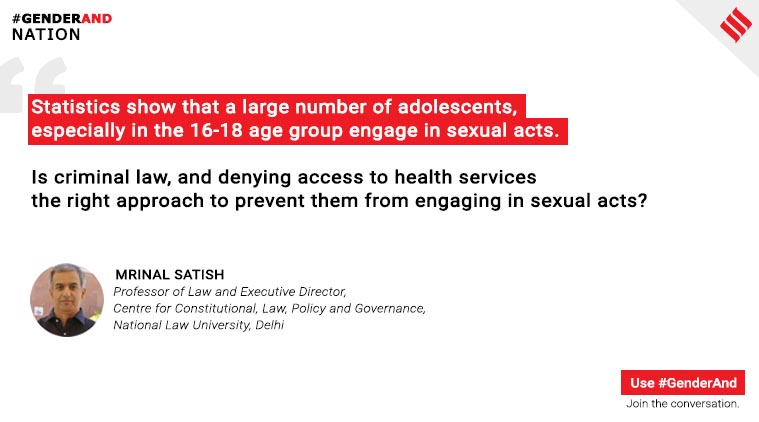
The focus of public health over the last few decades has been on educating and encouraging safe sexual practices, especially among adolescents. Mandatory reporting may have a detrimental impact in this regard. One may argue that children should not be engaging in sexual acts, and hence, criminalisation is the right approach. However, statistics show that a large number of adolescents, especially in the 16-18 age group engage in sexual acts. Is criminal law, and denying access to health services (including reproductive health) the right approach to prevent them from engaging in sexual acts? The Verma Committee had recommended that sex education, including education on responsible sexual behaviour be imparted in schools. This recommendation, which also has implications on issues relating to consent, has however unfortunately not been implemented.
The one-size fits all approach to reporting sexual offences
Story continues below this ad
The model of introducing mandatory reporting provisions was followed in the Criminal Procedure Code (Cr.P.C.) as well, when it was amended in 2013. Section 357C of the Cr.P.C. requires hospitals and doctors to provide first aid to victims of rape, and thereafter immediately inform the police about the incident. Failure to do so is punishable with a minimum punishment of imprisonment for six months, which may extend to two years. The first part of the provision was introduced since hospitals often refused to provide medical treatment to victims of rape. However, the second part (mandatory reporting) also leads to unintended consequences. If a woman who has been subjected to rape wants medical attention — including emergency contraception, protection against sexually-transmitted diseases, or termination of pregnancy — but does not want to report the incident to the police, the choice is denied to her. The doctor is required to inform the police, disregarding the woman’s agency. Hence, yet again, women may choose not to access legitimate medical services, and resort to home remedies or consult unqualified individuals. This may cause severe health issues, including death of these women.
Story continues below this ad
Mandatory reporting provisions may be required in certain contexts. However, blanket application of such provisions, ignoring health issues of adolescents and women, violates reproductive health-related rights of women and girls and also endangers their lives. A more nuanced approach is necessary, and it is time that we move away from the one-size fits all approach to reporting sexual offences.
GenderAnd is dedicated to the coverage of Gender across intersections. Use #GenderAnd and join the conversation.