I remember the Padmaavat backlash like it was yesterday. The 2018 film had barely arrived before it became a national controversy, with outrage over everything from Deepika Padukone’s outfit in a song to a presumed dream sequence between her and Alauddin Khilji. There were protests, threats, and a furious debate over whether the film had distorted Rajput history.
Then the movie was released. The outrage eventually gave way to acclaim, and Ranveer Singh’s unhinged turn as Khilji gave everyone something else to talk about.
But there is no Ranveer Singh performance to distract us from the uncomfortable question at its heart: why are we still so obsessed with the honour attached to women’s bodies?
Because whether Jauhar was an act of agency, a desperate choice, or the product of a deeply patriarchal world is where the debate usually begins—and ends. We argue over whether those women were brave. We argue over whether they chose death. We argue over whether people today have the right to question that choice.
And somewhere in all that noise, we forget to ask a rather basic question: why was death considered the more honourable option in the first place?
The women were brave. The system was not.
Let’s get one thing straight first: Jauhar was an act of extraordinary courage. For women who had little to no agency in the wars and sieges of medieval India, taking a decision as final as self-immolation in the face of enslavement, sexual violence and brutality required a kind of bravado most of us sitting behind our screens can barely comprehend. We don’t have to diminish that courage to question the circumstances that demanded it.
And yet, Jauhar—or a critical comment about it by a celebrity in 2026—is not an insult to anyone’s culture. Nor does acknowledging the horror of the practice mean disrespecting the women who died.
In fact, perhaps we do them a greater disservice by turning their deaths into something shiny and heroic, stripped of the circumstances that led them to the fire.
Because Jauhar was not happening in a vacuum. It was a product of a world where women had little control over what happened to their bodies, their marriages, their futures or their lives. Their choices were being made within the brutal rules of a patriarchal society—and sometimes, the only choice left to them was how they would die.
That is what makes the modern romanticisation of Jauhar so uncomfortable. We remember thousands of women for their sacrifice, their honour and their courage. We build legends around them. We put them on pedestals.
But how often do we stop and ask why they had to make that choice at all?
Jauhar is not a story about women being weak. It is a story about what women were forced to be strong enough to survive—and, sometimes, strong enough to die.
And that mirror hasn’t disappeared. We have simply changed the vocabulary around it.
Two women, two kinds of courage
Perhaps the easiest way to understand this is to go back to Padmaavat. The film gives us the grand, almost mythological version of Jauhar: Queen Padmavati and thousands of Rajput women walking into the fire, choosing death over capture and enslavement. Their courage is placed alongside that of the men fighting on the battlefield—justifiably so. They were not passive victims of their circumstances. They made an extraordinary choice in extraordinarily brutal circumstances.
But Padmaavat also gives us another woman who showed courage in a very different way.
Mehrunissa, played by Aditi Rao Hydari, spends much of the film watching the destruction and violence around her, inflicted by the very man she is married to. Eventually, she openly defies Khilji. She betrays her own king, helps Padmavati and Ratan Singh escape their captivity, and pays for that defiance with her own imprisonment.
Two women. Two choices. Two very different ideas of what it means to fight back.
One chose a death she believed was preferable to the life awaiting her. The other chose to live, knowing that survival could mean living with the consequences of defying a powerful man.
And this is where Padmaavat becomes far more interesting than today’s Jauhar debate. Because both women exercised the agency available to them in wildly different ways. One chose death. One chose defiance. Neither choice should require us to diminish the other.
Yet even today, when women make choices in response to violence, we seem far more interested in dissecting the choice than the violence itself.
 Different choices. Same courage. Same scrutiny.
Why did she stay? Why didn’t she leave? Why didn’t she speak up sooner? Why did she fight back? Why did she go back? Why did she survive?
The questions keep circling the woman.
The man who created the circumstances that forced her to make those choices somehow becomes a footnote.
And perhaps that is the most enduring legacy of the honour culture we claim to have left behind: whether a woman burns, stays, leaves, fights or survives, we still want to put her choice on trial.
The violence is his. The honour is hers.
And perhaps that is the part of this debate that should bother us the most.
Why is it always the woman’s response to violence that becomes a measure of her honour?
A woman is raped, and we ask what she was wearing, where she was, why she was there, whether she fought back. A woman stays in an abusive marriage; we ask why she didn’t leave. A woman leaves; we ask what happened to the family. A woman speaks up, we question her motives. A woman chooses silence; we question her credibility.
And centuries ago, a woman chose death rather than face sexual violence and enslavement. We turned that into a story about her honour.
The violence is committed against her. But somehow, the honour belongs to her.
That is why the debate around Bhasker’s comments—whether you agree with her or think she was completely wrong—is worth looking beyond. Because the outrage tells us something about how deeply desensitised we have become to the violence women face. We can discuss Jauhar as valour, sacrifice, culture and pride without sitting with the uncomfortable reality that the women were responding to the threat of violence inflicted upon them.
We romanticise the woman who chose death. We scrutinise the woman who survived. We judge the woman who spoke. We question the woman who stayed silent.
Perhaps the real question isn’t whether Jauhar was honourable.
Perhaps it is why a woman’s response to violence is still expected to determine whether the violence itself brings honour or shame.
The shame was never hers to carry.

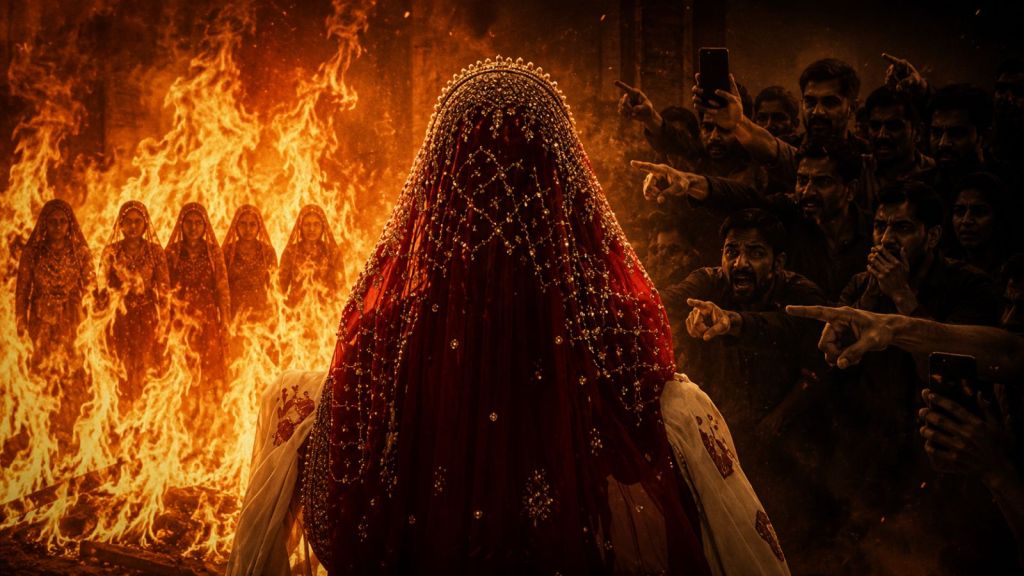 We forget to ask a rather basic question: why was death considered the more honourable option in the first place?

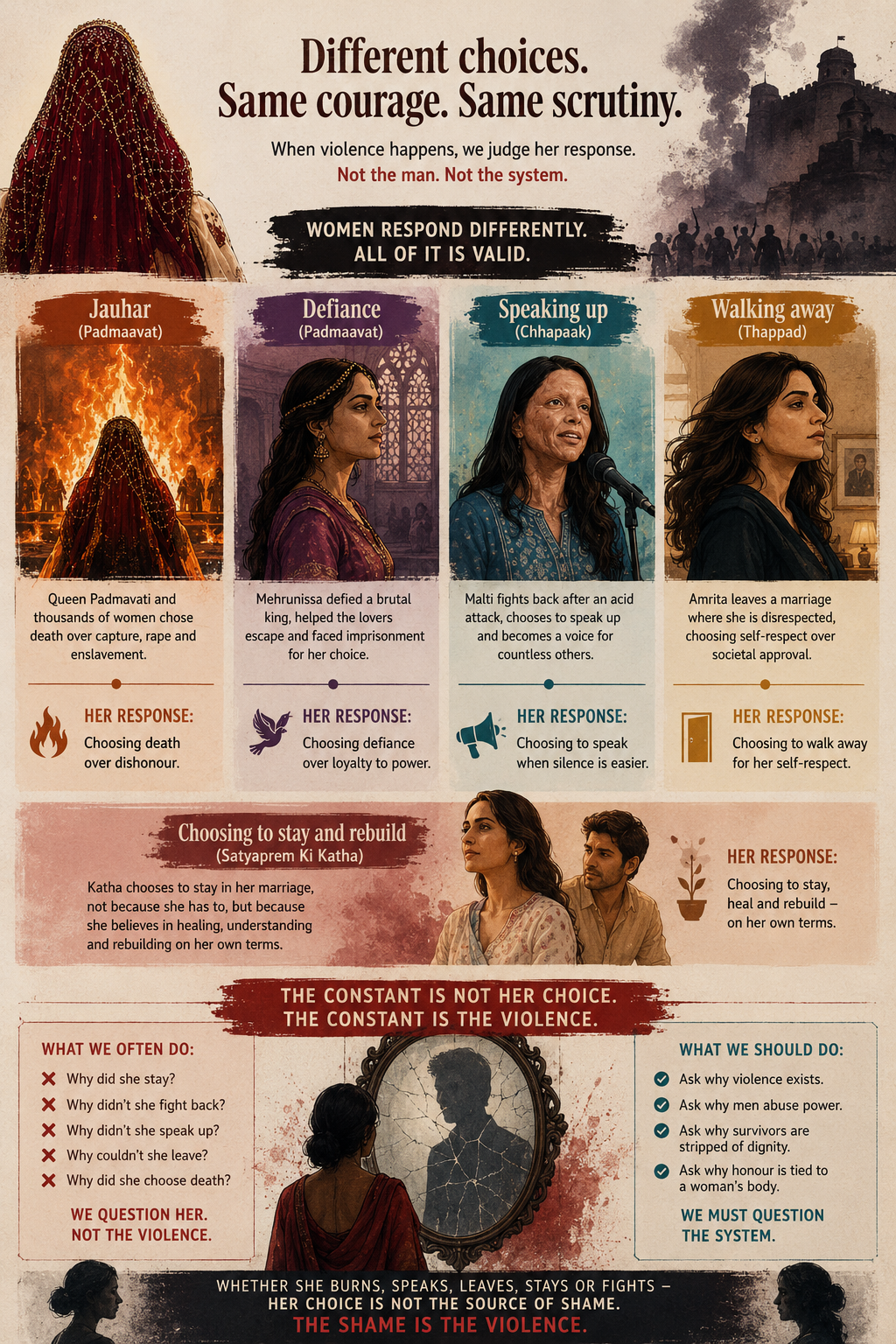 Different choices. Same courage. Same scrutiny.


 Share


