A protest at a university continued through the afternoon. By evening, banners had been removed, slogans faded into the noise, and students were returning to their hostels. Only a few photographs and videos remained. Everything had disappeared by the end of the day.
One protest ended by the evening, while the other lasted, even without its crowd. They were not necessarily different in anger, turnout, or issues. But between the two, an unseen force seemed to intervene: visibility.
A protest can fade from sight but never from memory. Its main battle may now be with being seen. Perhaps, in this age of algorithmic audiences, the site determines who is present. The algorithm determines who is seen.
So, what happens to a protest when its first battle isn’t with authority but with the camera’s gaze?
The protest has to look good now
The 2019 protests at Jamia Millia Islamia and the 2016 JNU protests did not become unforgettable because they were the largest. They became unforgettable because they refused to disappear. Images from these protests escaped the campus walls and entered the country’s democratic imagination, surviving long after the barricades were removed.
But every image that survives casts another shadow.
They signified a trend in student activism: protests often remain in the public consciousness long after they occur, mainly through the visuals caught on camera.
 What happens to a protest when its first battle isn’t with authority but with the camera’s gaze?
Earlier, protests had a live crowd. However, now they increasingly target an imagined one. The student with the posters understands the people close by but can’t know who will see the visuals tomorrow. A short clip might be watched later, not in the organizer’s calculation while addressing hundreds. This makes the protest increasingly camera conscious.
For the photo, the audience pushes closer. The placard is raised higher. There is a repetition of the loudest slogan. Many phones record the most sensational moment. None of this necessarily makes protests less authentic, but it does heighten awareness of how they will look.
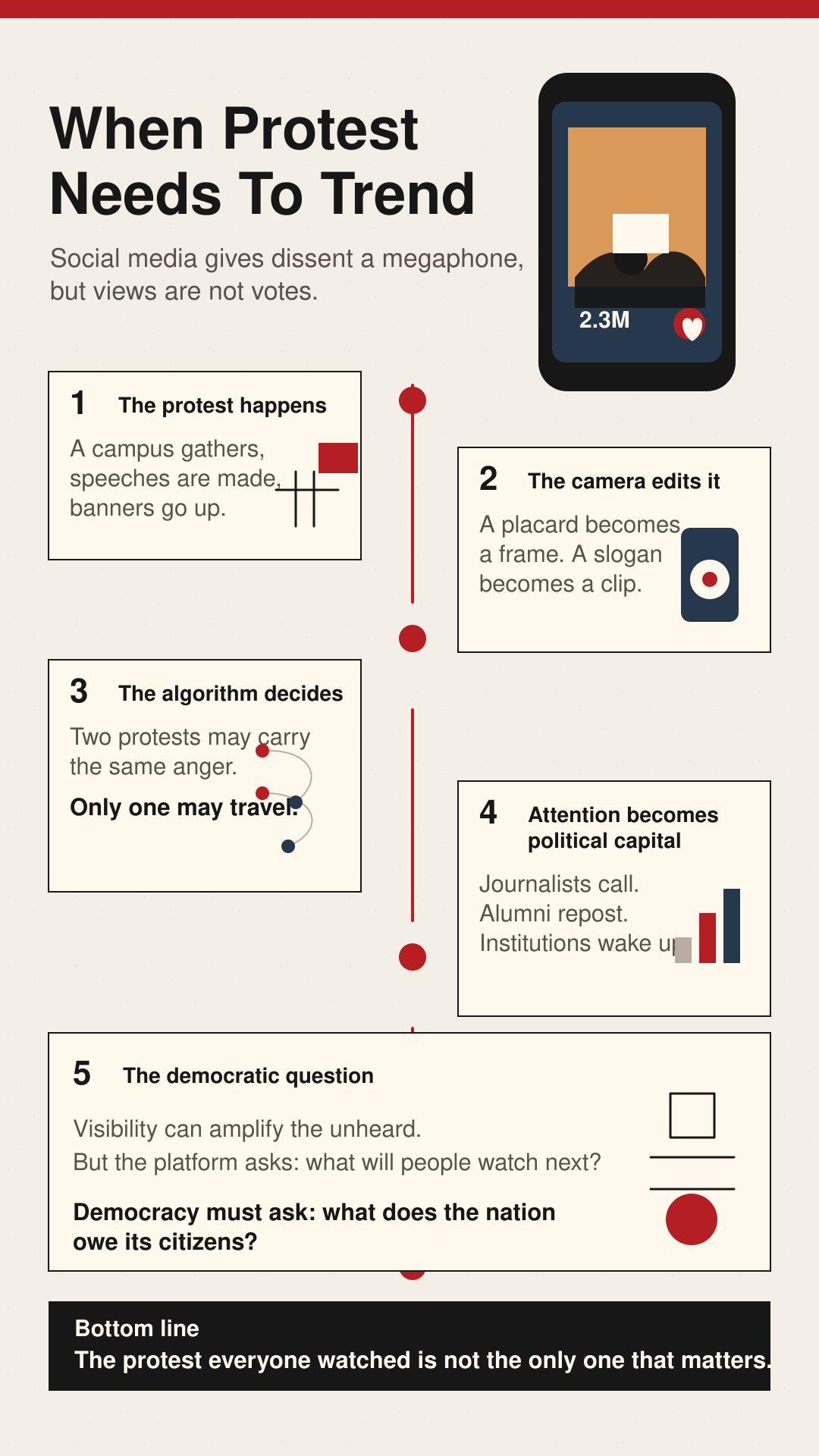
When visibility matters, people start thinking about how they appear to unseen people, as per Alice Marwick’s research. This subtle shift alters the dance of dissent. A placard becomes more than a message; it is a frame. A speech turns into a clip. A crowd is now an image waiting to spread.
Herbert Simon says when information floods in, there is scarcity of attention. The protest now shares space with everything else competing for ours.
But when capturing attention is the goal, does a protest merely demand to be heard, or does it learn how to perform?
When attention becomes political capital
The camera is no longer a witness. It is an institution.
Indian universities have always produced dissent. What has changed is its afterlife. A march now unfolds twice; once on the street, again on the screen. The first gathers the body. The second gathers legitimacy. Somewhere between the two, democracy begins negotiating with public attention.
Across Indian state universities, students gather over delayed scholarships, hostel shortages and rising fees with remarkable regularity. The speeches are delivered. The memorandums are submitted. The crowds disperse. And then — nothing. No archive. No headline. No national memory.
This is archival inequality: not the unequal right to protest, but the unequal chance of being remembered.
Michel Foucault argued that power is exercised through regimes of visibility, through deciding what enters public knowledge and what remains peripheral. The digital campus has inherited that grammar of power.
Elite, English-speaking campuses often begin with an audience: national newsrooms, influential alumni and media networks already listening. Regional universities begin with distance. Their struggles are no less urgent, only less discoverable.
This is where visibility hardens into attention, and attention begins behaving like capital.
A confrontation is more shareable than a committee report. A reel travels further than a resolution. The archive, then, is never simply a record of politics; it is politics.
And that is the peculiar alchemy of attention. The moment a grievance gathers public attention, it begins altering the behavior of institutions.
Journalists call. Alumni repost. Political parties borrow the language of students. Administrations suddenly discover urgency.
Attention does not replace organization, but it accelerates consequences. A grievance seen by millions becomes difficult to postpone. One witnessed only within campus gates is often easier to contain.
The camera is no longer a witness. It is an institution.
Can democracy be measured in views?
The instinctive answer is yes. After all, a phone camera has done what many institutions failed to do. It has documented police violence, preserved evidence, amplified marginal voices and allowed students to speak without waiting for television studios or editorial approval.
In that sense, visibility has undeniably widened the democratic public sphere.
Perhaps attention is the newest form of political capital. It can amplify the unheard. It can embarrass institutions into action. It can even rewrite the speed of accountability.
But it cannot become democracy’s measuring tape.
The architecture of attention is indifferent to values like justice. It does not ask whose rights were violated or whose Constitution was breached. It asks a simpler question: what will people watch next?
Outrage travels. Nuance waits. Spectacle spreads.
As scholar Zeynep Tufekci argues, networked platforms excel at amplifying collective action, but they cannot distinguish between what is engaging and what is important. They distribute attention, not democratic legitimacy.
That distinction changes everything.
Because the health of a democracy is revealed not by the protest everyone watched, but by the one nobody did — and whether that unseen voice still carries an equal claim upon the Republic.
Attention may decide what the nation watches.
Democracy must decide what the nation owes its citizens.
Visibility can give dissent a voice, but it cannot judge whether that dissent merits being heard.
The article is co-authored by Maleeha Shafi (Yale mentored researcher) and Azhar Ahmad (political science graduate). Both authors are featured in the University of Chicago.

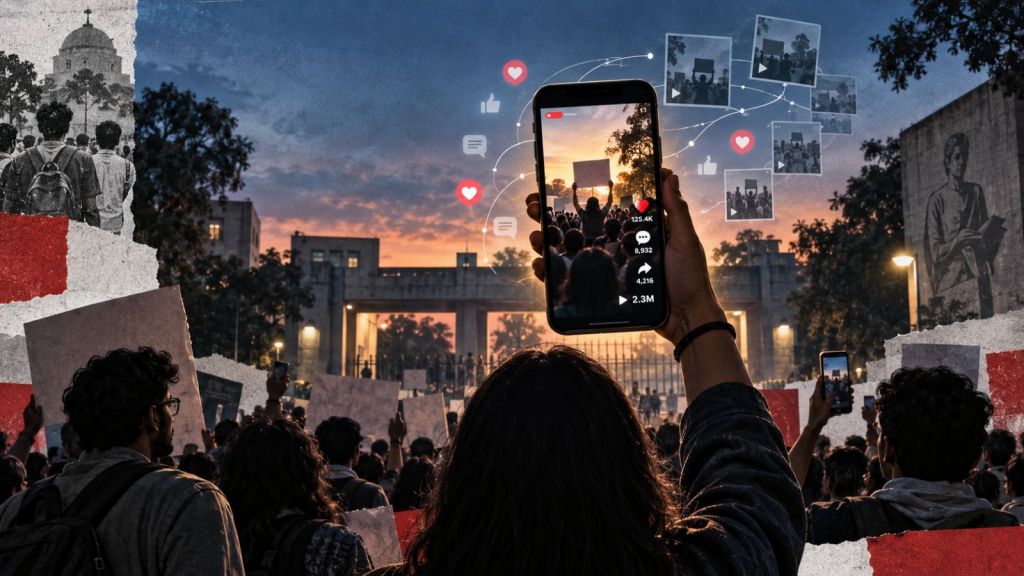 A protest can fade from sight but never from memory. Its main battle may now be with being seen. (AI generated image)

 What happens to a protest when its first battle isn’t with authority but with the camera’s gaze?
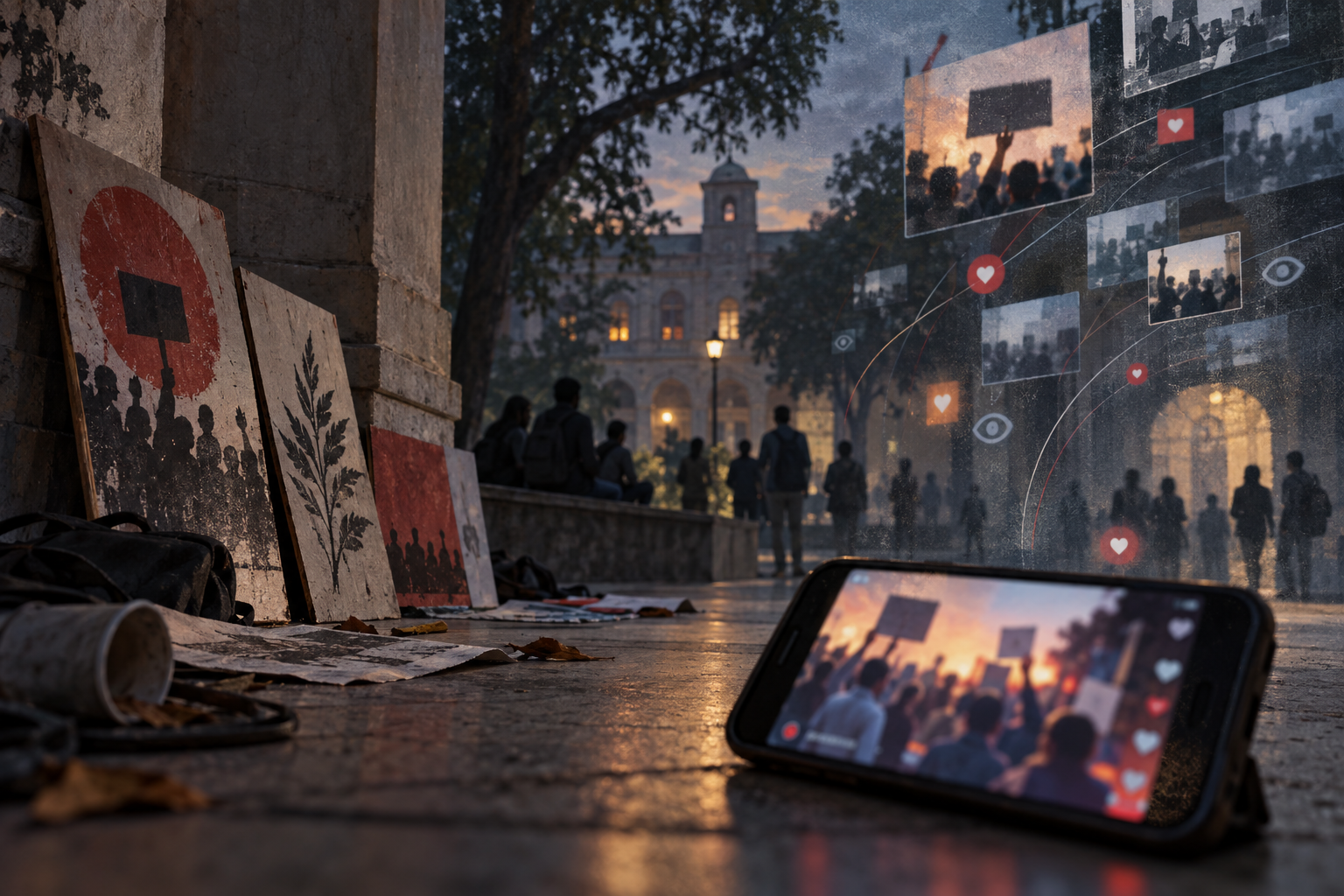 The camera is no longer a witness. It is an institution.

 Share


