
Parents vs AI: Is a chatbot babysitting your child?
We want tech companies to keep children safe online. But what happens when the chatbot knows more about a child’s digital life than their parents do?
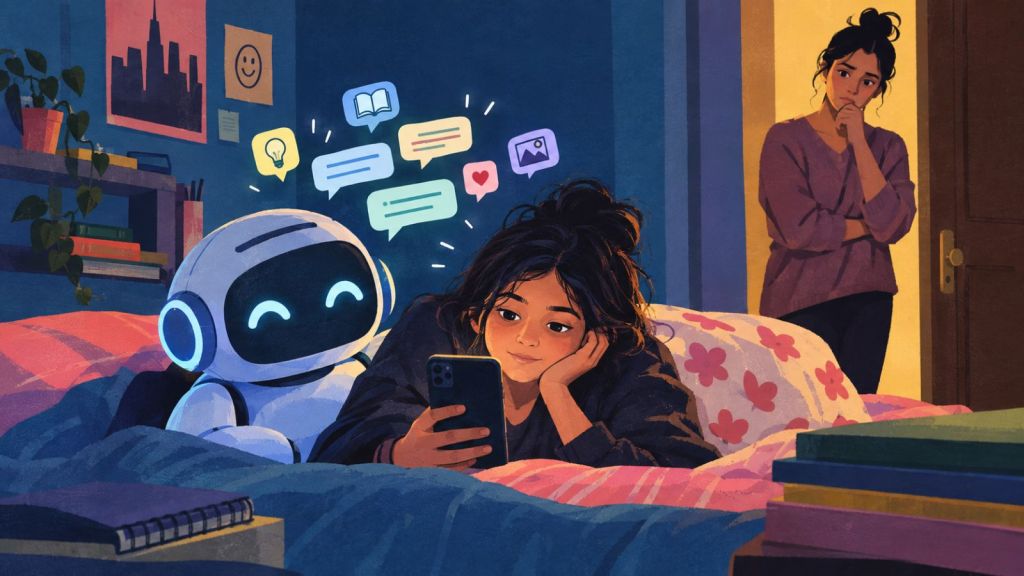 How much do you know about the way your child is using AI when you are not looking?
Big Tech has taken over large parts of our lives, and we know it. We use ChatGPT for work, research and academia; we ask it questions we once looked up ourselves, and increasingly, we rely on it to think alongside us.
That dependence is uncomfortable enough when we are talking about adults. With children, it is something else entirely.

OpenAI, Meta and others are changing their rules for teenagers and introducing more safeguards. They absolutely should. Children are more vulnerable users, and companies have a responsibility to make their products safer for them.
But there is another responsibility that is harder to regulate: the responsibility of parents.
Because somewhere in the conversation about keeping children safe from AI, we have started talking as though safety is something that can be built into a product and handed over to a company.
It cannot.
When AI becomes more than a tool
There are good reasons to be worried. Teenagers have already been involved in cases that have raised serious questions about the role of AI in their deaths.
16-year-old Adam Raine died by suicide in 2025 after extensive interactions with ChatGPT. His parents sued OpenAI, alleging that the chatbot engaged with his suicidal thinking and failed to adequately protect him. OpenAI has disputed those allegations.
In the UK, 16-year-old Luca Cella Walker died by suicide in 2025. An inquiry concluded that he had asked ChatGPT questions related to suicide.
There have also been cases involving younger teenagers and Character.AI, including 14-year-old Sewell Setzer III in Florida, whose mother alleged that his intense attachment to a Character.AI chatbot contributed to his isolation, and that the system failed to intervene when he expressed suicidal thoughts.
These cases should make technology companies deeply uncomfortable. They should make regulators uncomfortable too.
But they should also make parents stop and think about how much they actually know about their children’s lives online.
Not because parents can be expected to monitor every conversation or prevent every tragedy. A child’s suicide cannot be reduced to bad parenting, and companies should not be allowed to escape responsibility for the behaviour of their systems.
But because supervision has become harder precisely when it may be needed more.
A CNN investigation this year tested popular AI chatbots by posing as teenagers interested in violence. It found that many systems did not consistently recognise the danger or intervene appropriately.
That raises a simple question for parents: how much do you know about the way your child is using AI when you are not looking?
Not just whether they are using it, but why.
Is it helping with a maths problem? Writing an essay? Helping them understand something they are embarrassed to ask someone else about? Or has it become the place they go when they are lonely, angry or distressed?
The uncomfortable truth is that parents may have to put in considerably more effort than they are used to.
I don’t have children, so I know I am asking this question from the outside. But I am also a millennial, and I remember what parental restrictions looked like when I was growing up.
There was a limit on television. There were limits on when you could go out, when you could play and when you had to come home.
Our parents did not need television companies to tell them that we had watched enough television. They knew because they were paying attention.
That makes AI different from television or gaming. But the underlying responsibility is not entirely new.
We don’t expect cigarette companies to teach teenagers not to smoke. We expect parents to set boundaries, explain the risks and intervene when necessary.
AI is obviously not a cigarette. But the principle is worth considering — when something has the potential to influence a child’s behaviour and thinking, parents cannot simply leave the responsibility to the company that makes it.
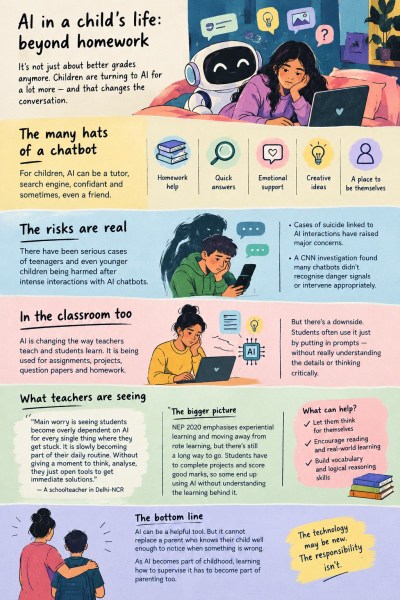 AI in a child’s life: Beyond the homework
You can’t just say “No AI”
However, parents cannot simply say, “No AI.”
They have to learn what these systems can do, what their limitations are and what kinds of conversations might be risky. They have to decide what their child can use AI for, at what age and under what circumstances.
Most importantly, they have to talk to their children.
An ex-colleague of mine, a working mother of two sons, one of them a teenager, told me her older son began using AI at around 14 to supplement his studies.
She has rules.
Gaming is leisure and has fixed hours. Social media is more strictly controlled. AI is allowed because it is useful for academics, but after a certain point, he is told to go back to his books.
“Gaming is fixed times and counted as leisure. AI is only for studies so we do trust it more. We are stricter for social media most of all,” she told me.
She is not under the illusion that this is a perfect system. She worries that her son could become dependent on AI or be misguided by it. She also knows she cannot simply ban something that is becoming part of education.
When I asked her whether parents should monitor their children’s AI conversations in the same way they monitor social media, her answer was blunt:
“Yes, we should but we are not.”
That, perhaps, is the bigger problem.
Parents have spent years learning how to talk about screen time, strangers online, social media, gaming and pornography. AI requires another layer of attention because the technology can talk back. It can sound sympathetic, remember things, and appear knowledgeable. It can become part tutor, part search engine and, in some cases, part confidant.
A child may not experience that interaction as using a piece of software.
A parent therefore cannot simply set a time limit and assume the job is done.
They need to ask questions. What did you use it for today? Did it tell you something that frightened you?
Why are you using it instead of asking a person?
They need to notice changes in behaviour. They need to make space for conversations that may be awkward. And they need to be willing to put the technology aside when it starts taking up too much space in their child’s life.
But dependence on AI does not always look like a crisis. Sometimes, it looks like a child who no longer stops to think before asking a chatbot for an answer.
A schoolteacher in Delhi-NCR says this is one of the biggest concerns they are seeing among students.
“Main worry is seeing students becoming overly dependent on AI for every single thing where they get stuck. It is slowly becoming part of their daily routine. Without giving a moment to think, analyse, they just open tools to get immediate solutions,” the teacher says.
The concern extends to the classroom too. AI use in teaching is increasing day by day, changing the way traditional teaching works. Teachers are using AI tools for assignments, projects and even question papers, while students are using them to complete homework and projects simply by putting in prompts.
That can have consequences for critical thinking. The teacher points out that while NEP 2020 emphasises experiential learning, project-based learning and moving away from rote learning towards application-based learning, there is still a long way to go. Students have to complete projects as well as score good marks, and some end up using AI to submit work without necessarily understanding the details behind it.
The teacher believes students at the school level should not be allowed to rely too heavily on these tools to complete their work. They need the space to think critically, learn by doing and reading, build their vocabulary and develop logical reasoning skills that will be useful later.
It is much easier to demand that OpenAI, Meta or Character.AI solve the problem.
They should solve their part of it.
But parents have a part too.
A company can introduce an age restriction, build a safety filter and stop a chatbot from responding to certain prompts.
None of those measures replaces a parent who knows their child well enough to notice when something is wrong. And this is where the conversation about AI and children needs to become more honest.
We cannot expect parents to monitor every second of their children’s digital lives. That is neither realistic nor healthy. But “I don’t know what my child is doing online” cannot become the end of the conversation either.
If AI is going to become part of childhood, then learning how to supervise it has to become part of parenting.
Parents cannot outsource this responsibility. They have to be involved. They have to set boundaries, check in, have uncomfortable conversations and be willing to change the rules as their children grow.
Not because AI is inherently dangerous, but because children are still learning how to tell the difference between what is safe and what is not, what is true and what is not, and who or what deserves their trust.
That is what adults are there to teach them.
The technology may be new. The responsibility isn’t.

 Share


