4 min read

Journalism of Courage



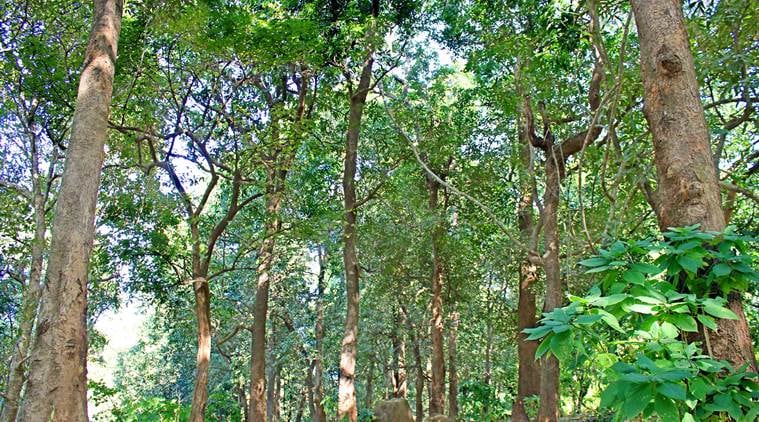 Indigenous mango trees on the hills of Chinchli in Dangs district in gujarat. (Express Photo by Javed Raja)
The cliffs towering over Chinchli, a tribal village in Dangs district, south Gujarat, are a patchwork of green. The walk up the hill starts from the pebbled bed of the seasonal Purna river, which is born on this edge of the Western Ghats. Past layers of teak, dhamdo, sadad and tanaj trees, through difficult terrain, we reach the top of the cliff. Here, on fertile black soil thrives a 10km stretch of an ancient, indigenous forest of naturally occurring mango trees.
The Gujarat Biodiversity Board (GBB) last month proposed that the belt, perhaps one of its kind in the country, be declared a biodiversity heritage site (BHS) under the provisions of the Biological Diversity Act. “This belt from Chinchli to Morzira has indigenous mango trees which must be approximately 150-200 years old. They have fallen and grown naturally over time, and so it is difficult to estimate their age. The trees have leaves of different shapes and sizes, their fruits are different in size and taste. More than anything else, they are rare wild mangoes,” says Agneeshwar Vyas, deputy conservator of forest (Dangs, north division). Having survived over these years, the trees also have a “strong genome” compared to the cultivated varieties like Kesar, Totapuri, Langda. “Preserving these varieties can be very important for future research on mangoes,” says Vyas.
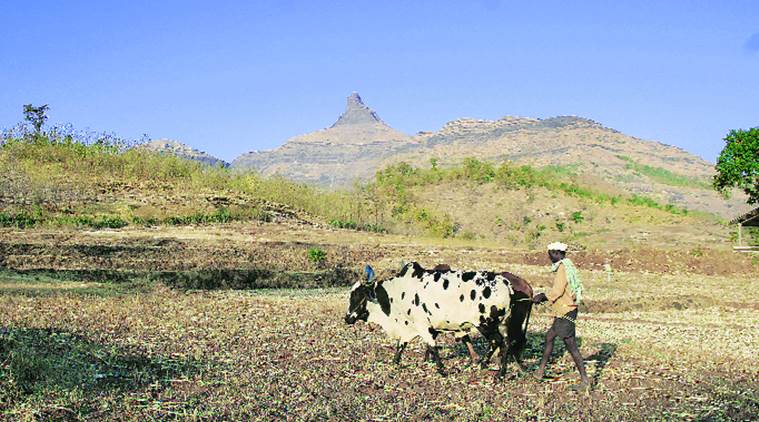 Green spot: a tribal resident cultivates the land. (Source: Photo by Javedraja)
But how is it that the trees have escaped any human intervention or felling for centuries? While the difficult terrain helps, the indigenous tribal communities’ (Konkani’s and Bhil’s) belief that the trees should not be touched played a bigger role. Hiraman Chhabde, a Konkani tribal and the member-secretary of a forest committee, says, “These mango trees are our capital. I do not know how old are they, but I have heard about them since my grandfather’s days. Forget felling or cutting, we do not allow anyone to pick the mango fruit either. People can take the fruit only after it ripens and falls on its own,” says Chhabde.
Most of the 1,500-odd residents of Chinchli depend on agriculture during the monsoon months. At other times, many men migrate to nearby districts of Gujarat and Maharashtra in search of work in sugar mills. “We worship natural elements like the mountain and trees. Agriculture is our main occupation, which is dependent on good monsoon. And we get good monsoon only because of mountains and trees. So, that is why we preserve the trees,” says Ganpat Chaudhari, a tribal and retired forest officer in the Gujarat government.
Vyas says that while people from neighbouring Maharashtra are known to come here in search of fuelwood, the local tribals in Chinchli are vigilant. “In neighbouring Maharashtra, the forest land has been converted into agricultural land. No forest remains,” he says.
According to the forest department, there are over 2,700 indigenous mango trees in the region. The fertile belt includes 68 species of trees, 25 species of shrubs, 100 species of herbs, 50 species of climbers, 25 species of grass and 20 species of lower groups of plants like moss. The cliffs are also nesting sites of critically-endangered species of vultures — around 50-60 long-billed vultures are found here.
This is a protected reserve forest, and the BHS status will only help in conservation of the biodiversity. It will not impinge on the local tribals’ rights to minor forest produce (MFP) or land to graze their cattle in the forest. The most important restriction will apply on the state government. “After the BHS status is granted, the state government cannot allot the land in the region for any purpose without the permission of the GBB.”
Forest officials and local residents also hope that the BHS tag adds tourism opportunities for Chinchli, known as the “Kashmir of the Dangs”. “People must have heard of, or seen, aam ki vadi (a mango orchard). But aam ka jangal (a mango forest) will be a unique experience,” says Vyas.
This article originally appeared in print as ‘The Wild Mangoes of Chinchli’.