


Journalism of Courage
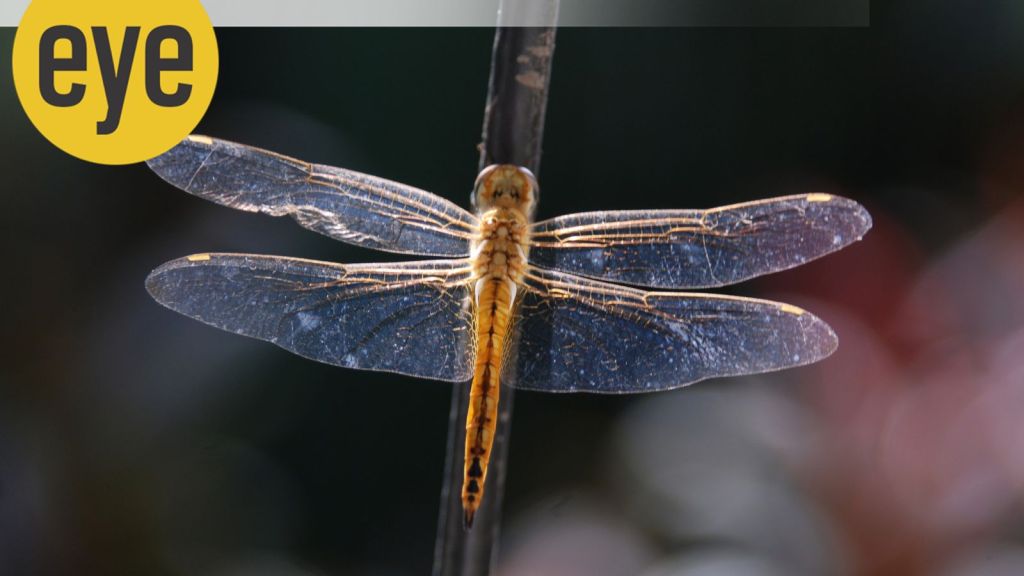 A dragonfly (Image Source: Ranjit Lal)
For far too long, insect flight baffled scientists. According to the laws of conventional aerodynamics, by which birds and aircraft flew, insects ought not to be able to generate the lift or thrust required for sustained flight. They were just too heavy. Then, with the help of extreme slow motion photography and the use of scaled-up models immersed in dense oil, they figured out how they managed to pull it off.
Insect wings comprise two layers of chitin called cuticle, a tough composite material strengthened with structural proteins. They sandwich a network of delicate but tough veins carrying blood and oxygen to the body and nervous system, besides being flexible and providing structural support and sensory information. The pattern of venation is often used to identify a species. Further, the glistening, often transparent wing, is extraordinarily flexible, twisting about its axis by as much as 45 degrees. Not all wings are transparent. The wings of butterflies and moths are covered with coloured scales, like overlapping roof tiles. They may be broad or long and slim or swept back, like the wings of fighter jets.
Usually most insects have two pairs of wings growing out of their bodies, which may work independently, or which more often are ‘zipped’ together with hooks to form one large wing. In some insects, like houseflies, the rear pair of wings are reduced to stubs called haltres, which work like gyroscopes. In others, like ladybirds the forewings form hardened elytra providing a sort of umbrella under which the hind wings fold when not in use.
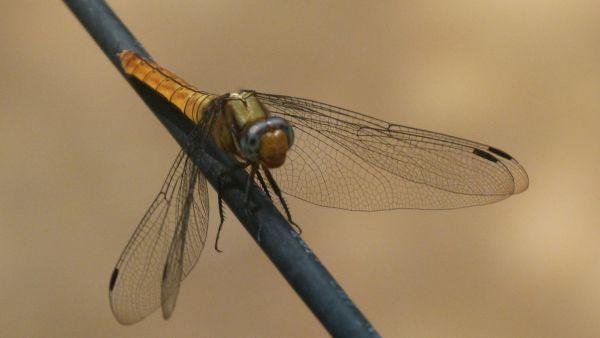 A dragonfly (Image Source: Ranjit Lal)
The wings are powered by tough muscles that may be ‘direct’ or ‘indirect’. Primitive insects like dragonflies and damselflies have direct muscles, one powering each wing, enabling them to beat independently but only as quickly as the nerve impulses command them to. Bees and flies, on the other hand, have indirect muscles that vibrate the entire thorax, enabling the wings to beat at a much faster (over 1000 beats per second for mosquitoes) rate. Flight muscles consume an enormous amount of fuel and energy and may comprise between 10 and 30 per cent of the insect’s weight.
While the wings of birds provide lift and thrust only on the down stroke (the upstroke is usually just a reloading exercise) the flexibility of insect wings, twisting about their axis, enables them to create lift and thrust on both the upstroke and down stroke. The wings create vortexes, along the leading edge – little tornadoes of air – which pull it (and the insect) upwards. If these vortices grow too large, they would cause the insect to stall, so a pressure gradient along the leading edge causes them to slide towards the end of the wing and drop off, where they create another sudden burst of lift. By deft manoeuvring of the wing tip at this point, the insect can change direction, gain or lose height in a millisecond or even to hover rock steady.
Very small insects use another method of creating vortices called the fling and clap (or Weis Fogh) method. Their wings ‘slap’ together on the upstroke and separate snappily on the down stroke, causing a vacuum to develop into which air rushes and creates a vortex to develop on each wing, which slides across the leading edge, and gets shed during the next ‘clap’ causing lift and thrust. It does cause more wear and tear on the wing than usual but enables vertical take-offs from a stationary position.
Most insect wings are stiffer and thicker along the leading edge and become more flexible towards the trailing edge. They are waterproofed with a waxy coating. The wings of some, like dragonflies, have an opaque ‘spot’ (the pterostigma) on the leading edge of their forewings – a group of tightly packed cells – that add mass to the wing, and are a great aid to steady gliding. Dragonflies are also equipped with what is called the tarsal reflex, which causes their wings to start beating automatically, the moment the feet lift off. As insects are cold-blooded, they have to first warm up their flight muscles every morning before taking to the skies. They can do this by detaching their wing muscles from the wings and you can often see the insect ‘vibrate’ as it does this! Bees however may use their whirring wings in their hives to cool it down, driving out the warm air and letting the cooler air in.
In some insects, like termites and ants, only the males have wings, which they too eventually shed while in others it’s the ladies. The better fliers usually have long slim wings, though even relatively broad-winged insects like butterflies are capable of extremely long distant flights like the Monarchs which fly from North America and Canada to South and Central America during migration. Cannily, they usually gain height and use the wind to waft them along, with the minimal use of energy.
It may be difficult to track a shiny green bluebottle in flight but you can watch dragonflies with their relatively slow-wing beats easily with binoculars. Hoverflies too may be observed and admired – it’s mesmerizing the way they stand stock still in mid-air before zipping away, and repeating the performance just nearby.
Insect wings are really marvels of natural engineering and we are now trying to emulate them, using flexible materials instead of stiff metal. Planes require engines to provide thrust and aerofoil shaped wings to provide lift. Both insects and birds need just their wings.