


Journalism of Courage
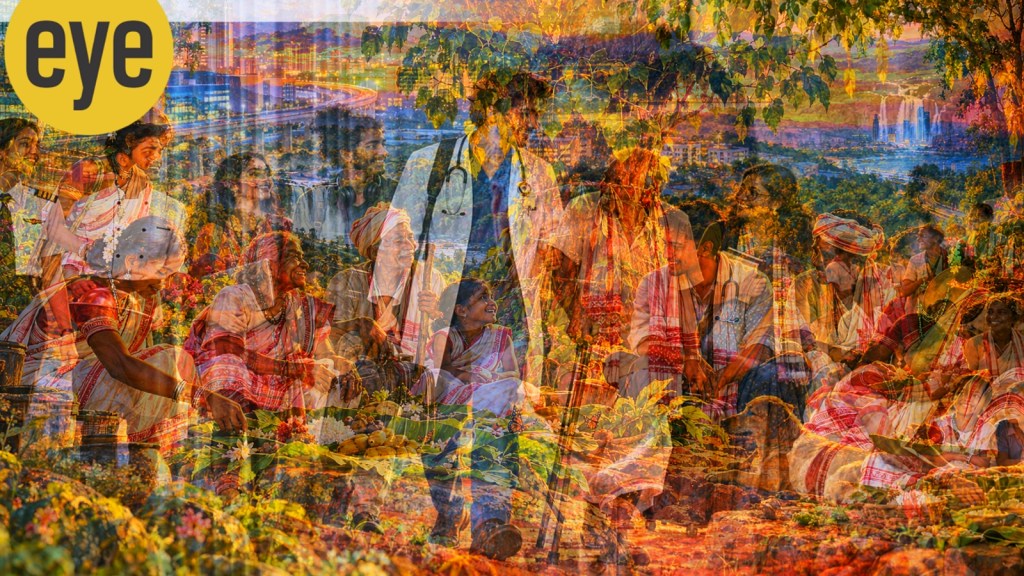 Illustration by Suvir Saran
I met Dr Shreyansh Tirkey on a Delhi street, not through an introduction, invitation or carefully arranged encounter, but through that oldest and most revealing human ritual: one stranger noticing another in difficulty.
I was struggling with a briefcase and suitcase. Their awkward weight pulled me off balance, challenged my shoulders, and turned each step into a small negotiation between dignity and gravity. Delhi streamed around me in its usual impatient river—cars coughing, horns arguing, feet hurrying past feet—when Shreyansh noticed.
He stopped. He came forward. He helped.
Before I knew his name, profession, faith, surname or tribe, I knew his instinct. He had seen another human being struggling and crossed the invisible distance between us.
There was something in his face I could not immediately place—the sculpted cheekbones, perhaps, or the quiet eyes; a stillness that seemed to carry another landscape within it. I wondered aloud whether he might be Javanese or from one of the Pacific Islands.
“No,” he said. “I am a tribal from Jharkhand.”
Some sentences end conversations; others open continents. His did the latter.
“Which tribe?”
“Oraon.”
The word arrived softly, but it carried hills, harvests, hardwood forests and histories older than the republic. And so, on an ordinary Delhi street, while he steadied my luggage and I steadied myself, Dr Shreyansh Tirkey began opening a door into an India I had lived inside all my life, yet had never properly entered.
Shreyansh comes from Ranchi, upon the undulating Chotanagpur Plateau, where red earth stains the monsoon, sal trees stand as sentries and waterfalls tumble through stone as though the land itself has suddenly remembered a song.
Jharkhand is a place India knows for coal, iron, mica and minerals. We have measured its mountains by what can be mined from them, its rivers by what can be dammed and its forests by what can be felled. But a landscape is not merely a warehouse of resources. It is memory made visible. It is mythology underfoot. It is mother, map and manuscript.
Shreyansh’s people were reading that manuscript long before most of us arrived with machines.
Oraon is his tribe; Kurukh is its language. His family follows the Sarna faith, in which nature is not scenery but sacred presence. There is no need to trap divinity within marble, place it on a pedestal, and quarrel over which priest holds the key. The elements are everywhere. The tree gives shade. The soil gives sustenance. The rain revives. The sun ripens. Gratitude is worship, and the earth is altar enough.
“Where do you go to pray?” I asked.
“At home,” he replied.
Before a wall, the family places leaves for those who came before—the grandparents and other departed elders whose bodies have disappeared but whose belonging has not. Food is offered upon the leaves and left there for the day. Slowly, it returns to the living world: an insect carries away a crumb, a bird claims a grain, the breeze lifts a fragrance.
Nothing is wasted. Nothing is entirely lost. The dead eat through the living; remembrance returns to the earth.
What a gentle theology. What an intelligent intimacy with impermanence.
His surname, Tirkey, he told me, is derived from a bird. Another name within the community, Kachhao, is associated with the turtle or tortoise. Even names maintain kinship with creatures. They do not merely identify an individual; they return the human animal to the larger family of life.
In our cities, we name towers after trees we have cut down. In Sarna tradition, the tree does not become branding. It remains a being.
Our conversation began around the Karam Festival, a celebration I had somehow lived more than half a century without knowing. Taking its name from the Karam tree, the festival honours nature, work, kinship and the ties that hold a community together. There is also Sarhul, the spring festival that celebrates the flowering of the sal tree and the marriage of earth and sky.
For Karam, sisters and brothers gather, sing, praise one another and dance. Food is prepared and offered. The community comes together not as an audience watching culture from plastic chairs, but as culture itself—moving, singing, sharing, remembering.
Shreyansh spoke of dhuska, made from a fermented batter of rice and lentils and fried until crisp-edged and tender-hearted. He spoke of handia, the fermented rice drink that is not merely a beverage but part of the community’s ceremonial and social life. He described chicken cooked and shared, and food offered back to nature with an understanding many fashionable manifestos on sustainability struggle to articulate: what comes from the earth must return to it with gratitude.
I am a chef. Food is the alphabet through which I have spent a lifetime learning to read people. A plate tells you what a people cultivated, what they endured, whom they welcomed, what they worshipped and how they survived. Adivasi food is not primitive food. It is place-conscious food—seasonal, sustainable, communal and clear. It knows the distance between hunger and harvest because it has walked it.
Shreyansh grew up in a joint family of 13 or 14 people. His father and uncles work together in the cement business. His mother is part of it too. They remain under one familial canopy—not without the ordinary complications of being human, I am certain, but with an ethic of interdependence that our increasingly isolated lives might envy.
In his generation, one became a teacher, another entered business. One is a chef in Bengaluru. Two are pilots. Another works in a bank. One works in filmmaking. Shreyansh studied medicine at RIMS, the Rajendra Institute of Medical Sciences in Ranchi, and is now Dr Shreyansh Tirkey. His interests draw him towards internal medicine and paediatrics. His younger brother is also studying medicine. In one Oraon family are doctors, pilots, a teacher, banker, businesspeople, chef and filmmaker.
For centuries, India looked at its Adivasi communities and imagined absence—of education, ambition, ability or sophistication. Perhaps the absence was always ours: an absence of curiosity, conscience and clear sight. They did not suddenly become capable when “mainstream” India noticed them. India merely began, belatedly and insufficiently, to remove a few of the stones it had placed upon their road.
Shreyansh’s paternal grandmother knew the weight of those stones. Widowed when his father was only eight or nine, she sold vegetables in the market and somehow found enough money to educate her children. I imagine her at first light, arranging green vegetables against the red-brown earth, her hands smelling of coriander, soil and survival. Perhaps she counted coins at dusk while her children bent over schoolbooks beneath an uncertain bulb.
She could not have known that one day her grandsons would study medicine, or that others in the family would fly aeroplanes, make films and work in banks. But perhaps every coin she saved contained a small prophecy.
That is how revolutions often begin—not with slogans from stages, but with a woman in a market refusing to let poverty write the final sentence of her children’s lives.
His mother, too, once reached towards a sporting future. She played hockey at a high level before an experience of prejudice and pain brought that journey to an early end. She does not dwell on its details, and neither shall I. Some wounds deserve witness without excavation. It is enough to say that talent was interrupted, possibility was narrowed, and a young woman returned home carrying a silence no medal could explain.
India has changed since then. But not enough.
As a small boy in missionary school, Shreyansh was once asked whether he was Hindu, Muslim or Christian. He knew only one answer.
“I am Adivasi.”
The other children abandoned him.
Imagine learning during recess that your identity can empty the playground around you.
Later, when visiting the home of an upper-caste school friend, he was given water in a disposable glass. At the time, he barely registered its meaning. Children often absorb humiliation before they acquire the vocabulary to name it.
Years later, that friend, Krish, understood what had happened and apologised.
I find something hopeful in that apology. It did not erase the act, but it interrupted its inheritance. Recognising the prejudice passed down to us, feeling ashamed of it, and saying sorry requires moral muscle. Krish grew beyond what he had been taught. That, too, is education.
But elsewhere the insults continued.
When Shreyansh mentioned that a cousin had attended the Ambani wedding, a fellow medical student asked, “Kya bartan dhone gaya tha?”—had he gone there to wash dishes?
One sentence, centuries of contempt.
The cousin was a guest.
Sometimes, while travelling, Shreyansh gives only his first name or initials. A full name invites the next question: “What is your caste?” In South Delhi, he and his companions found a rented apartment, he believes, because they were doctors. Had they arrived only as Adivasi men, the door might have remained closed.
So much has changed in India since 1972, the year I was born. So much changed in me after 1993, when I left for Manhattan, studied, came of age, built restaurants, earned a Michelin star and made my reputation as an Indian.
Decades later, I returned home almost to die—and instead lived to tell the tale.
In the India of the 1970s and ’80s, many of us gave only our first names. We instinctively understood that surnames were a form of social surveillance. A surname could place you inside a caste, community, region, religion or inherited rank before your character had entered the room.
I had hoped that a younger India would outgrow this hunger to categorise. Instead, the students I mentor, chefs who work for me and young people across professional spaces still ask one another, casually and confidently, “What is your caste?”
I find it disgusting.
Caste has become the appendix of the Indian mind—a vestigial organ inherited from another age, useless to a humane modern life, yet always capable of becoming inflamed, infectious and dangerous. We carry these obsolete classifications inside our consciousness and then wonder why the body of the nation remains feverish.
A surname arrives before the soul. A category cancels curiosity. We decide who a person is before allowing them to become.
Patriotism cannot mean applying powder to the nation’s face and declaring the reflection flawless. That is vanity, not love. Real patriotism is a mirror held steadily, even when the blemish is ours. It is pride with perception, affection with accountability. To love India is to praise her progress, protect her promise—and protest when her people are diminished.
Jharkhand has attempted to widen that promise. The Marang Gomke Jaipal Singh Munda Overseas Scholarship supports talented students from tribal and other marginalised communities in pursuing advanced education abroad. Its meaning is larger than a plane ticket or university admission. It allows communities historically described, dissected and decided upon by outsiders to produce scholars who can represent themselves before the world.
Shreyansh put its hope simply: “To represent our community in the whole world.”
Representation is not charity. It is correction.
And yet scholarships cannot do all the work. An Adivasi should not have to become a doctor, pilot or scholar before receiving ordinary human dignity. Achievement must not become the admission ticket to equality. The person selling vegetables, cultivating land, gathering forest produce or living in a village without reliable electricity is no less entitled to respect than the student entering AIIMS or flying to Britain.
Shreyansh told me that one of his friends came from a remote and painfully deprived part of Jharkhand, entered medical school through reservation and is now at AIIMS Delhi. Reservation is often mocked by those who mistake inherited advantage for individual merit. But talent is everywhere; opportunity is not. A seed struggling beneath a stone is not inferior to one growing in a garden. Remove the stone, give it light, and watch what was always waiting emerge.
What struck me most about Shreyansh was not injury but ease. He was neither ashamed of being Oraon nor interested in performing victimhood. His pride was quiet, rooted and real. He spoke of unity—of sharing what one has, feeding someone who is hungry and helping another member of the community rise. Not because tribal life is idyllic or free of human contradiction, but because survival has taught it the intelligence of interdependence.
Perhaps those we condescendingly call “backward” have preserved truths the rest of us abandoned on our march towards modernity. They know that no one eats alone. That ancestors remain present. That land is not merely real estate. That nature is not decoration. That community is wealth. That gratitude must be practised, not posted.
We exchanged numbers that day. We are now friends, waiting to share lunch or dinner when his medical life and my jostling between Delhi and Mumbai allow it.
But he has already fed me.
He gave me a morsel of another India—ancient but not obsolete, wounded but not weak, overlooked yet observant. An India living beneath sal trees and city roofs, in medical colleges and market stalls, speaking Kurukh at home and the language of possibility to the world.
I began by asking Shreyansh where he came from.
He left me wondering where the rest of us are going.
Perhaps the future of India will not be found only in its towers, expressways and trillion-dollar dreams. Perhaps it waits beside a wall in an Oraon home, upon green leaves holding food for the dead, while birds and insects arrive without asking one another their caste.
They eat.
The earth receives.
Life continues.
And for one sacred moment, no surname comes before the soul.