The house is humming. The family is gathering. The old toys are coming out.
And Papa is about to build a universe.
Janmashtami in our home was never simply a festival we observed. It was a world we assembled.
Every year, Papa—my father, Deepak—would help us build the jhanki. From trunks and cupboards came old toys, some handed down from my grandparents’ generation, their paint faded, their limbs occasionally loose, their faces carrying the strange solemnity of objects that had survived more childhoods than one.
Little cows. Little cowherds. Little people. Little gods.
Krishna. Radha. The gopis. Animals. Deities.
An entire civilisation waiting patiently in boxes for someone to bring it back to life.
And for a few enchanted days every Janmashtami, that someone was us.
My brother Samir and I, my sister Seema, and our cousins Sumita, Sangeeta and Raghav gathered around the grown-ups with the seriousness children reserve for projects adults mistakenly imagine are merely play.
Our Bhua, Deepa, was there. Her husband, our Phuphaji, Hargobind Bhatnagar. Our mother, Sunita. Papa, Deepak.
And above all, in the great constellation of my childhood memory, there was Dadi, Kamla Bhatnagar.
Her husband, my paternal grandfather, Bade Papaji, was Bhagat Saran Bhatnagar. They belonged to that generation that seemed to carry libraries in their memories and histories in their habits.
But Dadi did something remarkable.
She told us mythology without demanding that we surrender our minds.
Who knew a grandmother could be so cool?
She did not tell us these stories as if curiosity were a sin. She taught us to wonder, to question, to listen, to imagine.
Mythology, she seemed to suggest, was not the enemy of science. Science was not the assassin of mythology.
Both were humanity’s attempts to understand what it could see and what it could not.
Sometimes mythology reached towards a truth before science had found the language to explain it. Sometimes
science arrived centuries later and illuminated what mythology had been trying to imagine.
Sometimes they disagreed.
Sometimes they danced.
And sometimes they simply stood across the room from one another, equally aware that humanity still knew very
little about the mystery of being alive.
For us, however, the mystery of Janmashtami began with atta.
The Yamuna flowed through our jhanki, made from kneaded flour.
We shaped riverbanks and bends with our hands. We painted them with watercolours—blue for the river, brown for the earth, green for the trees.
Give a child flour and water, and he will make geography.
Give him an old toy, and he will make history.
Give him a shoebox and a mirror, and he will make the weather.
Papa, Samir and I did exactly that.
The greatest thrill of Janmashtami for me was our sound-and-light drama. We took a shoebox and turned it into a primitive projector. We found mirrors, reflective glass, coloured cellophane, scraps of plastic, anything that could catch or bend light.
Blue became night.
Silver became lightning.
Grey became rain.
Darkness became danger.
Light became revelation.
We created monsoon storms with mirrors and scraps.
And somewhere in the middle of all that glorious amateur theatre, Papa would begin the commentary.
Then Dadi would add something.
Bhua would remember another version.
Phuphaji would interrupt.
Someone would correct someone else.
Someone would laugh.
And the story of Krishna would rise from the floor, the walls and the flickering light.
We were not reading mythology.
We were staging it.
There was Kansa—evil, frightened, furious Kansa, haunted by the prophecy that a child would one day bring about his end.
There was the prison.
Devaki.
Vasudeva.
The newborn Krishna.
A child whose first breath was taken in captivity.
And then came the great crossing.
Vasudeva carrying the baby in a tokri.
The storm.
The river.
The danger.
The darkness.
The desperate journey towards safety.


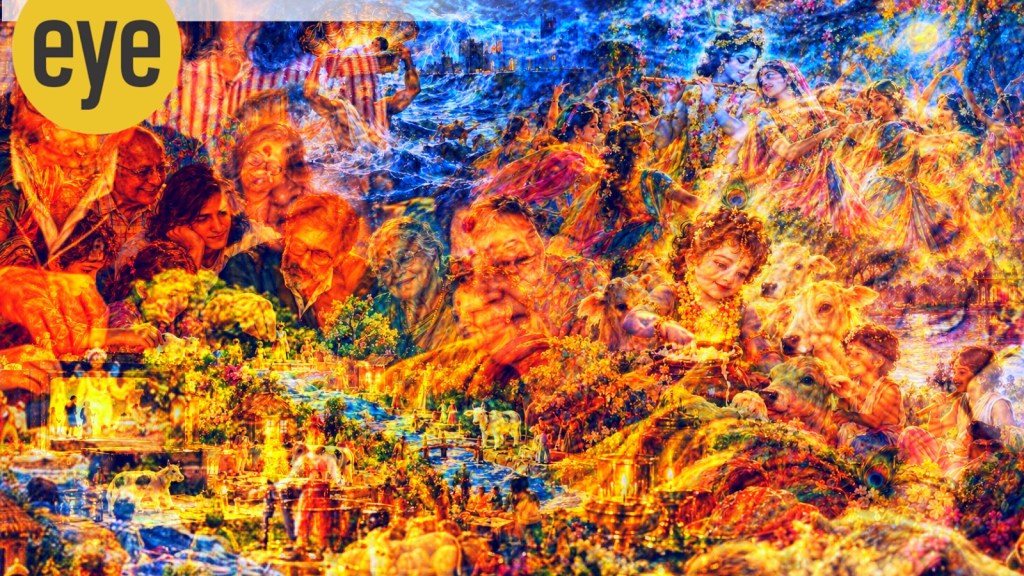 This year, Janmashtami came wrapped in remembrance (Iluustrated by Suvir Saran)