
The Constitution has always inspired Indians to question power and demand their rights
Linking the Constitution to January 26 affirmed that this was not a constitution created through elite discussions but a product of mass political struggle, and that it was not a gift from benevolent rulers, but one that was seized by the masses.
 Pandit Jawaharlal Nehru with folk dancers from Bombay at a Republic Day Parade. (Photo: Express archive)
The Constitution of India was completed on November 29, 1949, yet it came into force on January 26, 1950. The date memorialised the celebration of Independence Day from 1930 by hundreds of thousands of Indians, who would gather in public, hoist the national flag and recite the pledge of independence in multiple languages, affirming that Indians were an independent people and would achieve their aims through non-violent means. 71st Republic Day celebrations | Follow LIVE updates
ALSO READ | Republic Day 2020 LIVE updates: Celebrations to begin shortly from National War Memorial

Hundreds of people were arrested and charged by the colonial government for the simple act of reciting the pledge. Perhaps, the largest gathering was in January 1946, when 1,50,000 people gathered at Bombay’s Chowpatty and recited the pledge in Hindi, Urdu, English, Marathi and Gujarati. Linking the Constitution to January 26 affirmed that this was not a constitution created through elite discussions but a product of mass political struggle, and that it was not a gift from benevolent rulers, but one that was seized by the masses.
Also Read | 70 years of the Republic: Sunday Eye special on how our Constitution is a living, palpable force
What is the relationship between “We the People of India” and the Constitution? This question was uppermost in the minds of India’s leaders as they met in Delhi to draft the document. They remained acutely aware that the Constituent Assembly was a body nominated by the provincial assemblies, themselves elected on limited franchise. The Congress leadership, which dominated the body, sought to bring in representatives from all shades of opinion, from the Hindu Mahasabha to socialists, and represent various underrepresented groups be it women, tribals, Parsis or Christians. Leaders of the Congress Socialist Party refused to participate on the grounds that they wanted an assembly on universal adult franchise. Keeping this in mind, several members reminded the house of its limited representativeness and need to keep those absent in mind. MR Jayakar, a lawyer, and Dr BR Ambedkar, on the very first day of the assembly, pointed out the absence of most Muslim representatives (a majority of them joined the Assembly some months later) and the princely states (all except Hyderabad eventually sent members). Sportsman and politician Jaipal Singh Munda noted that despite there being millions of tribals in India, there were only six tribals in the Assembly and freedom fighter Purnima Banerjee protested the replacement of deceased women members with men. Both urged the Assembly to remember its commitments to those who could not speak in its halls.
Also Read | How first NDA regime created the crisis that its new citizenship law deepens
Those outside the Assembly constantly reminded the drafters of their presence, by writing petitions and sending letters and postcards, which ranged from fully fledged drafts of constitutions, to special demands ranging from minimum wages to cow protection, Muslim personal law to decentralised governance in the Northeast. As Ornit Shani’s work has shown, the Assembly and its bureaucrats took these letters seriously, sending replies and redrafting provisions based on popular debate. As the Constitution came into force, the government issued a range of low-priced publications and the Films Division produced films educating Indians about this new document. Within days of it coming into force, the Constitution came so alive in the popular imagination that ordinary people attributed meaning to its existence, took recourse through it and argued with it. So much so, that the Chief Minister of Hyderabad, a province that had not sent members to the Constituent Assembly, wrote with some agitation in 1951 that “an extraordinary tendency has been noticed recently for all sorts of people to move the High Courts citing fundamental rights”. Leaders from both the Hindu right and the Communist Party, who had questioned and critiqued the Constituent Assembly, were among the first to seek its protections. One of the earliest cases before the Supreme Court saw the president of the Hindu Mahasabha, NC Chatterjee, defending communist rebels in Bengal accused of arson and murder by challenging the constitutionality of criminal procedures.
Also Read | The handcrafted Constitution is a work of art
Dravidian separatists turned to the Constitution in the 1960s, as compromises over language were worked out. Faced with a ruling party with an overwhelming majority, opposition parties across ideological stripes united in defence of the Constitution as a check on majoritarianism, particularly after the Emergency in 1975. The Janata government resisted the temptation to tamper with the Supreme Court, allowing judges appointed by deposed PM Indira Gandhi to continue in order to protect institutionalism. Leftist lawyers became frontline defenders of civil liberties.
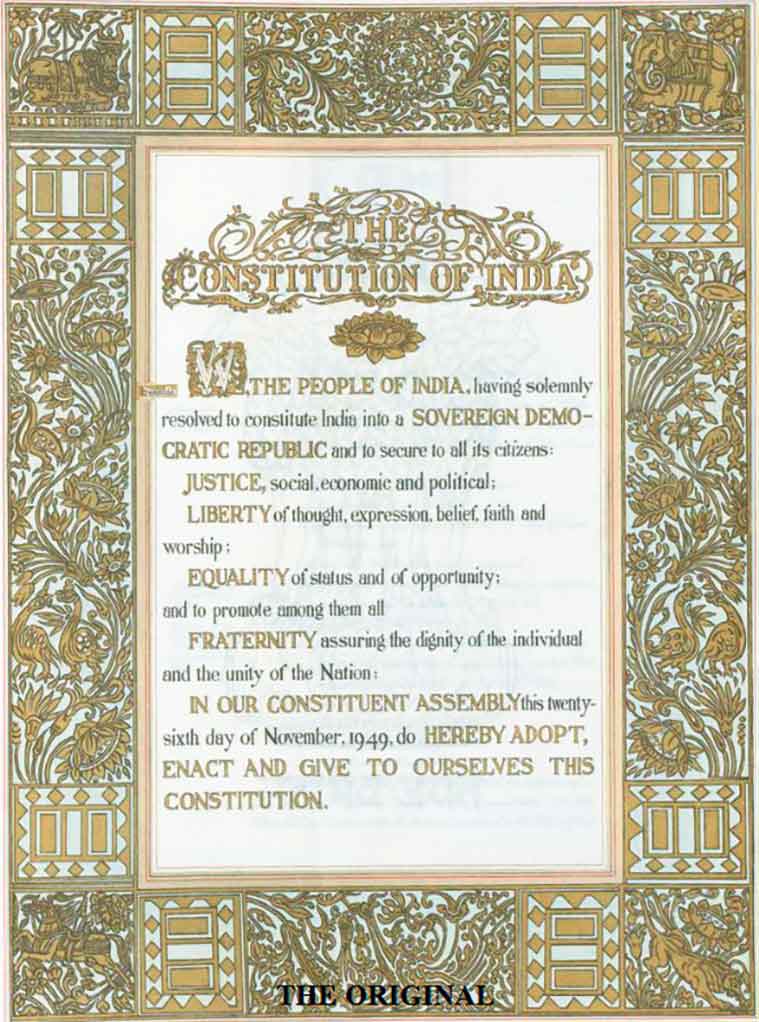 What is the relationship between “We the People of India” and the Constitution? This question was uppermost in the minds of India’s leaders as they met in Delhi to draft the document. (Photo: DAG)
While in the early years, Indians sought to call upon the Constitution as protection against the intrusive state, through the 1980s, they began relying on it to make claims for aspirational rights. Through the 1980s and 1990s, the Indian women’s movement, grassroot organisations like the Mazdoor Kisan Shakti Sangathan (MKSS) and Narmada Bachao Andolan, sex workers’ unions, artists and writers, environmentalists all built popular campaigns and litigated to get the Supreme Court to recognise that the constitutional protection of the right to life and liberty must be read widely to encompass the Constitution’s promises of justice, equality, liberty and fraternity.
Also Read | Poets, singers and writers speak about what the Constitution means to them ‘in letter and spirit’
The enactment of the MNREGA, the Right to Education, the implementation of the Forest Rights Act and the laws for prevention of sexual harassment are hard-won products of this movement. Dalit activists and political parties are central to the installation of the Constitution into popular consciousness, whether it be Mayawati’s reading of the Constitution during her political speeches, the mass campaigns to protect and expand affirmative action or the memorialisation of Dr Ambedkar holding aloft the Constitution in neighbourhoods across cities and villages. We see this memorialisation take another form, as tribals across Jharkhand and Chhattisgarh erect stone slabs with the provisions of the Constitution inscribed on them, reminding the government that the Constitution promises them sovereignty and control over their lands and livelihoods.
Also Read | Why January 26 was chosen to be the Republic Day
The Constitution has always been a site of struggle and the engagement of the people with it has faced many twists and turns, as governments in power have always been reluctant to be restricted by rules. It has also been limited in its effectiveness in areas of conflict, like Kashmir. However, in the past, people’s movements were aided by political parties and the courts. While MKSS began the move towards the right to information, they were assisted by the judicial recognition of the right and the legislation of that right into remedies by elected government. We face an unusual moment today, when both political parties and the judiciary seem to have stepped back from the role. It is unsurprising that hundreds and thousands of Indian citizens are filling that vacuum by stepping on the streets affirming the Preamble. As it is often pointed out, many of the tools of colonial governance, be it Section 141 of the CrPC or the powers of the governors over state governments, continued in independent India. However, members of the Constituent Assembly promised that these tools would be used and limited by the spirit animating the Constitution — its Preamble. It is striking that while previous popular engagements were by particular social or political groups seeking to protect or advance specific rights and provisions, today, people across demographic groups and geographic locations turn to the Preamble itself, to reawaken the spirit that animates the Constitution.
Rohit De is associate professor, department of History, Yale University, and the author of A People’s Constitution: The Everyday Life of Law in the Indian Republic (Princeton University Press, 2018)
 Share


