


- Tags:
- birds
- eye
- Ranjit Lal
- Ranjit Lal column
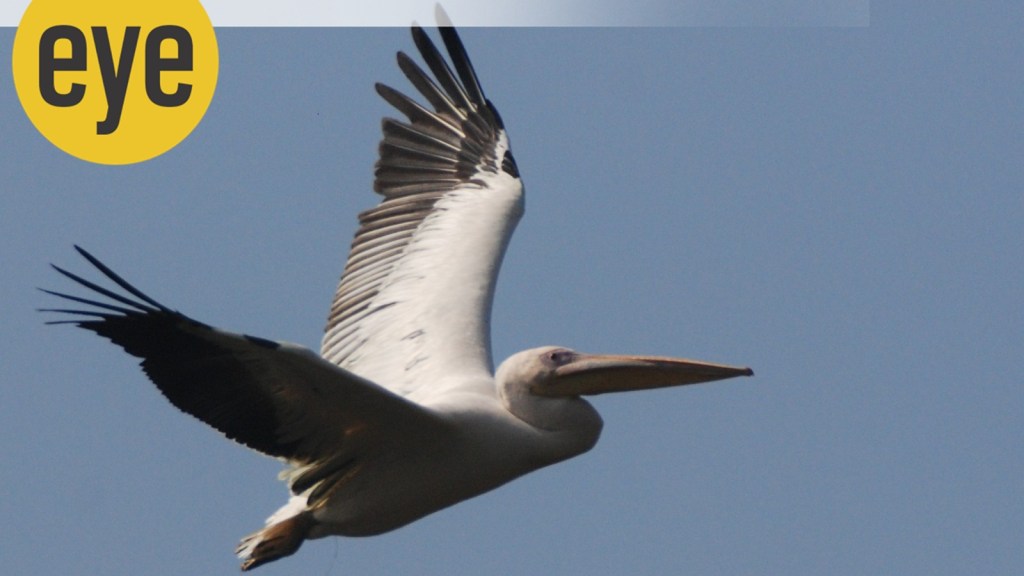 Great White Pelican (Photo: Ranjit Lal)
Always, they are mesmerising: whether they are black kites wheeling 2,000 feet high, lazily circling on thermals, their flight feathers splayed out, minute twists of the tail steering them or ducks and parakeets streaking across like squadrons of jet fighters or shrieking missiles. Even doves, taking off from a standing start with their startling ‘clap wing’ as their wings smack together on the upstroke, or a humming (or sun) bird, vibrating like an electric motor in front of the flowers it desires, beating its tiny wings 80 times a second.
We have long envied and emulated bird flight. The wings of birds come in various forms, depending on their function and the type of flight preferred by the bird. They are nothing but modified arms and hands, cloaked with lightweight but tough feathers that provide both lift and thrust. Thus, small forest hawks and owls and most passerine (perching) birds have ‘elliptical’ wings — short, almost stubby and curved, enabling them to execute deft, high-speed manoeuvres in tight spaces. Slim sickle-like ‘fastback’ wings like those of swifts and falcons enable speeds of up to 389 kmph. The falcon, in fact, has relatively large wings, which it tucks into its body while executing its killer dive. Seabirds like albatrosses have long slim wings, (which we have emulated in our gliders), enabling them to skim over the ocean waves, taking advantage of the wind currents, and they can weave just over the waves for hours on end with nary a wing-beat. The big boys — the eagles and vultures — have large, broad wings with splayed-out pinions at the end to provide lift and the slots at the ends of their pinions, smoothen the vortices spinning off the wing, again enabling them to soar smoothly for hours on end with minimal expenditure of energy.
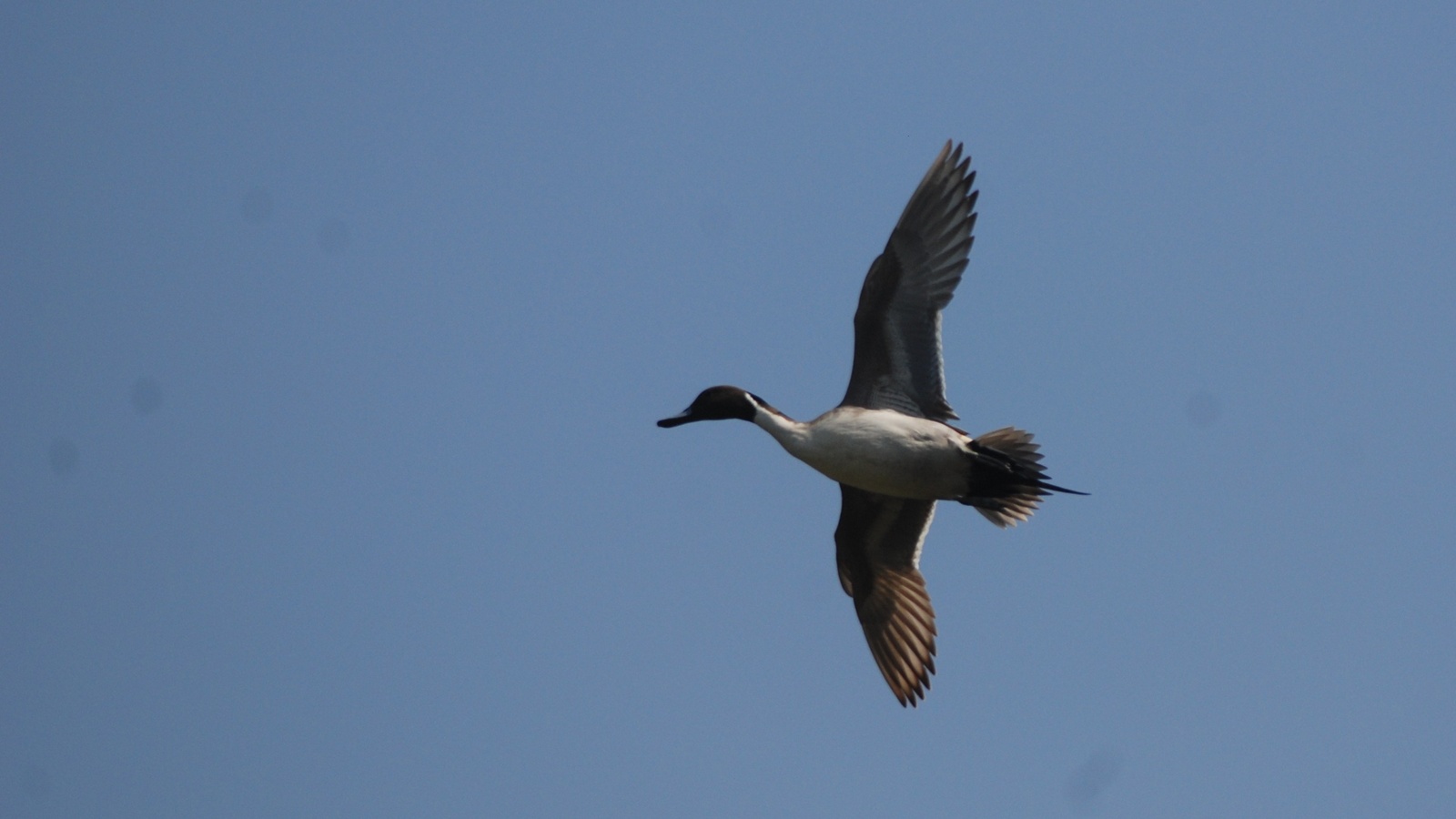 Pintail (Photo: Ranjit Lal)
There are basically two types of wing feathers: the stiff primaries at the end of the wings, which provide thrust, by working like propellers (twisting around their axis) and the softer secondaries that prove lift by curving on the down stroke and pushing the bird up. An ingenious pulley mechanism ensures that the bird is able to fold its wings on the upstroke, reducing drag, and then pull taut during the down stroke to provide lift and thrust. Only the hummingbird is exempt from this – it can swivel its wings around 180 degrees, so that it can get lift and thrust on both strokes, enabling it to hover blurrily in front of flowers and fly sideways, up and down and backwards.
The mighty flight muscles are attached to a keel along the breastbone of the bird. According to Salim Ali, we would need a breastbone four- feet long if we were to fly like birds. Flight muscles can be red – as in long distance fliers like geese and ducks, (hence the red meat) as they have to be fueled with a constant supply of oxygen from the blood during these vast journeys. A bar-tailed godwit was recently clocked doing over 11,000 km nonstop over oceans during its migratory journey. Muscles can be white – as in chickens and partridges, where a burst of glucose gives the bird the ability to blast off like a rocket when pursued. Hence, the white meat. But this runs out all too quickly and the bird has to go to ground; easy pickings for a retriever.
The bones in the wing are hollow and have air pockets that lighten and strengthen them and birds are able to oxygenate their muscles, both while breathing in and breathing out while flying.
Long distance migrants have to stock up on fuel (fat) before they embark on their migrations. They put on fat, and some of their organs, like the kidneys and gonads, actually reduce in size to lighten their burden and make space for the fat.
Feathers have to be kept in tip-top shape if they are to enable the bird to fly as required and birds take great care in ensuring this. I once watched a darter meticulously preen its wings for over 45 minutes, before I got tired and walked away. Every pinion has to be in perfect condition. They comb their feathers ensuring that the pinions slot tightly together and apply waterproof oil from a gland near their rear ends. Some birds like cormorants do not have this waterproofing oil because they use their wings more like flippers while diving underwater after fish. They can’t let their wings get too sodden though, because the weight would threaten to drown them. So, they literally spread out their wings to dry after every dive. Penguins too use their wings as flippers underwater.
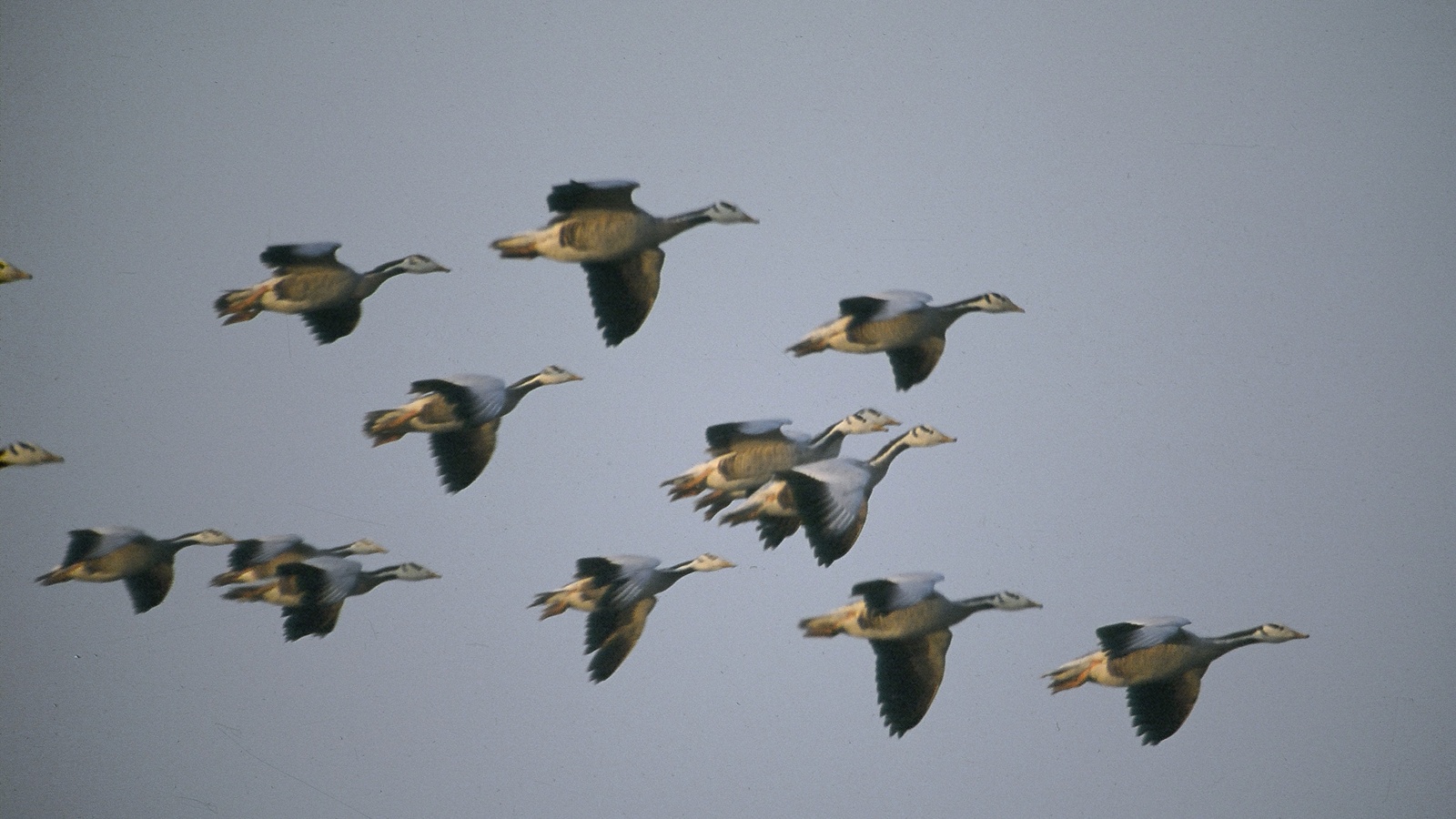 Bar-headed geese (Photo: Ranjit Lal)
Birds like ostriches have lost the ability to fly but more than make up for it by their ability to gallop over the ground and kick out like stallions, if attacked.
One experiment I like demonstrating is how a single flight pinion can provide lift: Hold a feather (say, one dropped by a black kite) lightly between thumb and forefinger and draw it forward at speed. Immediately you will feel the feather wanting to ‘take-off’ as it were. But feathers don’t last forever. They get tattered and battered and must be replaced, something that happens at least once a year. Ingeniously, these feathers fall off symmetrically from each wing ensuring that the bird is not unbalanced in flight.
There is nothing more evocative than watching skeins of geese or cranes flying in their traditional ‘V’ formation, so that the wash from the wingtips of the bird ahead buoys the bird behind it. Leadership is changed frequently, so the lead bird does not get exhausted.