
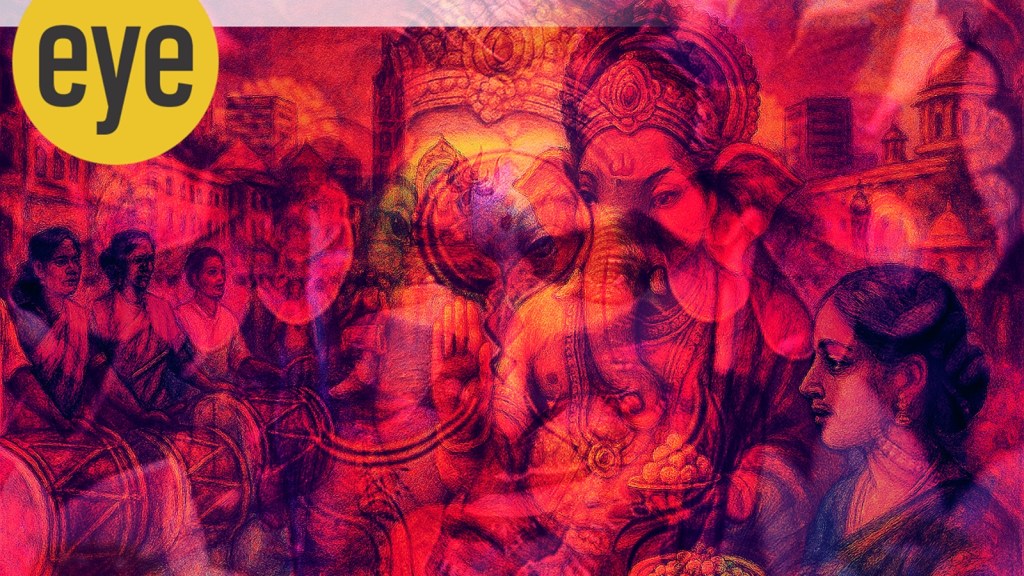
On Wednesday, Bombay was a thrum of thunder and theatre. Drums drummed, dust danced, devotion dazzled. Idols glittered with marigold garlands, glowing under makeshift lights. Children clutched paper flags, women clapped until their palms sang, men shouted slogans that were less war cries than love songs. The carnival of chaos and calm swelled like a single heartbeat — a belly as round and benevolent as the god it carried.
And yet, away from the clamour, Ganesh has always sat still. On my mother’s shelf, he rested in brass and clay and stone — small statues, smiling silently. Some plump, some slender, some with ears like elephantine umbrellas, some with trunks curled mischievously sideways. To gaze at her collection was to learn early that Ganesh is not one god but many moods: solemn and silly, playful and profound, a deity who can wear a hundred shapes without losing his soul.

He is memory, with his elephant head that never forgets. He is sacrifice, with his broken tusk surrendered so the Mahabharata might flow without pause. He is humility, perched on a mouse that proves even the smallest shoulders can carry the weight of the world. He is sweetness, with his modak — not only as metaphor, but as morsel, as sugared promise that patience is not wasted, that devotion delivers delight.
Ganesh is the god who laughs with you, not at you. He winks at worries, welcomes weakness, whispers courage. To invoke him is not to summon lightning, but to steady one’s own step. Little wonder then that in countless Indian homes, before every wedding, every prayer meet, every new venture, his name is the first note sung. And so it was in mine, where music began with him. For more than four decades, my training in classical music has started with his name: Ganesh, the guardian of beginnings, the happy god of laughter, the keeper of rhythm itself.
If Bombay offered spectacle, Nagpur gave sustenance. In that city, the festival’s heartbeat was not only in drumbeats but in sundal — the sacred salad of chickpeas and coconut. Handed to us in warm paper cups at the pandal each evening, it smelled of toasted coconut and crushed green chilli; the paper cups steamed slightly as we held them in the humid dusk. It was simple and sacred, earthy and ecstatic, as if a recipe could gather neighbours into kinship. Children gobbled greedily, elders chewed slowly, and the streets smelled equally of sandalwood and coriander.
Ganesh Chaturthi in Nagpur was never ritual alone; it was friendship seasoned and served. Perhaps that was always the point. When Bal Gangadhar Tilak transformed Ganesh Chaturthi into a public festival, it was not to divide but to unite — to give people a shared purpose, to teach a city to breathe in chorus. The idol in the pandal was never only a god; it was a reason for strangers to become companions, for neighbours to remember they belonged to one another.
And if Nagpur was food and fellowship, Delhi was devotion in hush. There, Ganesh did not arrive in grand processions. He was invoked in living rooms, through lamps lit low and songs sung soft. The glow of ghee, the perfume of jasmine, the stillness of silence — all of it folded into one invocation. In Delhi, Ganesh was never a spectacle. He was trust, quiet and unquestioning, that good luck could be courted with a whispered name and a bowed head.
But if Delhi was soft, Pune is sound incarnate. In Pune, Ganesh takes form in every corner, every street-side shrine, every sudden stall glowing with flowers. The drums there are different — thunderous, throbbing, thrilling. Women beat them with such force that your eardrums should burst, and yet they don’t. Instead, they build a viral vibration, not disease but delight, a shared high that sweeps the city into another realm.
I have known two Ganpatis in Pune, and I miss it this year. Our home in Koregaon Park, shared with Chef Vardhan Marwa and his wife, Shavika, becomes a listening post for those drums. Today is her first Ganpati, and she is out on the streets with Vardhan, surrendering to the sound. How jealous I am. For Pune teaches you that Ganesh is not stillness — he is surge, he is sound, he is city itself.
And I know this: our restaurants — Murphy’s, Gora, Faro — will be blessed by Ganesh this year. Diners may not see the god on their plates, but they will feel him in the vibration of those drums, in the energy that soaks walls and windows. The percussion of Pune is not contained; it spills, seeps, saturates. It reminds us that the god’s grace is not silent. It shakes you awake.
Whether in Bombay’s roar, Nagpur’s sundal, Delhi’s song, or Pune’s percussion, Ganesh has remained the same: a god who insists on beginnings, who makes no threshold impossible. And what a form he wears. His elephant head teaches that wisdom and memory are the foundations of courage. His large ears remind us to listen more than we speak. His round belly assures us that life is large enough for mistakes, laughter, forgiveness. His broken tusk tells us that imperfection is not a flaw but a fable — that even brokenness can be beautiful. His mouse mount teaches that the vast can rest on the tiny, that power has no meaning without humility. His modak promises sweetness after struggle.
Every symbol of Ganesh is a story, every story is a mirror. He does not live only in temples. He lives in every artist who breaks a tusk to finish a poem, in every child who rides a bicycle too big for them, in every neighbour who presses chickpeas and coconut into your hand.
Nor is Ganesh bound by India alone. Across cultures, the world has always yearned for guardians of beginnings. The Greeks had Hermes, quick-footed messenger of gods, trickster and guide at crossroads. The Romans had Janus, two-faced god of doorways, who gazed forward and backward at once. And everywhere — from rabbit’s feet in America to horseshoes in Ireland to lucky pennies in England — humanity has reached for symbols of luck, for omens of good fortune. Ganesh is India’s offering to this global grammar of grace.
But unlike trinkets of chance, Ganesh is not merely a charm. He is possibility made visible. He tells us that laughter is prayer, that beginnings are not frightening if taken with love, that wisdom can be gentle, that humility can be mighty, that imperfection can be holy. He is not confined to dogma or scripture. He is not a god of division. He is as much at home in a Pune drumbeat as in a Delhi lamp, as welcome in Nagpur’s sundal as in a Greek crossroad.
Ganesh Chaturthi was marked a few days ago. The idols have returned to water, the pandals have emptied, the drums have hushed. But the god remains. He is not a Wednesday alone. He is forever. He is the laughter that lingers, the song that steadies, the sundal that satisfies, the drum that awakens, the idol you kiss before stepping out the door.
Ganesh is the happy god. He is ours — not as property, but as presence. Ours as reminder, ours as rhythm, ours as resilience. He is love, abundance, blessing. Nothing more, nothing less.
And perhaps that is enough.

 Share


