
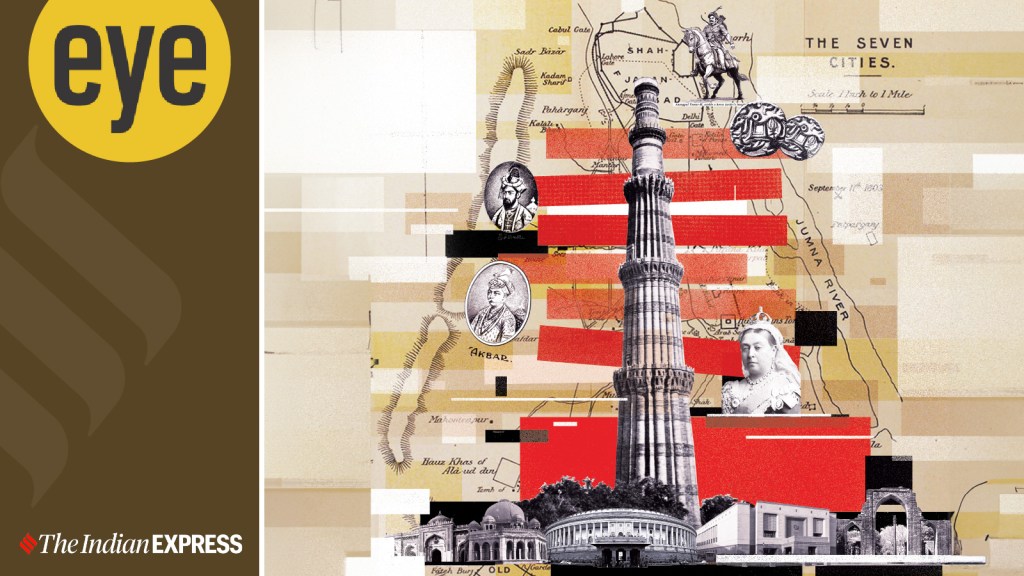
It seems trite to say that Delhi is a site at which many ruling powers have felt impelled to create capitals. After all, almost all talk of Delhi’s history tends to begin with a list of its several ‘cities’ — starting from Lal Kot, established in the mid-11th century, and going through to New Delhi, founded in the 20th century by the British. But behind such banal, bald statements of fact, lies a complex history of how the place came to be invested with this aura of power.
The name, in its earliest mentions — ‘Dhilli’ — is not very ancient and first came to be applied to a fortified city established around 1052, in what is familiar to us as the area around Qutub Minar. It was established as a capital by a king called Anangpal, who ruled over a fairly modest kingdom. Human habitation and even urbanisation was not new here, as it was already an important centre of trade and Jain pilgrimage, known as Yoginipura. Rather, the term ‘Dhilli’ came specifically to be applied to the place after it became a fortified, political centre.

A real boost to the city’s political importance came in the 13th century, as it became the capital of a growing empire, the Delhi Sultanate. Some idea of how this may have been viewed by those who lived in the city at that time, may be had from an inscription, dating to August 1276, that was originally installed in a stepwell at Palam, close to Delhi’s present-day airport. This Sanskrit inscription commemorates the construction of the well by a local landowner, Uddhara, and gives us very interesting information.
A significant part of it is devoted to extravagant praise of the then ruler, Ghiyas-ud-din Balban (1266-1287). The extent and influence of his empire is expressed in hyperbole — as encompassing territories from Afghanistan to Bengal to the far south of the subcontinent. The inscription goes on to comment in equally extravagant terms about Delhi. In the eyes of the author of the inscription (Pandit Yogishwar) the significance of the city does not lie in a glorious past. In fact, so recent is its fame, that he has to specify that the city of Dhilli is better known as Yoginipura. Neither does he refer to any sacred significance, though there are other sources that link the site of Delhi with nearby Indraprastha, where god Indra is believed to have performed sacrifices. Rather, the Palam Baoli inscription attributes the significance of Delhi to being the seat of an empire with great territorial extent.
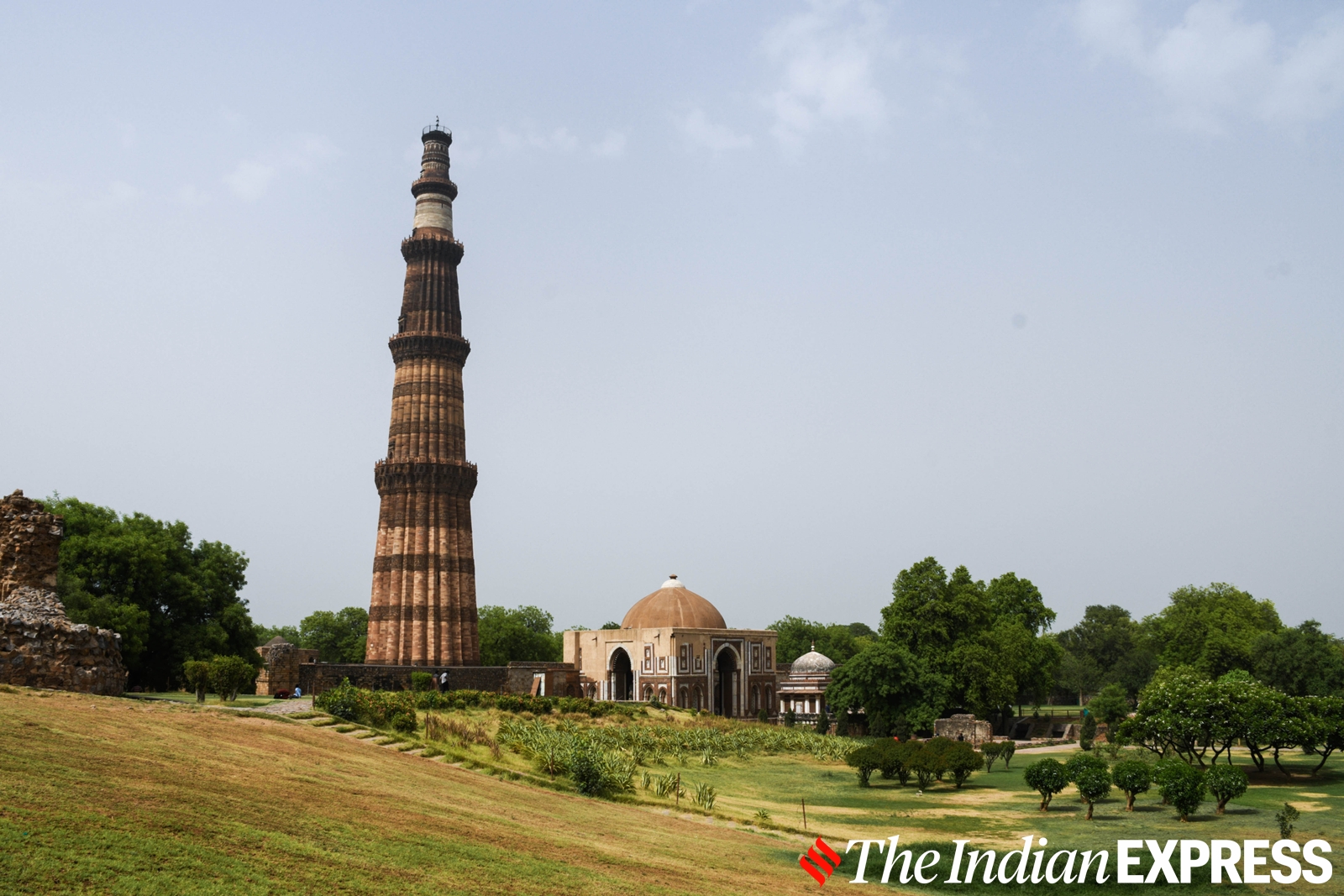 A view of the Qutub Minar complex. (Express file photo)
*****
This political significance, a relatively new phenomenon in Balban’s time, was strengthened as time went on. The eponymous Delhi Sultanate, under a succession of dynasties, ensured that the name of the city was etched in the popular mind as a centre of imperial power. Incidentally, during this time the name Dhilli acquired its Persianised form, ‘Dehli’, in the official record. In popular usage, it probably continued as Dhilli for much longer, slowly morphing to Dilli, which is still in use today. Later, the British would make it ‘Delhi’.
One consequence of the association of the name ‘Delhi’ with imperial power, was its ultimate disassociation from its original physical site. For various practical reasons, as time went on, successive Sultanate rulers shifted their capitals to other sites in the Delhi area. Thus, Jalaluddin Khilji (1290-96) moved his capital to Kilugarhi, to escape the influence of rival factions in the older capital. Incidentally, all that seems to have survived of the capital of Kilugarhi is the name Kilokari, one of Delhi’s numerous ‘urban villages’.
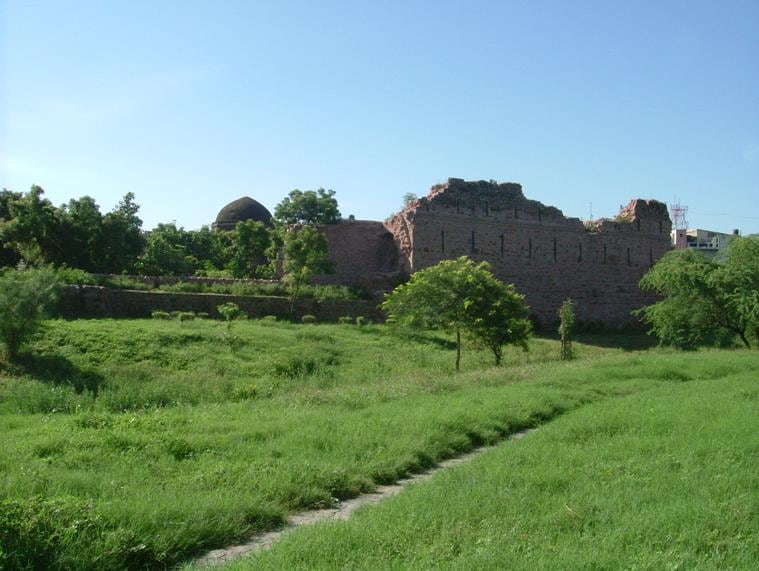 The fort of Siri, built by Alauddin Khilji in 1290, now lies shrouded under a thick foliage of trees and a blanket of apartments. (Express archive)
Jalaluddin’s successor Alauddin Khilji moved his capital to Siri (1303), where he had quartered his army during his standoff against the invading Mongols. The Tughlaqs, too, built new capitals. Balban built Tughlaqabad (1320-21) for strategic reasons on a rocky stronghold; Mohammad bin Tughlaq founded Jahanpanah (1326-27), in the midst of a newly fortified area, and Firoz Shah, by building Firozabad (1354) next to the Yamuna, took advantage of the benefits of the river as a waterway as well as a source of water.
Though these new cities all had their own distinct names, the original site in Mehrauli, by the mid-14th century, had begun to be called Dehli-e-Kuhna, i.e. ‘Old Delhi’. Implicit in this appellation was the idea that the name ‘Dehli’ itself moved to each of these new cities, in turn as each became the capital.
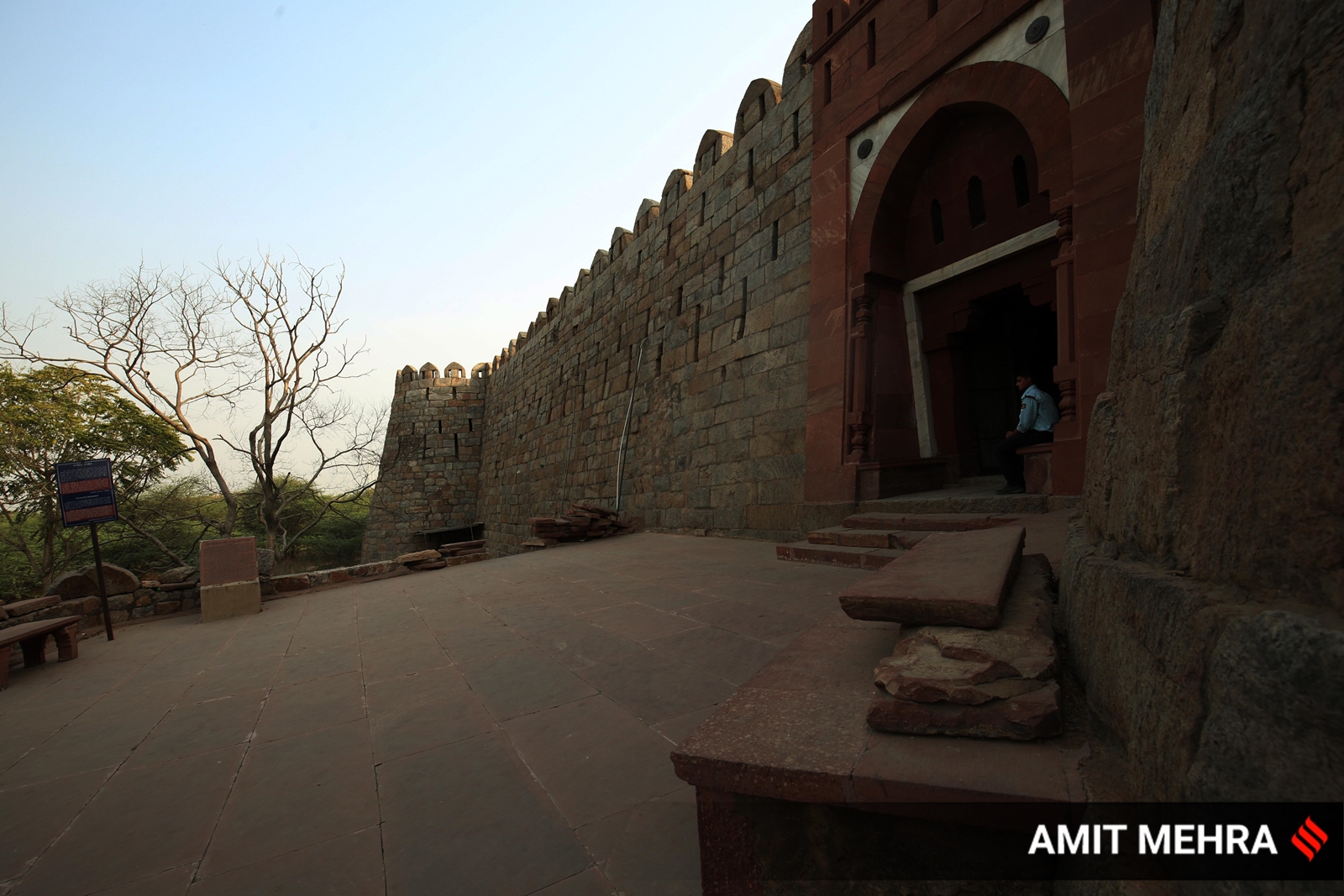 The Tughlaqabad fort, established in 1320-21. (Express file photo by Amit Mehra)
Circumstances dictated eventually that the capital of the Delhi Sultanate move away from Delhi altogether, as it did under Sikandar Lodi, who moved the capital to Agra in the early 16th century. The Lodis were soon replaced by a new power, the Mughals, who were to found a new long-lived dynasty. The founder of the dynasty, Babur, wrote in his memoir soon after he had defeated Ibrahim Lodi at Panipat in 1526: “The capital of all Hindustan is Delhi”. Clearly, the association of Delhi with power was stronger than Agra, even two decades after the shift of the capital. Moreover, after a decisive battle, before moving to Ibrahim’s capital in Agra, Babur first came to Delhi. Here, he went for a sort of pilgrimage to the tombs of several previous rulers.
Babur’s successor Humayun built a city in Delhi, named Dinpanah (1533), from where the Suri ruler Sher Shah and his successors also ruled. Akbar however would move the capital again to Agra in the 1560s and it would remain the capital till 1648. Yet, Delhi’s association with imperial power did not diminish, despite the capital moving away. A Sanskrit inscription from Mandsaur in Madhya Pradesh, dating to 1607 during the reign of Jahangir, refers to the emperor’s father, Akbar, as Dillishvara, the ‘lord of Delhi’, even though it had been many decades since Akbar had moved the capital away from Delhi. Jahangir himself, who never reigned from Delhi, is described as Shahanshah-e-Dehli, or the ‘emperor of Delhi’, in a Persian inscription on a bridge he commissioned in 1621 that leads to the Salimgarh Fort in Delhi.
Jahangir’s successor Shahjahan, after several years reigning from Agra moved the Mughal capital back to Delhi, founding a new city, around 1638. Shahjahan’s decision to build a new city is not surprising. To someone who had a deep interest in architecture, the laying out of a new city was the ultimate way to leave his mark in history. The specific choice of Delhi as a site was no doubt influenced in large part by the desire to invoke the aura associated with the name of Delhi. And though the city was given the name Shahjahanabad — ‘founded by Shahjahan’, the unspoken assumption was that this was the new Delhi.
Syed Ahmad Khan, writing in the mid-19th century, said, of Shahjahanabad, that this was where “Delhi now is”. With the founding of Shahjahanabad, the previous Mughal city in Delhi — Humayun’s Dinpanah — was given the title of ‘Old Delhi’. Which is incidentally why we still refer to Purana Qila (old fort) as such, though there are several older than this.
The Mughal empire eventually declined. The British Indian empire, for reasons connected with the history of the establishment of British rule in India, had its capital in Calcutta. Even so, when in 1876 Queen Victoria decided to assume the title of ‘Empress of India’ it was decided that the announcement of this to the people and princes of India would be made at a grand event in Delhi. Similar coronation durbars were held to mark the accession of Queen Victoria’s successors, Edward VII and George V, to the title of emperor. Each time the justification given for choosing Delhi as the venue was that in the minds of the people of India, Delhi was the real capital, and ultimately, the main aim of the durbars was to package British rule for Indian consumption.
Following the Durbar of 1911 the British actually moved the capital to Delhi, again a decision based on a perception of what would be a popular move among Indians. Like many other rulers before, they also built a new capital city. This latest Delhi was unambiguously named ‘New Delhi’, and in a pattern that was being repeated once again, relegated Shahjahan’s city to the status of ‘Old Delhi’.
 Beside the obelisk is a statue of the King himself standing solemnly, which had earlier stood at the India Gate till the 1960s before it was unceremoniously removed. (Express file photo by Tashi Tobgyal)
****
New Delhi’s site, plan and architecture were carefully chosen, drawing on historical associations. Nevertheless, the heavy symbolism in the buildings failed to serve its intended purpose. Indians were not convinced that the British had their interests in mind, and barely 16 years after the formal inauguration of the new city, the British left Indian shores.
With Independence in 1947, the government of the free nation chose to occupy the site that the British had created, instead of building a new capital. The reason, partly, was pragmatic. A country that had just emerged from a prolonged period of colonial oppression had other priorities. The basic needs of its population had to be met, at the same time the foundation for a strong and independent national economy had to be laid out. This was no time for symbolic gestures, nor was there a need for them. It did not matter that it was a colonial viceroy for whom a house had been built, as long as an Indian president occupied it. As for Parliament House, it had always been built for what had by the 1920s become a largely Indian representative body, a result of concessions extracted from the colonial government through prolonged national struggle. Much less was there any need for a new capital.
Nevertheless, in the decades that followed Independence, New Delhi saw a transformation. At and around its core, which we call Central Vista, new government buildings were built, to accommodate new departments and ministries, which were needed as the new government’s functions went into areas beyond the colonial government’s main concerns of defence, policing and extraction of revenue. There was also a greater democratisation of the space, as new public institutions, such as the National Museum and the National Gallery of Modern Art, and, later, the Indira Gandhi National Centre for the Arts. In this manner, the post-Independence state appropriated and re-inscribed the city of New Delhi, thus giving it a new meaning.
In a sense, this re-working of the colonial city was another Delhi. In recent years, the process of the removal of many of the landmarks of the post-Independence era has been accelerating. We are likely to be left with a situation where, while we can see the older cities of Delhi inscribed as monuments and historic sites, we will be left without traces of the city created after Independence.
Through many changes in regime over the centuries, rulers have made and remade Delhi, drawing on its past but also seeking to give it new meaning. In the process, Delhi came to signify more than a physical site. It became an idea, a name associated with political power; to be invoked in the exercise of power, but also equally in challenges to entrenched authority. Nizamuddin Auliya, reminding Emperor Ghiyasuddin Tughlaq of the limits to his power had said ‘Dehli dur ast’ — Delhi is yet far. In our times, following Subhash Chandra Bose, many who seek redress from the central authorities have raised the slogan ‘Dilli chalo’ — march to Delhi.
Swapna Liddle is a Delhi-based historian, who has authored The Broken Script: Delhi under the East India Company and the fall of the Mughal Dynasty, 1803-1857 (Speaking Tiger); and Shahjahanabad: Mapping a Mughal City (Roli Books)

 Share


