
Solidarity Trial: What progress has been made so far?
WHO Solidarity trial: In the hunt for possible Covid-19 treatments, WHO has halted enrolment for the hydroxychloroquine arm of trials. What led to the move, and what progress has been made with the other arms of Solidarity so far?
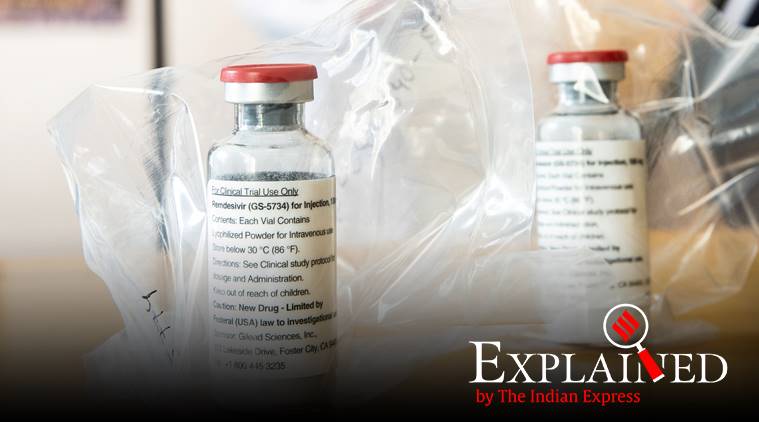 Remdesivir, often described as the most promising of the options. (Reuters Photo/File)
Late on Monday night India time, the World Health Organization (WHO) announced it would no longer assign patients to the hydroxychloroquine (HCQ) arm of the multi-country Solidarity Trial on possible treatments for Covid-19. The announcement raises several questions, particularly in India which is a major manufacturer/exporter of the drug and has also reposed implicit faith in its therapeutic and prophylactic role for health workers exposed to Covid-19 cases.
What is the Solidarity Trial?
“Solidarity” is an international initiative for clinical trials launched by the WHO, along with partners, to help find an effective treatment for Covid-19. It was originally supposed to look at four drugs or drug combinations: remdesivir, HCQ, ritonavir/lopinavir and lopinavir/ritonavir/interferon beta 1a. Now with HCQ trial enrolment stalled for at least the next few weeks, the Solidarity trial will proceed with the other three arms. Some data on HCQ will still be generated, though.

According to WHO: “By enrolling patients in multiple countries, the Solidarity Trial aims to rapidly discover whether any of the drugs slow disease progression or improve survival. Other drugs can be added based on emerging evidence… Over 400 hospitals in 35 countries are actively recruiting patients and nearly 3,500 patients have been enrolled from 17 countries. Overall, over 100 countries have joined or expressed an interest in joining the trial, and WHO is actively supporting 60 of them.”
India is among the countries where the Solidarity Trial is being carried out. Four hospitals in Jodhpur, Ahmedabad, Chennai and Bhopal have received regulatory approvals, and more will follow. In all, patients in 20-35 hospitals in the country will be part of the trial.
Have any of the arms made particularly good progress?
So far, remdesivir is widely being described as the most promising, although results of various trials have sometimes being conflicting. Developed by Gilead Sciences Inc, remdesivir is a broad-spectrum antiviral which was previously tested in humans with Ebola virus disease, and which has also shown promise as a drug against MERS and SARS, both of which are caused by coronaviruses.
A trial funded by the US National Institute of Allergy and Infectious Diseases has found, in the preliminary results, significant positives to the use of remdesivir in patients requiring oxygen therapy. The drug was found to speed up recovery during a trial and the results were encouraging enough to warrant publication of the results even while the trial was still on. However, In an earlier, truncated study reported in The Lancet, Chinese researchers had concluded they could not find any “statistically significant clinical benefits” of the drug.
What results was HCQ showing in trials, and what led to the suspension?
Hydroxychloroquine is a drug used in the treatment of autoimmune diseases such as rheumatoid arthritis and lupus, and also as a malaria treatment and preventive. In a sense, it remains part of the trial because patients who had been earlier randomised to get the drug will continue to do so until the treatment is completed. The WHO is expected to take a call on its future inside the trial by mid-June.
Also Read | India underlines faith in HCQ: drug’s benefits outweigh risks
On Monday WHO Director General Tedros Adhanom said: “On Friday, The Lancet published an observational study on hydroxycholoroquine & chloroquine & its effects on COVID-19 patients that have been hospitalised. The authors reported that among patients receiving the drug, when used alone or with a macrolide, they estimated a higher mortality rate. The Executive Group of the Solidarity Trial, representing 10 of the participating countries, met on Saturday and has agreed to review a comprehensive analysis and critical appraisal of all evidence available globally. The review will consider data collected so far in the Solidarity Trial and, in particular robust randomised available data, to adequately evaluate the potential benefits and harms from this drug. I wish to reiterate that these drugs are accepted as generally safe for use in patients with autoimmune diseases or malaria. The Executive Group has implemented a temporary pause of the hydroxychloroquine arm within the Solidarity Trial while the data is reviewed by the Data Safety Monitoring Board.”
The study led by Brigham and Women’s Hospital had concluded: “We were unable to confirm a benefit of hydroxychloroquine or chloroquine, when used alone or with a macrolide, on in-hospital outcomes for COVID-19. Each of these drug regimens was associated with decreased in-hospital survival and an increased frequency of ventricular arrhythmias when used for treatment of COVID-19.” Macrolides are a class of antibiotics that include the antibiotic azithromycin.
What are the other arms of Solidarity?
Both of these are with a combination of the drugs ritonavir and lopinavir, with one arm trialling the combination together with an additional substance. Ritonavir and liponavir are second-line HIV drugs, known as HIV protease inhibitors, that have been in use for some time. They bolster the immune system, which reduces the chances of a HIV-positive person developing complications such as tuberculosis.
Their use in India for HIV, though, is very limited — 70% Indian patients are on first-line drugs. These drugs are manufactured in India mainly for export mostly to African countries. Following early reports from China on successful use of the drug combination, India in February had obtained regulatory clearance for their use in Covid-19. The drugs were used in a handful of patients before India began to focus on HQL and azithromycin by the end of March.
India’s change of stance came following a 199-subject trial in China on the efficacy of ritonavir/lopinavir. The study reported that at 22.1%, the mortality reported in the trial was substantially higher than the 11% to 14.5% mortality reported in initial studies of patients hospitalised with Covid-19. However the drugs have not been written off as candidates in the hunt for Covid-19 treatments.
📣 Express Explained is now on Telegram. Click here to join our channel (@ieexplained) and stay updated with the latest
What is the other arm that includes ritonavir/lopinavir?
It involves the two drugs in combination with interferon beta 1a — which belongs to a class of substances known as cytokines that are secreted by immune cells to signal other cells to act against an imminent or acute infection. It is used to treat diseases like multiple sclerosis. Some studies have shown that if interferon beta 1a is added to ritonavir and lopinavir, there are better results than when the antivirals alone are used.

 Share


