
Explained: Why ex-Mizoram Governor Kummanam Rajasekharan could hold key to BJP’s best Lok Sabha chance in Kerala
Despite being actively in the state for over three decades, the BJP has no major ally to boast of, apart from the newly-founded Bharat Dharma Jana Sena, a party floated by the son of an Ezhava community leader.
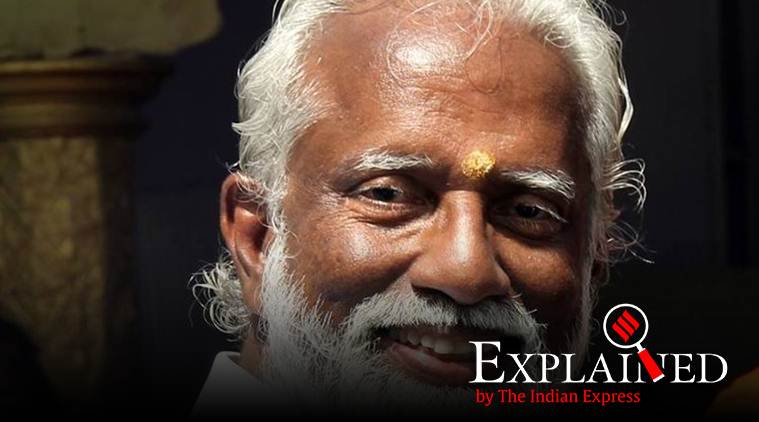 Kummanam Rajasekharan is said to be the favourite among the local cadre to fight from Thiruvananthapuram.
Mizoram Governor Kummanam Rajasekharan gave up office today and is likely to contest from a seat where the party sees it’s best prospects of winning in the upcoming Lok Sabha elections. Governors relinquishing retirement roles to return to active politics is not uncommon in India, but in this context, it speaks volumes about the local BJP’s inability to find a candidate from among its own to break new ground in Kerala.
Kummanam Rajasekharan, a far-right leader who headed the BJP unit in Kerala until May last year when he was abruptly appointed by the Narendra Modi-led government as the Governor of Mizoram, is said to be the favourite among the local cadre to fight from Thiruvananthapuram, a seat the party lost by a whisker to Congress’ Shashi Tharoor in 2014. The party pinned down upon the 66-year-old’s name after it conceded defeat in persuading Mohanlal, one of Kerala’s biggest actors, to contest on the lotus symbol from Thiruvananthapuram.


Now take this. If the central leadership disapproves Rajasekharan’s name, even if he aspires to fight elections, the party then will have to persuade Suresh Gopi, an actor-turned-Rajya Sabha MP who has indicated his reluctance to fight elections on more than one occasion. If Gopi too declines, then the party will fall into a real quandary over whom to field.
This sums up the state of affairs of the BJP in Kerala, the last big state in the country where it is yet to win a Lok Sabha seat on its own. In the 2016 Assembly elections, it may have made history by getting its first MLA in the Assembly. But, rumours are rife this time that if the party fails to open its account in parliamentary elections, the national leadership and the RSS could abandon the state unit. There are many reasons why that could happen.
First, the party in Kerala is wracked with factionalism at the top level with dissensions and disagreements a regular feature at key meetings. The two prime factions are led by former state presidents PK Krishnadas and V Muraleedharan who want their candidates to be nominated in constituencies considered favourable for the party. When PS Sreedharan Pillai, a moderate face in the party, was appointed state chief last year, he had promised to end all infighting. But in the run-up to the elections, bitter rivalry within the party threatens to damage prospects at the hustings. The leadership has also been unable to rein in rebel leaders like PP Mukundan who has threatened to contest as an Independent in Thiruvananthapuram.
Second, in post 2014-electoral politics, one of the strategies widely employed by the Modi-Shah combine has been to import influential leaders from rival parties who may be unhappy there. This strategy has paid off heavily in states like Uttar Pradesh, Assam and Gujarat. But in Kerala, despite Pillai’s repeated calls of keeping the door open for any leader who wished to join, that hasn’t quite happened. The Congress in Kerala is equally known for its rival ‘groups’ and factions, but somehow, it’s leaders have privately admitted that crossing over to the saffron party would amount to committing a ‘professional blunder’.
Third, if the Ram Janmabhoomi movement was the ideal springboard for the BJP at the national level to make huge political gains across the Hindi heartland, many believed the agitation at the Sabarimala temple could do the same trick for the party in Kerala. In fact, Pillai, while addressing workers of the Yuva Morcha, called it a ‘golden opportunity’ for the party. In the course of reporting during the agitation, several BJP and RSS workers exuded confidence that they finally had an issue that appealed to the core Hindu vote base and could help consolidate the community’s support across castes for the party when it mattered.
However, the handling of the party’s months-long violent agitation, during which female journalists were attacked and clashes erupted with police force at the temple premises, has been critiqued both inside and outside the organisation. It’s call for frequent shutdowns, especially on a day when one of Mohanlal’s big-budget films released, did not go down well with many people. In contrast, the Congress took out peaceful, flag-less demonstrations, carving out the path to file a review petition against the Supreme Court verdict. Even the CPI(M), which was in the dock for insisting on implementing the ruling, surprised many by parading lakhs of women to create a wall connecting the state’s northern and southern ends.
Fourth, one of the prime hurdles on the party’s path of growth has been the state’s demographics, its large minority vote base accounting for nearly half of the electorate. The BJP has still not succeeded in shedding its anti-minority image and captures little attention in Muslim and Christian-majority areas. On the contrary, the Congress continues to receive a large share of those votes through its tactical alliances with parties like the Indian Union Muslim League (IUML) and the Kerala Congress (Mani). In fact, in the final rounds of counting in Thiruvananthapuram during the 2014 polls, then-BJP candidate O Rajagopal lost out to Shashi Tharoor as a result of the Latin Catholic voters in coastal areas siding with the Congress candidate. The BJP may have gained in Hindu-majority urban areas, but lost too much in the minority segments.
Finally, coalitions are everything in Kerala’s politics. No political outfit, even the CPI(M) or the Congress, can aspire to come to power single-handedly. That’s why they work hard at working out deals with smaller regional parties that have influential catchment areas. Despite being actively in the state for over three decades, the BJP has no major ally to boast of, apart from the newly-founded Bharat Dharma Jana Sena (BDJS), a party floated by the son of an Ezhava community leader. In the 2016 Assembly elections, the first time it faced voters, the BDJS came third in all the 36 seats it contested, getting just 4 per cent of the popular vote.
With dates of the parliamentary elections likely to be announced by the Election Commission any day, all coalition fronts have their hands full with chalking out the candidate list. While the Left Front has prepared it’s nominee list without any major hiccups, the Congress is still engaged in talks with allies. For the BJP, it seems everything hinges on what the central leadership has to say about Rajasekharan’s candidature.

 Share


