As India’s tiger population bounces back in certain well-protected pockets, big cats walking out of tiger reserves are making headlines. But dispersal is natural for the tiger — a solitary, territorial animal that must eke out its own space with exclusive hunting and reproductive rights.
Extensive use of radio-telemetry has offered new insights into the big cat’s single-minded pursuit of optimal space. But anecdotal records suggest that tigers have been testing the limits of their subcontinental range for some time. Consider:
In 2016, conservationist and hotelier Balendu Singh hosted the Jahangirs — Pakistani human rights activist Asma and her industrialist husband Tahir — at Ranthambhore. During a fireside chat, Tahir mentioned occasional sightings of tigers near their holiday home in Murree, across the LoC.
“There is no recorded history of tigers in Jammu. I was naturally incredulous but did not contest the guest’s claim. I remembered him when I heard that a tiger was photographed by an Army patrol above Rajouri — less than 100 km from Murree,” Singh said, marvelling at the idea of tigers defying human perception and boundaries.
Despite their large size and lazy gait, tigers are adept at negotiating non-forest landscapes, while remaining mostly out of sight. Even small green patches can help them travel through landscapes dotted with villages
Tiger dispersals are mostly exploratory — they do not follow linear paths, and find their way around barriers such as highways, railways, canals, mines, and human habitation.
In 2019, wildlife biologists documented a male tiger’s journey within Maharashtra, from Tipeshwar to Dnyanganga sanctuary. To cover a linear distance of 315 km over 225 days, the tiger walked some 3,000 km through a mosaic of forested and agricultural landscapes.
During this journey, the tiger used 89 resting sites — 73 in forests and 16 outside — where it stopped for various durations, between seven hours to one week. The smallest of these resting sites outside forests was merely 0.001 hectare — smaller than a 10ft x 11ft room. Some of these pit stops were made merely 300-500 meters from human settlements.
Males tend to disperse more
A study of 29 tiger cubs between 2005 and 2011 in Ranthambhore found that males had a greater probability of dispersal (92.3%) than females (36.4%). Males also dispersed further (4.5-148 km) than females (4.6-25.8 km) from the area of birth.
Over the last two decades, long-distance dispersals of male tigers have been well documented:
2003: Broken Tail, the firstborn of Ranthambhore’s iconic tigress Machhli, travelled a linear distance of 150 km to Darra sanctuary near Kota, where it was run down by a train.
2008: A tiger walked a linear distance of 197 km from Bhadra tiger reserve to Dandeli sanctuary in Karnataka.
2011: Another Karnataka tiger made a linear distance of 280 km from Bandipur tiger reserve to Shikaripura.
2018: A tiger from Ratapani sanctuary in Madhya Pradesh moved to Mahisagar in Gujarat — a linear distance of over 300 km.
2023: A tiger from Maharashtra’s Brahmapuri travelled 2,000 km across four states to reach Rayagada in Orissa — a linear distance of 650 km.
2024: A tiger from Rajasthan’s Sariska travelled over 100 km to Haryana’s Jhabua forests.
While dispersal is usually a male forte, tigresses have also been recorded walking long distances. In 2015, a tigress explored over 340 km to reach Ranipur sanctuary in Uttar Pradesh from Panna, located some 99 km away in Madhya Pradesh.
Looking for territory, mates
Typically, a male tiger’s larger territory encompasses smaller territories of multiple female tigers. While related tigresses (siblings or mother-daughters) may concede space to one another in adjacent ranges, every male tiger must establish its own territory when it comes of age.
Within the finite limits of shrinking forests, this leads to frequent duels between young pretenders and the dominating, mature males already in control of prime plots. If lucky to survive the face-offs, the vanquished flee the victor’s territory.
For old tigers, such displacement would signal impending death. But with time on their side, the young floaters must keep exploring for vacant slots and accessible tigresses.
A tiger forest reaching its carrying capacity is not the only scenario when individual tigers wander outside.
Tigers are also known to set off when moved to new locations as part of population management strategies. In Madhya Pradesh, for instance, the first male tiger shifted to Panna from Pench in 2009 started walking south, looking for its erstwhile home. It had to be recaptured. Last month, tigress Zeenat showed the same restlessness after being packed away from Tadoba (Maharashtra) to Simlipal (Odisha).
Tigresses may also disperse to protect cubs. In 2011, a tigress walked out of Ranthambhore with its two cubs after the male that sired them was airlifted to repopulate Sariska. Wary of new males looking to kill the cubs and mate with her, the tigress took refuge in the ravines and mustard fields by the Chambal river, where the cubs did not survive too long.
Not a zero-sum game
Not all dispersals have happy endings. But surplus tigers from ‘source’ reserves must fan out looking to reach low-tiger-density areas. When they succeed, fresh gene flow revitalises isolated populations. When they don’t, they die.
Also, without adequate monitoring and necessary intervention, tiger dispersals through non-forest areas and human habitations may fuel man-animal conflict, eroding the goodwill the national animal banks on. Dispersal routes popular with tigers indicate the potential for developing and protecting new habitats and corridors so that the big cat may reclaim lost ground.
According to the latest all-India tiger estimate, one-fifth of India’s tiger area spanning 16 tiger reserves harbours only 25 — or less than 1% — of India’s 3,682 tigers.
There are enough forests for dispersing tigers to fill up.

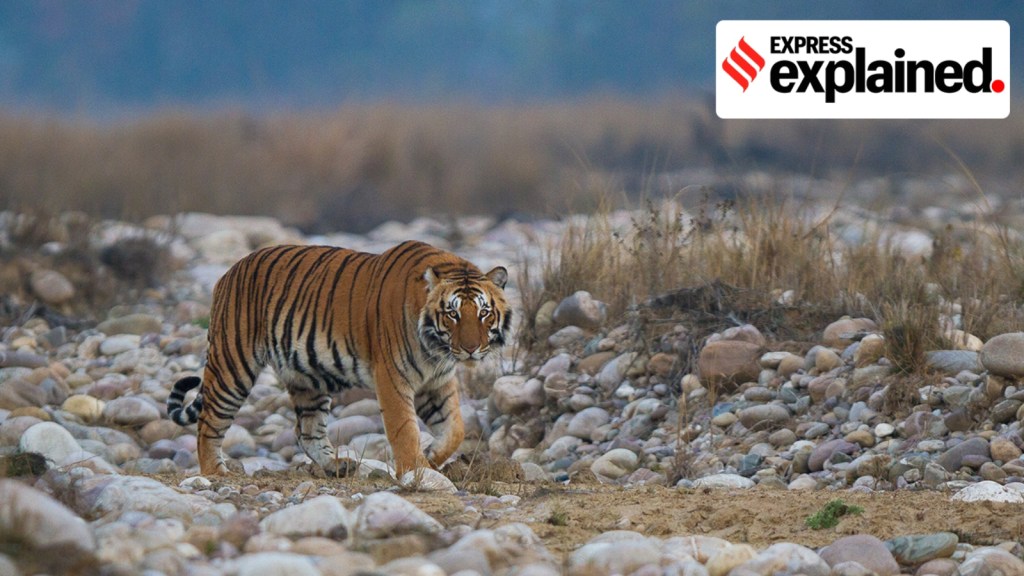 A tiger taking an early morning stroll at the Jim Corbett National Park in Uttarakhand. (Wikimedia Commons)



 Share


