Most people know the Shiromani Gurdwara Parbandhak Committee (SGPC) as the body that manages historic Sikh gurdwaras, including Sri Harmandar Sahib (the Golden Temple in Amritsar). As a statutory organisation, it controls the finances, properties, and administration of gurdwaras falling under the Sikh Gurdwaras Act, 1925. Often called the “mini-Parliament of Sikhs”, its General House is meant to be a genuinely representative body, elected by the Sikh electorate (the Sangat).
The SGPC, however, has far more impact on state politics. According to the Act, 170 elected members — chosen from constituencies spread across Punjab, Haryana, Himachal Pradesh, and Chandigarh — and 15 nominated members, drawn from Sikhs across the country. Six are ex-officio members: the Jathedars of the five Takht Sahibs and the Head Granthi of Sachkhand Sri Harmandar Sahib. Thirty seats are reserved for women.

Despite these provisions, the SGPC — which happens to be India’s biggest elected religious body — has not had an election in 15 years now. We explain why.
How an SGPC election is supposed to work
Under the Sikh Gurdwaras Act, 1925, and the Sikh Gurdwaras Board Election Rules, 1959, the Central government appoints a Chief Commissioner, Gurdwara Elections, who heads the Gurdwara Election Commission — the designated authority for conducting SGPC polls.
The Chief Commissioner notifies state governments or administrations (Punjab, Himachal Pradesh, Chandigarh) to prepare electoral rolls for each constituency — Haryana is not included as the state formed its own Haryana Sikh Gurudwara Parbhandak Committee in 2014, abolishing the SGPC seats in Haryana.
The Chief Commissioner then notifies dates for nominations, scrutiny, withdrawal and polling for a general election. Once elected, members hold office for five years from the date of constitution of the elected house.
Why the House is already 15 years old
The last general election to the SGPC was held in 2011. However, a court dispute over the voting rights of Sikhs who trim or shave their beard/keshas kept the newly elected House in limbo. After a 2016 amendment to the 1925 Act disqualified such Sikhs from being SGPC electors, the members elected in 2011 could only formally begin their tenure.
Counting five years from 2016, that Board’s ordinary term ended in 2021. Because Section 51 allows an existing House to continue “until constitution of a new Board”, the House elected in 2011 has continued to function well past 2022, since no fresh general election has since been held or completed.
In August 2025, the issue came up in Lok Sabha. Congress MP and former Punjab Deputy Chief Minister Sukhjinder Singh Randhawa asked the Central government whether any timeline had been fixed for SGPC elections.
On behalf of the government, Minister of State for Home Affairs Nityanand Rai replied: “The government had already appointed a Chief Commissioner to begin preparing fresh electoral rolls for a new SGPC Board. However, several cases filed in the Punjab and Haryana High Court challenging the preparation of these rolls have resulted in a stay, halting further progress.”
During fresh electoral rolls revision, 51 lakh voters were registered in Punjab.
Pending petition
One of the pending matters — Baldev Singh and Anr. v. Shiromani Gurdwara Parbandhak Committee and Anr. — lies at the heart of the stay. The petition has restrained the Gurudwara Election Commission from finalising the fresh electoral rolls until the case is decided.
Baldev Singh Mianpur, an existing SGPC member and Shiromani Akali Dal (Badal), or SAD(B), leader, told The Indian Express that his plea is that Sikh voters in Haryana should be given voting rights and the SGPC seats in Haryana should not be abolished, as it was done in 2014 after Haryana carved out its own gurdwara management structure. He argued that Haryana’s Sikhs still want to vote in SGPC elections and should not be denied a vote or the right to contest merely because of the newer state-level body.
He denied allegations that the plea was meant to delay SGPC elections, saying he has “no objection” to elections being held — his only demand is that Haryana’s Sikhs also get to participate.
A status quo
Separately, some voices — including independent former Akali functionaries — have alleged that the ongoing stay conveniently suits the ruling faction of the SAD(B), which currently controls the SGPC, because it lets the existing (2011-origin) House continue indefinitely without facing fresh elections.
Lakhvir Singh, who describes himself as an “independent Sikh activist”, has approached the Punjab and Haryana High Court demanding fresh SGPC elections or at least hold byelections on some 34 seats that lie vacant.
He alleged that the SAD (B) leadership is “running away” from elections. SAD(B) won the 2011 SGPC election and the 2012 Punjab Assembly election decisively, but has since lost two state Assembly elections (2017, 2022) and fared poorly in three parliamentary contests (2014, 2019, 2024). According to Lakhvir’s plea, the SAD(B) continues to control SGPC not through popular mandate but by default.
Lakhvir’s advocate, Harnirmal Singh, said that by November 2025, there were “roughly 34 constituencies without any elected representative”, as 33 elected SGPC members had died and one had resigned. According to him, the Act provides a complete, self-contained mechanism to fill these 34-odd vacancies using the existing (2011-era) electoral rolls — without touching, delaying, or needing to wait for resolution of the separate general-election dispute (the Baldev Singh case).
The advocate said that Section 53 of the Act states that whenever a vacancy arises “owing to death, resignation, or any other reason,” a new member “shall be elected” (or co-opted, matching how the original member got the seat). He also mentioned that Rule 57 of the 1959 Election Rules lays down the actual procedure for such a byelection, and says it should be conducted “as soon as may be convenient after the occurrence of the vacancy”.

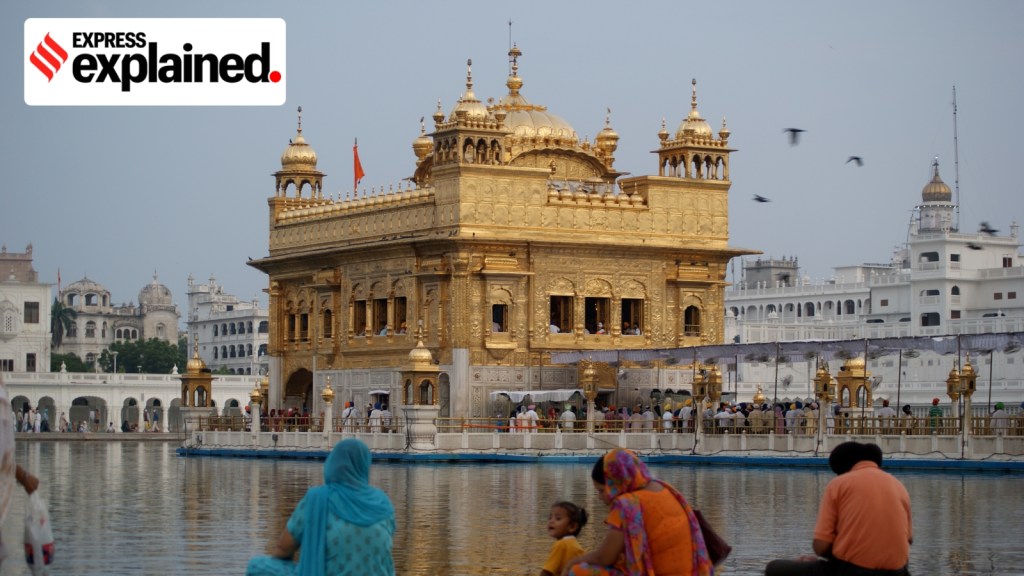 The Shiromani Gurdwara Parbandhak Committee manages historic Sikh gurdwaras, including Sri Harmandar Sahib (the Golden Temple in Amritsar). Photo: Wikimedia Commons


 Share


