
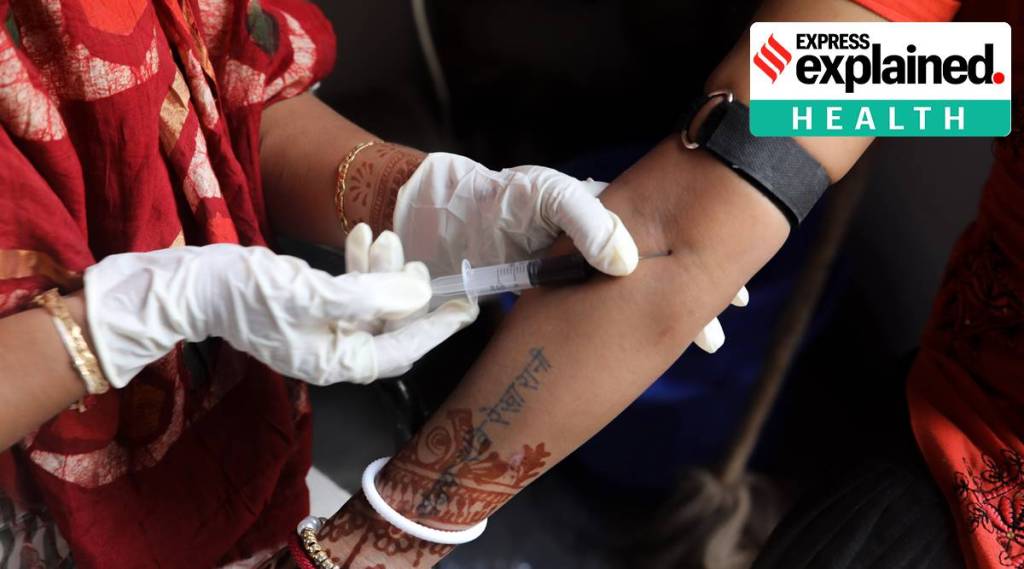
What are seroprevalence studies, and why are these numbers so much higher than the number of confirmed cases reported nationally?
Seroprevalence studies (or serosurveys) estimate the share of the population that test positive for antibodies using serology tests. The presence of a specific antibody in a sufficiently high concentration will suggest that the tested person was previously infected. Typically, such studies test individuals who are selected at random using sampling techniques that will allow scaling the results to the general population. You do not need to test everyone, or even a majority of the population —what we need is a randomly drawn set of individuals, provided that those who agree to participate in the test are not somehow systematically different from those who refuse.
Sometimes readers think we need very large samples to have an estimate that is not biased — this is not true. We might, however, need large samples to achieve precision. Think of throwing darts at a board; if my arm always sways a bit to the right, many more of my darts might end up on the right side of the board. This is bias. Precision, on the other hand, refers to whether I can throw my darts so that they hit the same area consistently without a big spread. Precision is desirable because it helps us check whether the estimates from one study overlap with findings from another or not. If two studies result in very imprecise estimates, it is hard to tell them apart. With a large number of observations, one can get more precision, but that does not rule out bias.

The difference between nationally reported numbers and those from serosurveys comes, at least in part, from the fact that most Covid-19 cases in India have been asymptomatic. Among those with any symptoms, there is significant variation in symptoms. There is also some fear of stigma and threat of quarantine. As a result, not everyone with symptoms gets tested and the number of cases found positive from testing current cases with RT-PCR remains a lot smaller than that from seroprevalence studies.
What can we learn overall from studies in India?
Studies in large urban centres in India, including ones that my co-authors and I did in Mumbai as well as other studies in Pune, Delhi and Hyderabad, suggest that large shares of the population in these cities had antibodies — which means they had been infected. Our recent IDFC Foundation study in Karnataka, which was led by my co-authors Anup Malani (UChicago), Anu Acharya (Mapmygenome) and Kaushik Krishnan (CMIE) and me, found that over 44% of rural areas also had antibodies. With an infectious disease that is spreading rapidly, the share of the population that has antibodies will rise over time. This is expected. The pace of spread is a function of interaction between people, the level of precautions taken, and how many people are currently infected. Results from the state government in Karnataka from a few weeks ago show that almost 13% of individuals tested with RT-PCR were positive with a current infection. Recall that most of these are likely asymptomatic. If each one gets just one more person infected, almost a quarter of the population would be infected in just a couple of weeks even if you started with zero cases before the 13% got infected. 📣 Express Explained is now on Telegram
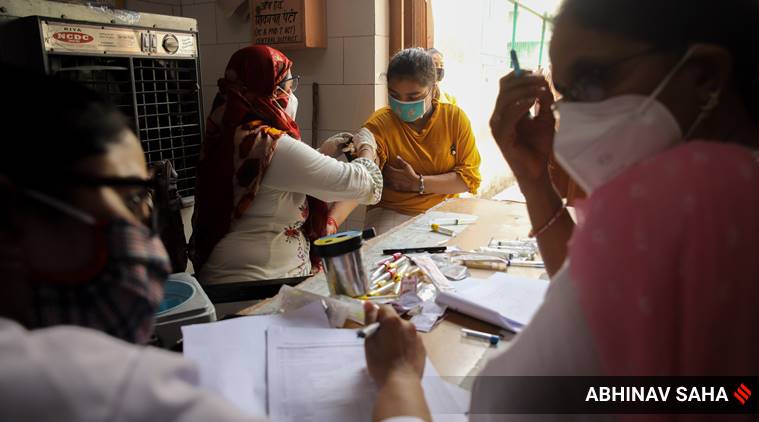 Health workers collect blood samples in Majnu Ka Tila in New Delhi (Express photo by Abhinav Saha)
Why do the second rounds of serosurveys sometimes give lower numbers than the first?
There could be several reasons why second-round surveys in the same population might show lower numbers. One explanation could be that some people might not want to give blood again for a study after knowing results from the previous time, so the study might end up sampling from those who did not want to participate in the first round. In addition to concerns of non-random selection, we have seen reports from several studies about antibodies decreasing over time. Antibodies are what the body produces when it fights an infection. Once the infection passes, there is no need for the body to produce it continuously, so a decline is normal in this sense. That doesn’t mean there are no antibodies at all, even if the concentration is lower than what is considered “positive” on a lab test for antibodies. More importantly, the waning antibodies doesn’t mean the body is susceptible to another infection immediately. Scientists are also studying whether there are other mechanisms of the body’s immune system that might provide long-term immunity after recovering from a Covid infection.
Don’t miss from Explained | Models throw light on venues triggering most COVID-19 infections
Why do different studies from the same state or city show different numbers on prevalence?
Different studies often use different sampling methods and different testing methods. For instance, researchers at Translational Health Science and Technology Institute reported that the serology test developed by them was 20% more sensitive (which means the test will show a positive result if the sample has antibodies) than the Covid Kavach test kit. Such differences can create a wedge in findings unless studies are able to adequately adjust for sampling methods and test accuracy when making predictions. Beyond this, studies often have different timeframes. With a rapidly evolving epidemic, estimates can vary significantly within just weeks. Based on numbers reported in the Karnataka government’s recent study, 12% of the population was currently positive on RT-PCR; hence seroprevalence is expected to increase by almost 12% in just over a week for antibodies to be detectable.
 There is still value to conducting testing in random, population-representative, samples — especially in parts of the country where the epidemic is still spreading rapidly (Express photo by Abhinav Saha)
Why is there so much variation between different parts of a city or state?
There is little reason to expect that the estimates of seroprevalence will be identical in various parts of a state or a city. For instance, early studies in Mumbai found that a rapidly spreading infectious disease will almost certainly spread differently in different parts of the state based on when it was seeded, the level of mobility and interactions, the density in these areas, and whether people follow masking and distancing precautions.
If seroprevalence is higher than 50-60%, what does that mean for herd immunity? Can we go back to normal life now?
Three things are clear from studies so far. First, the Covid-19 epidemic has already infected a large share of India’s population, if not a majority. Second, the epidemic has affected rural areas in almost equal measure. Contributing factors include the large migration from urban to rural areas during the lockdown, as well as lockdown restrictions that were less stringent relative to urban areas. Third, even if seroprevalence in some parts of the country is expected to be over 50%, it is too soon to infer that the remaining individuals will be protected or whether those infected previously will be immune for a long time. In fact, one concern is that if everyone drops their guard assuming herd immunity is here, there are a lot of people who are likely to get infected and possibly sick in a very short period of time. India has experienced a rather fortunate turn of events so far with the healthcare system not getting overwhelmed with caseloads from Covid. It is hence critical to continue to practise masking, handwashing, and physical distancing even as most parts of the country start resuming economic activity slowly.
 Health department team at Jawaharpur (Express Photo)
Is there any value to doing more testing at this point?
A testing strategy that focuses on symptomatic cases is appropriate in the clinical setting, where the doctor needs to know what the patient suffers from, and information from the test will determine the course of treatment. This is not the situation we find ourselves in. Instead, the challenge is one of public policy, not of clinical decision-making. There is still value to conducting testing in random, population-representative, samples — especially in parts of the country where the epidemic is still spreading rapidly. From a policy perspective, it can be immensely helpful for governments to learn where there are hotspots of infection so they can act quickly to limit large scale transmission in those areas while other areas can continue to be economically active. This kind of targeted suppression will also ensure that states’ health systems will have the capacity and preparation to deal with surges in demand for healthcare for Covid.
Professor Manoj Mohanan is Associate Professor at Sanford School of Public Policy at Duke University, and also holds secondary appointments in the Department of Economics and the Global Health Institute. An applied microeconomist working in health policy and global health, he is working on research projects in India, Kenya and China. He is one of the authors of a serosurvey that concluded that 54% of Karnataka’s urban population and 44% of its rural population had been exposed to the novel coronavirus by August.

 Share


