Olga Smirnova, the prima ballerina of the Bolshoi Ballet, one of the world’s leading classical ballet companies in Moscow, has quit to protest Russia’s invasion of Ukraine. “I am against war with all the fibres of my soul,” the dancer said in a post on Telegram. She has defected to the Netherlands, where she will perform with Dutch National Ballet in Amsterdam.
Earlier this month, David Motta Soares from Brazil and Jacopo Tissi of Italy, who were among the top solo dancers at Bolshoi Ballet, had also quit as the war in Ukraine raged.

Who is Olga Smirnova?
Olga Smirnova captured imaginations when she performed on stage. In 2013, when Smirnova was 21, The Guardian reviewed her performance by calling her “the company’s newest, brightest star…awesome”. “Tall and amber-eyed, with a regal set to her head, expressive arms and long swayback legs, she is the physically perfect instrument of her art form. To this, add a restraint and purity of line which makes all that uber-dancing that so many ballerinas have fallen prey to in recent years – all those oversplit jetés and arabesque penchées, all those music-blurring hyperextensions – look overblown and passé,” said the newspaper. Since then, her oeuvre has been including complex productions such as Anna Karenina, Swan Lake, The Taming of the Shrew and Giselle. In 2016, she was appointed prima ballerina of Bolshoi Ballet.
Smirnova graduated from Vaganova Academy, where she had been trained by Ludmila Kovaleva, a master and the moving force behind some of the top ballet performers across the world.
In an interview with Vaganova Today, Smirnova said that she was “proud to be a Bolshoi Theatre prima ballerina”. “It’s a very special feeling to dance on its world-famous stage. I feel it’s great that the theatre can afford to mount large-scale classical productions, involving large numbers of soloists and corps dancers, and that we are so conscientious about preserving our classical heritage. While maintaining my classical repertoire, I also have opportunities to take part in new creations and modern works, and to work directly with the greatest choreographers of our time,” she said.
She also said that she was “a responsible person who likes to plan ahead and set clear goals for herself, over time I have also learned to enjoy the moment, to cherish what I have today and the memories that it will bring to me later”.
Now, events appear to have forced her hand.
The dancer, who has a Ukrainian grandfather and grew up in St Petersburg before moving to Moscow to perform, calls herself one-quarter Ukrainian. “In a modern and enlightened world, I expect civilised societies to resolve political matters only through peaceful negotiations. I never thought I would be ashamed of Russia, I have always been proud of talented Russian people, of our cultural and athletic achievements. But now I feel that a line has been drawn that separates the before and the after. It hurts that people are dying, that people are losing the roofs over their heads or are forced to abandon their homes. And who would have thought a few weeks ago that all of this would happen? We may not be at the epicentre of the military conflict, but we cannot remain indifferent to this global catastrophe,” she has said.
What’s next for Smirnova
The Dutch National Ballet has said they were welcoming Smirnova with “open arms”. She will appear with them as the heroine of Raymonda, a grand ballet in three acts by Marius Pepita, in Amsterdam on 3 April.
Other artists who have quit
Since the war began artists in Russia, across genres, have been vocal in their opposition despite this being considered an act of treason that could attract heavy penalties, including years of imprisonment, in their country.
A star late-night chat show host, Ivan Urgant, was taken off air after he put up an Instagram post with the caption “Fear and pain. No to war”.
Some cultural organisations have taken steps to silence their members, such as the Mayakovsky Theater in Moscow that has reportedly issued a gag order to its artists – they are not allowed to comment on the invasion.
Yet, artists such as Elena Kovalskaya, the director of another state-financed Moscow-based theatre Meyerhold Center have been making their voices heard. “It’s impossible to work for a murderer and receive your salary from him,” she said. In the past weeks, 79-year-old Russian conductor Thomas Sanderling, who was the head of the Novosibirsk Philharmonic Orchestra, also decided to quit, adding that he was also opposed to the total ban on all forms of Russian art and artistic activity.
For Tugan Sokhiev, the music director and principal conductor of Bolshoi Theatre, however, the war and the call for him to register a protest amounted to great pressure. He quit from his position at Bolshoi Theatre and from Orchestre National du Capitole de Toulouse in France. “People were waiting for me to express myself and to hear from me my position on what’s happening at the moment,” he said in a statement, adding that he was being compelled to choose between “my beloved Russian and beloved French musicians”. Though he said that he would never support any form of violence, Sokhiev stopped short of denouncing the war.
On the other hand, the New York Metropolitan Opera has sacked Anna Netrebko, a star soprano, as it cuts ties with performers and arts organisations from Russia “until the invasion and killing has been stopped, order has been restored, and restitutions have been made”.
Newsletter | Click to get the day’s best explainers in your inbox

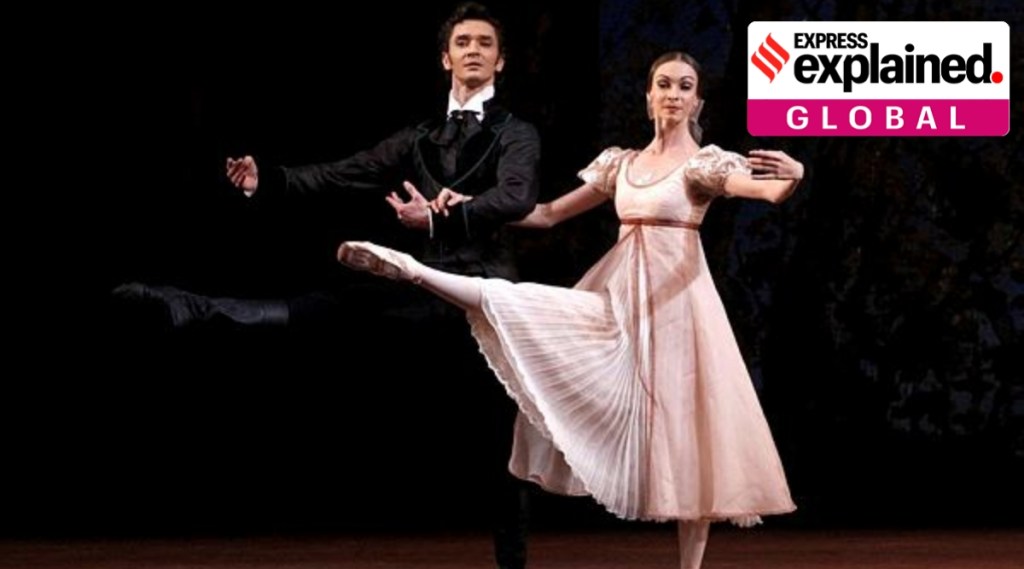 Dancers Olga Smirnova (R) in the role of Tatyana and Vladislav Lantratov in the role of Onegin perform during a media preview of the ballet "Onegin" at the Bolshoi Theatre in Moscow, July 10, 2013. (Reuters)




 Share


