4 min readNew DelhiJul 16, 2020 07:09 AM IST
First published on: Jul 15, 2020 at 12:10 PM IST
 Ashok Gehlot and Sachin Pilot in New Delhi in 2019. (Express Photo: Anil Sharma)
Rajasthan government crisis: Late on Tuesday (July 14) night, Rajasthan Assembly Speaker C P Joshi issued notices to 19 rebel Congress MLAs including Sachin Pilot on a petition seeking their disqualification by the Congress.
Pilot had been sacked as Deputy Chief Minister and chief of the Rajasthan Pradesh Congress Committee after he and his supporters failed to attend meetings of the Congress Legislature Party for two consecutive days.
The battlelines are now clearly drawn in the Rajasthan Congress. The BJP is watching and waiting for its opportunity to strike. (Follow live updates on the Rajasthan political crisis)
What does the notice issued to Sachin Pilot and his supporters by the Rajasthan Speaker indicate?
There are two main takeaways.
First, the move clears all speculation about the exact number of MLAs who are with Pilot.
Second, it shows that the numbers game in Rajasthan is much closer than what it had been assumed at the beginning of the crisis — even though Chief Minister Ashok Gehlot continues to have a slight edge.
Rajasthan Chief Minister Ashok Gehlot addresses the media in Jaipur on Tuesday, July 14, 2020. (PTI Photo)
How many MLAs does the Congress have now?
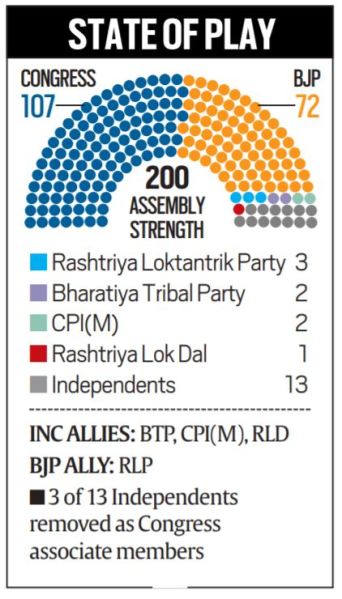
The Congress had won 100 seats in the Assembly elections of December 2018. The party won one seat (Ramgarh) later in a by-election, which took its tally to 101. Subsequently, six MLAs of the BSP joined the party, taking its tally to 107.
With the issuing of the notices to 19 MLAs, the strength of the Congress in the Rajasthan Assembly now effectively stands at 88.
Also read | What next in the Rajasthan government crisis?
What does Chief Minister Ashok Gehlot say?
Gehlot claims the support of Independents and members of the smaller parties, and says that he still has the majority in the 200-member House.
But although he has claimed the support of 109 MLAs, the fact that 19 MLAs are with Pilot shows that he will have to depend heavily on the 13 Independents and MLAs of smaller parties like the BTP and the CPM to win in the event of a trial of strength in the House.
And can he be sure that MLAs of these smaller parties will support him?
There is still confusion on whose side the two BTP MLAs are.
It also remains to be seen whether the two CPM MLAs will vote for Gehlot or abstain in the event of a trial of strength. The CPM had suspended its MLA and legislature party leader Balwan Poonia from the party for a year for violating party discipline by voting in favour of the Congress candidate in the recently held Rajya Sabha elections.
How do the numbers stack up on the side of the BJP, then?
The BJP has 72 MLAs of its own, and has the support of the 3 MLAs of the Hanuman Beniwal-led Rashtriya Loktantrik Party, which takes its tally to 75. If the BJP sees an opportunity to topple the government, it can be expected to pull out all the stops to try to do so.
The 19 Congress MLAs have been given time until Friday (July 17) to reply to the Speaker’s notice. But they can challenge the notices served on them in court, either before or after that date. That will add a new dimension to the power struggle.
Should the disqualification process get stayed by a court order, and there is a trial of strength in the Assembly, the numbers game will become tight for Gehlot.
📢 Express Explained is now on Telegram. Click here to join our channel (@ieexplained) and stay updated with the latest
That is because the Congress rebels may go with the BJP, and the saffron party will then have, along with Beniwal’s three MLAs, 94 votes in the Assembly.
And the fortunes of Gehlot (88) will then depend solely on the 13 Independents and the MLAs of the smaller parties.

 Ashok Gehlot and Sachin Pilot in New Delhi in 2019. (Express Photo: Anil Sharma)

 Rajasthan Chief Minister Ashok Gehlot addresses the media in Jaipur on Tuesday, July 14, 2020. (PTI Photo)



 Share


