
According to estimates based on hybrid seed sales of maize in Punjab this year, nearly 3.03 to 3.23 lakh hectares may have come under spring/summer maize cultivation in Punjab — the highest-ever estimated area under the crop in the state. This marks a sharp jump from last year, when around 1.92 to 2.02 lakh hectares were estimated under the crop and around 1.50 lakh hectares in 2024.
Experts warn that Punjab may now be unknowingly moving towards two consecutive water-intensive crops — spring maize followed by paddy — at a time when nearly 80% of the state’s groundwater blocks are already overexploited or categorised as “dark zones”.
So, what explains the rise of such cultivation despite scientific concerns, and what is the government doing about it? Here’s what to know.
Why spring/summer maize is a major concern
The area under spring/summer maize has increased manifold in Punjab during the past few years, even though the crop is not officially recommended by Punjab Agricultural University (PAU), Ludhiana. Agriculture experts say the crop has quietly expanded from barely 25,000-35,000 hectares some years ago to over three lakh hectares now.
This year alone, sources in PAU estimate that nearly 3.04-3.24 lakh hectares may have come under spring/summer maize cultivation. The Punjab government, however, does not officially record this area because the crop is not considered part of the state’s recommended cropping system. Still, the field reports of Punjab’s Agriculture Department suggest that 96,500 hectares was recorded until last week and the final field survey reports are yet to come.
Ajai Rana, chairman of the Federation of Seed Industry of India, said: “Around 6,000 tonnes of hybrid spring/summer maize seed were sold in Punjab this year. Since about 8 kg seed is required per acre, this quantity is sufficient to cover nearly 7.5 lakh acres (3.04 lakh hectares).”
Most hybrid maize seed sold in Punjab comes from large private companies because Punjab itself hardly produces hybrid maize seed, a senior scientist at PAU said on the condition of anonymity. Last year, around 3,800 to 4,000 tonnes of seed was sold.
Where Punjab stands on spring/summer maize
Punjab Agriculture Minister Gurmeet Singh Khuddian told The Indian Express that he was aware of the scale of spring/summer maize cultivation. He said that the government generally records the area under kharif and rabi crops, whereas crops grown during spring/summer are usually not included in regular official crop records.
Khuddian added that the Agriculture Department has been making consistent efforts to increase the area under kharif maize and is also providing incentives to farmers adopting maize cultivation in place of paddy as part of the state’s crop diversification programme.
“At the same time, farmers are repeatedly being advised to avoid water-guzzling crops like spring/summer maize, but many are still looking at short-term gains without worrying about the long-term impact on groundwater depletion,” he said. On the rapidly falling water table in Punjab, he said: “If tomorrow there is no water left, what will they or their future generations do?”
A farmer near Chunni Kalan drying and spreading his maize crop at Grain Market Kharar, Punjab. Photo: Jasbir Malhi
Experts warn that this expansion is a “red flag” because spring maize is being followed immediately by paddy cultivation, resulting in two consecutive water-intensive crops in a state already facing severe groundwater depletion. PAU discourages spring/summer maize mainly because it is a highly water-consuming crop grown during the hottest months of the year — from February to June.
Traditionally, spring maize used to be sown in February after potato harvesting and harvested by May-end or early June. However, many farmers are now sowing it even till March-end, pushing harvesting to late June or early July. Immediately after harvesting maize, farmers transplant paddy varieties.
Scientists say spring maize can require 15 to 19 irrigations depending on sowing time, heat waves and soil texture. After that, paddy requires another 21 to 25 irrigations for short-duration varieties and nearly 28-30 irrigations for long-duration varieties. “Punjab cannot afford two back-to-back water-guzzling crops,” said the senior PAU scientist.
Why farmers are growing a water-guzzling crop
The biggest reason is profitability: between kharif and rabi crops, they want to take a third profitable crop in the form of spring/summer maize.
While kharif maize generally produces around 22-25 quintals per acre (1 acre = 0.4 hectare), spring maize can yield nearly 40-50 quintals per acre under good management. Farmers earn significantly higher returns between Rs 40,000 to 50,000 per acre after meeting expenses, despite the heavy irrigation requirement and lower rates.
Out of nearly 3.24 lakh hectares, nearly 60,000 to 80,000 hectares might be used for making silage, which is also called pashuan da achar (pickle of cattle) — a process of fermenting and storing green fodder for cattle. Currently, Punjab has nearly 200 to 250 commercial silage-making units, even supplying to several states.
Maize grown for silage is harvested weeks before it fully ripens. According to an expert, such maize can be grown in areas “where the water table is not very low”, as not just the number of irrigations would be less owing to early harvesting but also the area itself.
For years, Punjab has promoted kharif maize — sown during the monsoon season and harvested in October — as an alternative to paddy because it requires much less irrigation due to rainfall support. But the area under kharif maize, which is sown and harvested alongside paddy in Punjab, has remained stagnant between 90,000 and 1.30 lakh hectares for over a decade.
Experts say farmers are reluctant because kharif maize gives lower yields and lacks assured procurement, like minimum support price-assured paddy. Farmers are thus shifting towards more profitable crops like spring maize followed by paddy despite its heavy impact on groundwater.
Punjab already has over 3.2 million hectares under paddy cultivation every year, and nearly 80% of its groundwater blocks are categorised as overexploited, dark, or critical zones. Experts warn that the rapid expansion of spring/summer maize is quietly worsening the groundwater crisis because the crop depends mostly on tube-well irrigation during peak summer months.
Scientists are concerned that while the government officially pushes crop diversification, the unchecked growth of another water-intensive crop outside official records may ultimately defeat the entire purpose of reducing pressure on Punjab’s depleting water table.

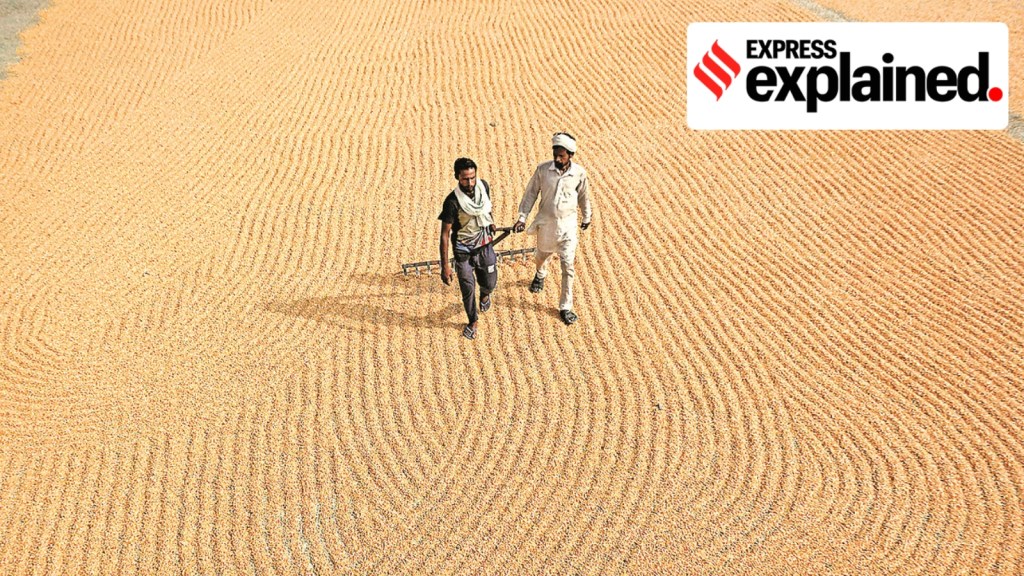 Workers dry maize in the sun at the grain market in Jalandhar on June 20, 2020. Photo: PTI

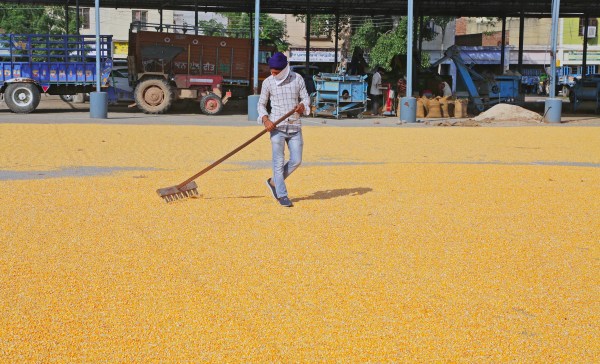 A farmer near Chunni Kalan drying and spreading his maize crop at Grain Market Kharar, Punjab. Photo: Jasbir Malhi

 Share


