Although DSR is being projected as a major water-saving and labour shortage solution, scientists are increasingly raising a difficult question: can Punjab save groundwater at the cost of increasing chemical dependence and potential deterioration of soil health?
Punjab’s push for direct-seeded rice
Punjab’s groundwater situation has become alarming after decades of intensive paddy cultivation. Traditional puddled transplanted rice requires continuous flooding of fields for 7-8 weeks after transplantation. This consumes massive quantities of groundwater, especially in central Punjab districts where paddy cultivation dominates.
DSR changes the method entirely. Instead of transplanting nursery-grown seedlings into flooded fields, seeds are directly sown into moist soil using seed drills. Since the field is not continuously flooded during the early growth period at least for three weeks, irrigation demand declines significantly.
According to scientists from Punjab Agricultural University (PAU), Ludhiana, DSR can reduce water consumption by approximately 15-20% in Punjab’s conditions. It also reduces labour dependency, which has become another major challenge in Punjab agriculture due to rising labour costs and shortage of migrant workers during peak transplantation season.
Weeds remain the biggest challenge
Yet the very factor that helps DSR conserve water also creates its biggest agronomic problem.
Unlike conventional transplanted paddy fields, where standing water naturally suppresses weed growth, DSR fields remain relatively dry or moist during the first few weeks. This creates ideal conditions for weeds to germinate simultaneously with rice plants.
Agricultural experts say DSR fields witness the growth of multiple weed categories including grasses, sedges, broadleaf weeds, and even “weedy rice,” which resembles cultivated rice and is difficult to identify and control.
Some commonly reported weeds in Punjab include swank, madhana, chini gha, takri gha, mothas and paddy motha. In several districts, especially Pathankot, weedy rice has emerged as a serious concern because it directly competes with paddy plants and significantly reduces yield.
According to the 2025 research paper “Weed Dynamics and Control Measures in Direct-Seeded Rice” published in the International Journal of Research in Agronomy, weeds in DSR can reduce crop yields anywhere between 15% and 100% depending upon infestation intensity and weed-management practices. The study described weed management as one of the “biggest challenges” in DSR cultivation systems.
Because weeds emerge aggressively during the initial crop stage, herbicides become central to DSR cultivation.
 The continued expansion of paddy cultivation has aggravated water scarcity issues in Punjab, which is already grappling with depleting groundwater. Photo: File
In their joint paper titled “Tar-Wattar DSR: a solution to Labour Problem”, Jasvir Singh Gill and Makhan Singh Bhullar of the Department of Agronomy, PAU Ludhiana, recommended the spraying of the herbicide Stomp/Bunker 30 EC (pendimethalin) “at 1.0 liter/acre in 200 liters of water, in a moist field, immediately after sowing”. The paper explains that the herbicide effectively controls annual grass weeds and small-seeded broadleaf weeds during the early crop stage.
Apart from pendimethalin, several post-emergence herbicides are also recommended depending upon weed intensity and weed type. These include Nominee Gold, Ricestar, Almix, Vijaya, and Counsil Active formulations.
Experts say that unlike conventional puddled paddy — where flooding itself acts as a weed suppressant for nearly a month — DSR requires repeated and highly precise weed-management interventions.
Is Punjab saving water while increasing chemical load?
This is now emerging as one of the most debated questions surrounding DSR. While the technology undoubtedly helps conserve groundwater, scientists and researchers are increasingly examining whether excessive dependence on herbicides could create long-term ecological problems.
The concern becomes even more significant because pendimethalin — considered almost mandatory for successful DSR weed control — has been under regulatory scrutiny.
The Central government had included pendimethalin among a list of pesticides proposed for phase-out or ban due to toxicity-related concerns. Experts have pointed out that the herbicide can persist in soil for several weeks after application and is toxic to aquatic life.
Scientists from PAU have clarified that more studies are needed regarding its long-term impact on soil ecology and environmental systems.
Soil health risks
The 2025 paper on weed dynamics examined that despite being promoted as a major water-saving technique, DSR is becoming increasingly dependent on herbicides because weeds germinate alongside rice plants in non-flooded fields. It warned that continuous reliance on herbicides could adversely affect soil biology over time.
According to the researchers, excessive herbicide residues may interfere with soil microbial activity and reduce the biodiversity of beneficial microorganisms that play a crucial role in nutrient cycling, decomposition of organic matter, and maintenance of soil fertility.
The paper noted that repeated herbicide use may gradually weaken natural biological processes that sustain long-term soil productivity.
Researchers also warned about the emergence of herbicide-resistant weeds: a problem already reported in several agricultural regions globally. Continuous use of the same chemical formulations allows certain weed species to evolve resistance mechanisms, forcing farmers to apply stronger doses or multiple herbicide combinations over time. This creates a cycle of increasing dependence on chemicals.
The study further cautioned that sustainability cannot be judged solely on the basis of water savings.
Overuse the bigger risk
Another serious concern in Punjab is not merely herbicide usage, but overuse. Agriculture department officials have repeatedly observed that many farmers apply pesticides and herbicides in quantities higher than officially recommended doses.
One senior agriculture officer pointed out that if Punjab witnesses 5 lakh acres under DSR, the recommended pendimethalin requirement would be 5 lakh litres. However, actual consumption could rise substantially higher because of excessive or repeated applications. Such trends raise concerns not only about soil contamination but also about groundwater quality and ecological balance.
Interestingly, PAU scientists themselves have acknowledged that alternatives need to be developed. Bhullar has suggested that if pendimethalin is banned in future, farmers may adopt traditional stale seedbed practices involving double pre-sowing irrigation (rauni). Under this method, weeds are first allowed to germinate after irrigation. They are then uprooted through light cultivation before sowing.
The process may be repeated to reduce weed pressure further before final DSR sowing. Farmers can subsequently rely more on manual weeding if needed.
The 2025 paper also strongly advocated integrated weed management instead of excessive chemical dependence. Researchers recommended combining limited herbicide use, crop rotation, mechanical weeding, mulching, stale seedbed preparation, competitive rice cultivars (cultivated plant), and biological and eco-friendly weed suppression methods.
The study also highlighted emerging research on allelopathic plant residues and beneficial microbial strains that may naturally suppress weed germination.
The larger agricultural contradiction
Punjab today finds itself trapped in a larger agricultural contradiction. On one hand, groundwater depletion has made traditional water-intensive paddy cultivation environmentally unsustainable. On the other hand, the most practical alternative currently available — DSR — depends heavily on herbicides for successful implementation.
Agricultural scientists broadly agree that DSR remains an important climate-adaptive technology for groundwater-stressed states like Punjab.
“Unless weed management becomes chemical-free, Punjab may end up replacing one environmental crisis with another — groundwater depletion with gradual soil degradation and rising chemical stress on ecosystems,” said Devinder Sharma, distinguished agriculture and food expert, adding that the bigger question now is whether Punjab can develop a model of DSR that saves both water and soil together. He said that the system of rice intensification (SRI) technique can be promoted with more research, as it saves water and provides more yield without using chemicals to manage weeds.

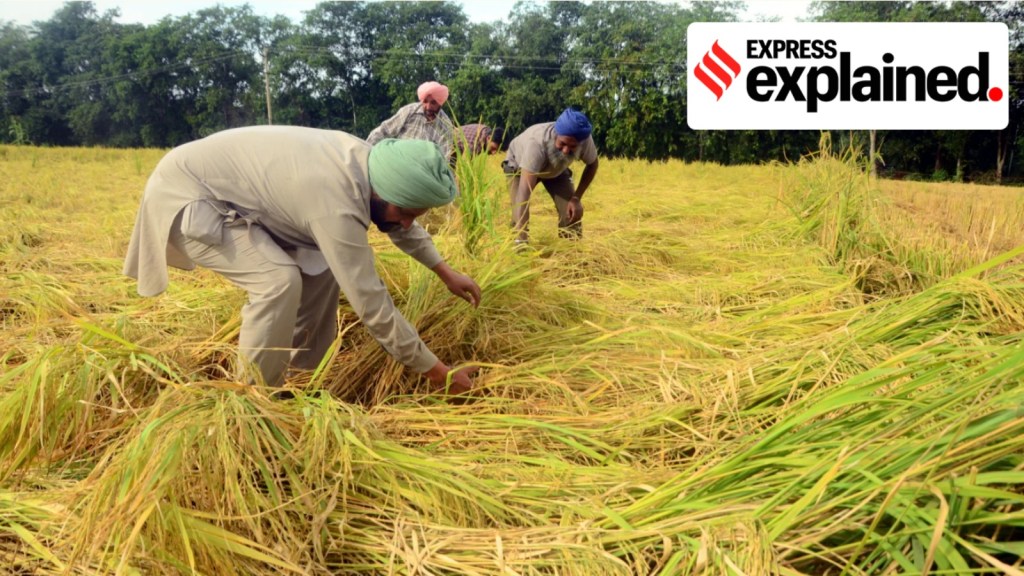 Punjab’s groundwater situation has become alarming after decades of intensive paddy cultivation. Photo: Harmeet Sodhi

 The continued expansion of paddy cultivation has aggravated water scarcity issues in Punjab, which is already grappling with depleting groundwater. Photo: File

 Share


