
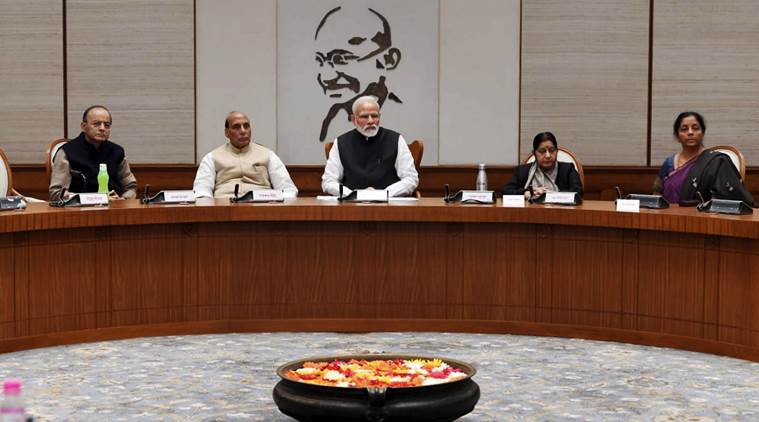
 PM Narendra Modi, Union Home Minister Rajnath Singh, External Affairs Minister Sushma Swaraj, Defence Minister Nirmala Sitharaman and Finance Minister Arun Jaitley during a Cabinet Committee on Security (CCS) meeting to discuss the situation arising after the Pulwama terror attack, in New Delhi. (PTI Photo)
In the beginning, there were traditional wars between India and Pakistan — in 1947- 48, 1965 and 1971. Over the last three decades, we have had a series of military crises — in 1987, 1990, 1999, 2001-02 and 2008 to mention a few—that threatened to blow up into a regular war, but didn’t.
The terror attack in Kashmir that killed 40 CRPF men last month set the stage for a new military crisis that promised to follow the familiar pattern. But New Delhi chose a different response this time — Indian fighter aircraft dropped bombs on a terror camp in Balakot in Khyber Pakhtunkhwa and engaged the Pakistan Air Force in aerial combat for the first time since 1971.

As in 1987, so in 2019, there is an apparent discontinuity in the nature of India-Pakistan military conflict. If Pakistan’s acquisition of nuclear weapons made a big difference in 1987, India’s willingness to call Pakistan’s atomic bluff seems to have broken the mould again.
‘Strategic patience’
But first to nuclear weapons. Many see Pakistan’s nukes as a response to India’s first nuclear test in May 1974 that was called a “peaceful nuclear explosion”. If the nomenclature of “PNE” reflected India’s penchant for self-deception, Pakistan was already on the path to acquiring nuclear weapons.
The trigger for Pakistan’s nuclear programme was the war of 1971 — which led to the transformation of East Pakistan into Bangladesh. To the utter shock of Rawalpindi, its two allies — the US and China — did not or could not stop the Indian Army from assisting in the breakup of Pakistan.
The first order of business for Pakistan’s leader Zulfikar Ali Bhutto, who took charge of a shrunken Pakistan in January 1972, was to put its nuclear weapon programme on fast track. Gen Zia-ul-Haque, who ousted Bhutto in 1977, intensified the nuclear quest and proudly announced in 1987 that Pakistan had accomplished its “atomic mission”. By the late 1980s, Prime Minister Rajiv Gandhi had begun to put together India’s own nuclear arsenal.
Explained: Global diplomacy to de-escalate matters between India and Pakistan
Optimists hoped that the dangers of escalation to a nuclear level would compel India and Pakistan to freeze their conflict and manage their bilateral relations responsibly. But the Pakistan Army leadership had other ideas. It saw the nuclear balance giving it the opportunity to embark on a low-intensity conflict against India by supporting cross-border terrorism.
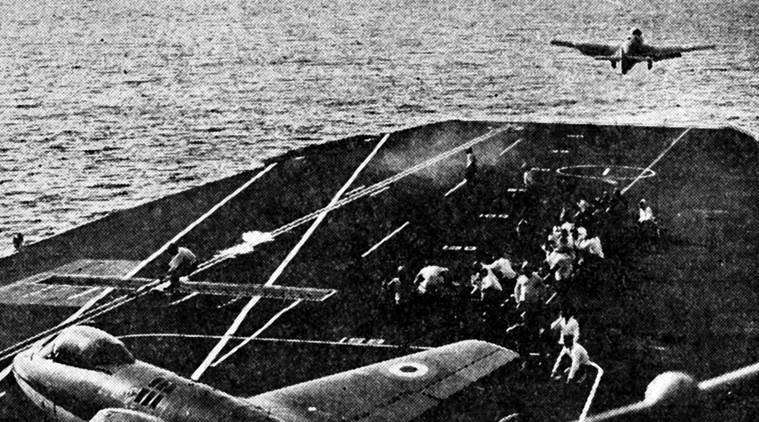 A Sea Hawk taking off from the INS Vikrant deck (1971). (Express Archive)
The Pakistan Army had bet that its atomic quiver had neutralised India’s vast conventional military superiority and given it the freedom to bleed India with a thousand cuts. As Pakistan unleashed terror through outfits like Jaish-e-Mohammad and Lashkar-e-Toiba to target India’s civilians and military, New Delhi seemed paralysed by the nuclear factor and unable to retaliate effectively.
Thanks to the fear of nuclear escalation, New Delhi bought into the dogma that “strategic patience” is better than “military adventurism”. An important part of the dogma was the proposition that the Line of Control in Kashmir was sacrosanct and can’t be crossed under any circumstances.
Even when it had to fight a limited war — for example to vacate Pakistani aggression in Kashmir’s Kargil sector in the summer of 1999 — New Delhi issued strict instructions to the armed forces not to cross the LoC. The same was true for the military confrontation with Pakistan during 2001-2002, following the attack on Parliament.
While the government of Atal Bihari Vajpayee ordered full-scale military mobilisation to confront Pakistan’s support for cross-border terrorism on both occasions, the Manmohan Singh government during its decade-long rule convinced itself that military confrontation with Pakistan did not produce any significant political gains — either in the reduction of cross-border terrorism or in the resolution of political disputes with Pakistan. It decided against a military response to the terror attacks on Mumbai at the end of November 2008.
 Photos show an Army jawan in sugarcane fields of Gurdaspur (1965). (Express Archive)
If India chose the “responsible” path of “nuclear restraint” and respected the “sanctity of the LoC”, Pakistan seemed to revel in the opposite. It hoped that the fear of escalation to a nuclear war would bring the international community to compel India to make major concessions on Kashmir.
‘Offensive defence’
Prime Minister Narendra Modi and his National Security Adviser, Ajit Doval, came with a very different theory — that it is possible to strengthen India’s deterrence against major terror attacks from Pakistan — and a commitment to break out of the constraints imposed by nuclear weapons. They also refused to accept the mythology that there is some kind of “divine sanctity” to the LoC. They note that Rawalpindi’s support for cross-border terrorism means Pakistan does not deify the LoC.
Under Modi, New Delhi adopted the strategy of what some have called “offensive defence”. It has chosen to raise the intensity of its military response to Pakistan’s continuous infiltration of terrorists into Kashmir and step up Army actions beyond the Line of Control. New Delhi also conducted “surgical strikes” in September 2016 against terror launchpads across the LoC in response to an attack earlier that month against an Indian Army brigade headquarters in Uri.
Also read | How Pakistan was nudged to yield in India’s favour
The IAF bombing of Balakot in the early hours of February 26 and its aerial encounter with the PAF the next day are part of the strategy to counter Pakistan’s “nuclear impunity”. Many are worried that Modi’s strategy has increased the danger of the South Asian rivals peering down the nuclear abyss.
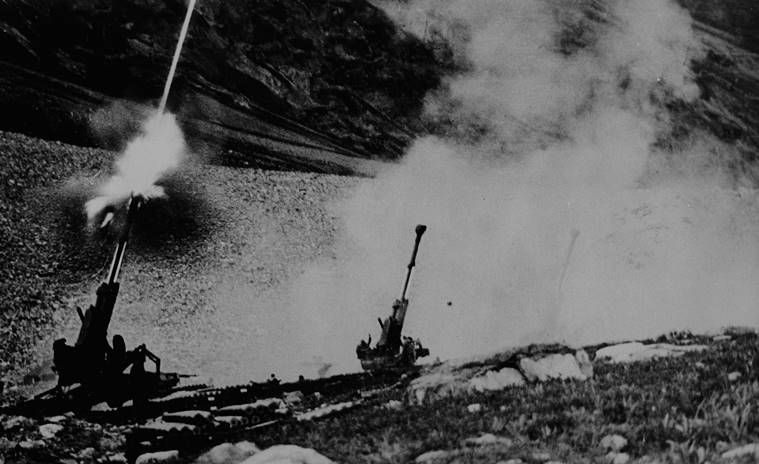 Bofors guns in operation in Kargil (1999). Express archive
But Modi and his advisers might argue that it may be worth exploring where the nuclear brink is rather than resigning forever to the impossibility of countering Pakistan’s terrorism. Unlike its predecessors, the Modi government is not frightened by the talk of international intervention and mediation on Kashmir in the event of escalation.
Modi and his advisers are confident that the global reaction can easily be managed. New Delhi seems to believe that international concerns on escalation can, in fact, be turned into pressure against Pakistan to curb its support for terror. That there has been little international empathy for Pakistan (China is the lone exception) after the Balakot bombing underlines the shifting geopolitical fortunes of India and Pakistan over the last three decades.
In its addiction to nuclear weapons and jihadi terror, Pakistan appears to have forgotten the importance of keeping up with India on the economic front. India’s GDP edging towards $3 trillion today is nearly ten times larger than Pakistan’s at about $300 billion. In its obsessive quest for “strategic parity” with India, Pakistan is beginning to fall behind Bangladesh on economic and social development.
Nuclear weapons certainly changed the military balance in favour of Pakistan at the end of 1980s. Pakistan’s steady but relentless relative national decline may be turning that balance in India’s favour in the early 21st century. This may not immediately lead to India prevailing in the prolonged conflict with Pakistan. Nor will Rawalpindi find it easy to change the policies of the last three decades. We may not know how the present and future crises might end, but there is no question that Balakot has changed the familiar script of India-Pakistan military crises.
This article first appeared in the print edition on March 4 under the title ‘India-Pakistan tensions: How a pattern ended’. The writer is Director, Institute of South Asian Studies, National University of Singapore and contributing editor on international affairs for The Indian Express.
 Share


