
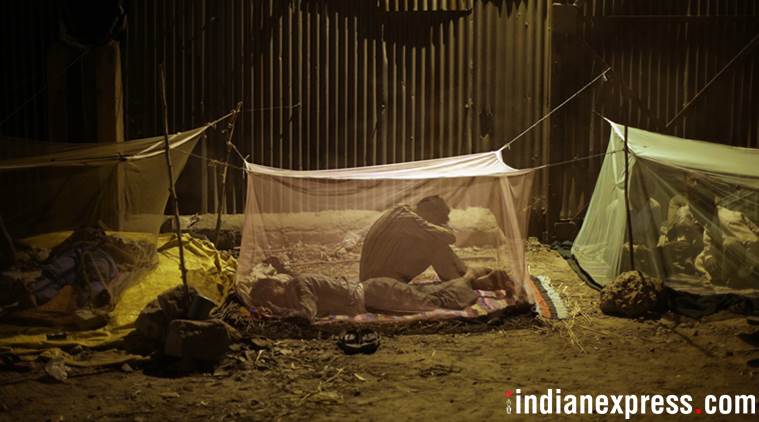
 When social protection schemes were created in India after Independence, most of the country was reeling from famine, de-industrialisation and multiple deprivations. (Express photo by Oinam Anand)
By Shrayana Bhattacharya, John Blomquist & Rinku Murgai
A steady, safe, well-paid job is the best protection against economic hardship. But when this ideal situation is not possible, social protection programs help people become more resilient to risks. Typically, a comprehensive social protection system requires three types of instruments to work together.

* First, promotional instruments invest in the ability of families to survive shocks on their own — by enhancing productivity, access to job opportunities and incomes through human capital infrastructure, wage legislation, labour policies, skills training and livelihood interventions.
* Second, preventive instruments aim to reduce the impacts of shocks before they occur by enabling households to use their savings from good times to tackle losses in tough times. This is mainly done through social insurance programs.
* Third, protective instruments mitigate the impacts of shocks after they have occurred through tax-financed redistribution from the non-poor to the poor. These programs would classically be called anti-poverty measures as they target social assistance or safety net programs to the poor or destitute, whether in kind or cash.
Also read | In election year, why difference between schemes and systems matters
When social protection schemes were created in India after Independence, most of the country was reeling from famine, de-industrialisation and multiple deprivations. Half the population was chronically poor, the country had an aggregate food deficit, financial and banking networks were underdeveloped, growth rates were weak, and technology available for program administration was rudimentary. Therefore, India’s policymakers focussed almost exclusively on anti-poverty, protective instruments.
But that India no longer exists, and the country’s social protection system needs to evolve and catch up with the needs of its new demography and risk profile. Analysis of the latest available data from 2012 highlight three stylised facts that are important to guide this evolution.

* First, despite the dramatic fall in households below the poverty line to 22%, the challenge of chronic poverty remains. Despite a decline in poverty levels, India shelters pockets of deep poverty and these households are geographically clustered. A significant 15% of households that were poor in 2005 remained poor in 2012. That’s 37 million households — the population of Germany.
* Second, inequality across locations and demographic groups has increased. The poverty rate of six of the poorest states in the country is twice that of other states. Seven low-income states — Chhattisgarh, MP, UP, Odisha, Jharkhand, Rajasthan, and Bihar account for 45% of India’s population but nearly 62% of its poor — continue to need strong safety nets programs. Within states, poverty and vulnerability remain highest amongst Adivasis. Women are largely missing from the workforce, and face serious risks to their mobility and well-being.
* Third, the majority of India is no longer poor. Instead, half of India is vulnerable. These are households that have recently escaped poverty with consumption levels that are precariously close to the poverty line, and remain vulnerable to slipping back. Programs must ensure that those who’ve escaped poverty are able to sustain improvements.
As families move out of poverty and the middle class grows, social protection programs can no longer be singularly focused on chronically poor households. In 2016, while traditional safety nets such as the Public Distribution System (PDS) expended $16 billion, the life and accident insurance programs spent less than $16 million together. Programs such as PDS and MGNREGS still constitute half of social protection spending in the country.
It’s critical that programs help those vulnerable to poverty to anticipate and manage risks and shocks better, not only attempt to provide aid to relieve deprivations experienced by the poor. Three types of portable tools are needed to prevent the new vulnerable class from falling back into poverty and debt traps — health insurance, social insurance (in case of death, accident and other calamities) and pensions. Portability is key to ensure migrants receive support while they try to build new lives in new places, as state governments often use residency criteria to target benefits.
At present, only 4% of households in India use government social insurance programs. Use of private sources of insurance is higher, particularly for wealthy households. IHDS 2012 data show that 27% households report members using/benefitting from private insurance. Unsurprisingly, the bottom 20% report very low uptake of private options for market-based insurance. Most Indian households — poor and non-poor — rely on personal savings to deal with health, accidents, or climate shocks. Micro surveys and administrative data also highlight major gaps in pension and health insurance coverage.
Recent policies have taken steps in the right direction. The boost in crop insurance, new pension plans for the elderly, the rise in contributory pensions for those who have the wherewithal to save, and larger coverage of health insurance programs will help India re-balance its social protection architecture to match the needs of the rising numbers of its vulnerable people.
However, the need to re-balance the mix of programs between protection and prevention may not require a dramatic change in the current umbrella social protection budget. Given the huge diversity in the economic profile of India’s states, a variety of approaches will be called for.
For instance, the needs of the rising middle class with access to private insurance markets in Delhi and Maharashtra will differ markedly from the needs of poorer states such as UP and Bihar. Delhi should be enabled to spend its centrally allocated social protection resources differently from UP. In states where many poor and vulnerable households are still not able to save enough to insure themselves against crises or times of high prices, social assistance will remain a core intervention. In low income states, anti-poverty programs such as PDS or MGNREGS, if implemented well, can serve twin goals of protection and prevention by ensuring India’s vulnerable don’t become poor, and that the poor live with dignity during times of drought or food price inflation.
Effective safety nets can dramatically reduce the number of poor and the likelihood that poverty will be transmitted from one generation to the next. Strengthening their delivery systems is key, while allowing state governments to choose the optimal mix of preventive and protective programs to suit their state’s needs within an umbrella social protection budget.
If insurance coverage is adequate and expands, many families would not need to rely on safety net transfers in the face of old age or health crises which would otherwise push households into long-term poverty and debt traps. Thus, an increased emphasis on interventions that help anticipate risks should be expected, particularly in medium- and high-growth states.
India is no longer a largely chronically poor country but a more unequal and vulnerable country with pockets of deep poverty. India’s future shared prosperity will depend to a large extent on how its social protection system evolves and catches up with its diversity and demography.
Bhattacharya is Senior Social Protection Economist; Blomquist and Murgai are Lead Economists, The World Bank.
 Share


