
Explained: Why ultra-Orthodox Jewish sects are more vulnerable to Covid
When the COVID-19 outbreak surfaced, many in the ultra-Orthodox Jewish community suddenly found that the epidemic was at their doorstep. Why was there a spike in infection numbers among members of the community?
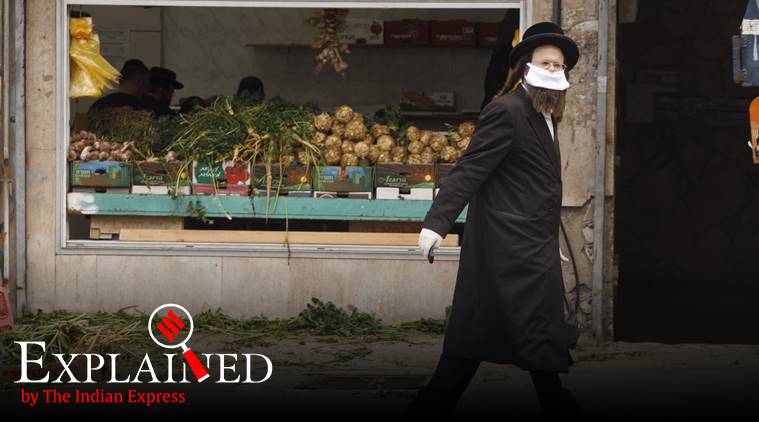 A man wearing a protective face mask walks past a grocer selling fresh vegetables during lockdown in the city of Bnei Brak, Israel, on Monday, April 6, 2020. (Bloomberg: Kobi Wolf)
Three weeks after Israel marked its first COVID-19 infection on February 21, the country witnessed a spike in infections particularly in the densely populated city of Bnei Brak, where there is a large population of Orthodox and ultra-Orthodox Haredi Jews.
The government had begun imposing public health rules and social distancing measures to curb the spread of the infections — and on March 19, Prime Minister Benjamin Netanyahu declared a national state of emergency.

On April 7, Israel’s Health Ministry announced in a report that nearly one-third of the COVID-19 cases in the country had been traced to the cities of Jerusalem and Bnei Brak, concentrated in the ultra-Orthodox neighbourhoods. The Health Ministry recommended isolating the Haredi neighbourhoods to prevent the spread of the infection, which the government later implemented.
News reports and social media content in Israel soon began showing police and security officials struggling with the enforcement of public health and social distancing guidelines in these neighbourhoods, including making arrests of radical Haredi Jews found violating rules.
Videos on various platforms showed that police and security officials were subjected to slurs and accusations, being called ‘Nazis’ and ‘Communists’ by some radical Haredi Jews.
Some other reports showed these altercations becoming physical, and how in some cases, young Haredi boys were retaliating against these public health rules by spitting on officials. Most of these incidents of violence have been recorded in neighbourhoods with large Haredi populations in Jerusalem and in the nearby city of Beit Shemesh.
In New York, where there is a large population of Orthodox Jews, there have also been incidents of conflict between members of the community and police. Local news reports said Orthodox Jewish communities in and around New York were among the first to record COVID-19 infections. Despite the implementation of public health orders in New York, several Jewish weddings and funerals had taken place.
Following the funeral of a prominent local rabbi, New York police had to step in to disperse large crowds of Orthodox Jews. New York City Mayor Bill de Blasio posted on Twitter: “My message to the Jewish community, and all communities, is this simple: the time for warnings has passed.”
Members of the Jewish community felt that they were being unfairly singled out due to the actions of some people in the community. There were also reports of anti-Semetic threats against the community following this incident on social media. Some members of the community believe that the controversy concerning violations of health rules by Orthodox Jews, including their reluctance to vaccinate, is unfairly inflated and highlighted in the news.
Why are Orthodox Jewish communities reluctant to follow government public health guidelines?
According to Prof Benjamin Brown of the Hebrew University of Jerusalem and researcher at the Israel Democracy Institute, who has conducted extensive research on Orthodox Judaism and the ultra-Orthodox Jewish community, this isn’t a case of the community being against health services, but rather that of them simply not being up-to-date with these developments due to their lifestyle and related religious beliefs.
In Judaism, explains Brown, it is a religious commandment that tells people to get medical care and to do everything necessary to stay away from dangers, including potential dangers to health. “All Orthodox and ultra-Orthodox Jews are aware of that and accept that. In their private lives, they all do that. Even during the COVID-19 epidemic, a vast majority of the Haredim did comply with the rules and regulations,” says Brown.
So why then was this spike in infection numbers observed among members of the community? That happened in part due to the lifestyles that the Haredim follow, that are characterised by segregation, them largely containing themselves within their own neighbourhoods and cities.
 Israeli Prime Minister Benjamin Netanyahu declared a national state of emergency on March 19. (Image via Reuters)
How do ultra-Orthodox Jews learn about public health issues?
The ultra-Orthodox Jews also do not use the Internet, smartphones, mass media, social media and other information sources and rely on their own community members for it. Government officials also do not do much to communicate with them.
However, there are some political figures in Israel who are involved with the community. Some within the community too, are more modernised, and do use the Internet and acquire information from newspapers, television and social media to help spread necessary information.
“The Haredim have their own religious authority and religious tenets to follow that these authorities say. Most of them, at least in the main Haredi sectors, are not up to date, are very old and are not very involved in public affairs,” says Brown.
When the COVID-19 outbreak surfaced, many in the community suddenly found that the epidemic was at their doorstep. “Suddenly people say there is an epidemic, and then what do you do? So you go to the religious leaders who are the same and even more so,” says Brown, explaining how religious leaders did not know what it was.
“One of the more prominent leaders, Chaim Kanievsky, had not even heard about the epidemic and he later found out and said “no need to close schools”.
What role did schools and religious gatherings play in spreading COVID-19?
Among Orthodox and ultra-Orthodox Jewish communities, religious schools or yeshivas play an important role, along with Torah learning and public prayers. Boys live in dormitories in close proximity in these yeshivas, with Torah learning taking up most of their time.
When Israel’s government suggested closing these religious schools to curb the spread of COVID-19, it caused consternation among the community members. According to Brown, the resistance to closing these schools also delayed the Israeli government’s response in tackling COVID-19, increasing cases of infections.
“According to Judaism, prayers can be done alone, but the most favourable way to do it is in public in a minyan, with 10 male adults, according to Jewish law, in synagogues. So the Haredim who strictly follow Jewish law, practise this three times a day in synagogues,” explains Brown.
The order to close synagogues, he explains, came because of concerns of crowding in the place of worship, making it easy for people to get infected.
Among many in the community, there was little resistance to these orders — and only from some within the ultra-Orthodox community. “A small minority within the Haredim didn’t accept this because they are the really radical Hardemim, meaning ultra-Orthodox. They have a hostile attitude towards the Israeli government. If they’re abroad, they have some suspicion towards the Israeli government, but in Israel, its hostility,” says Brown.
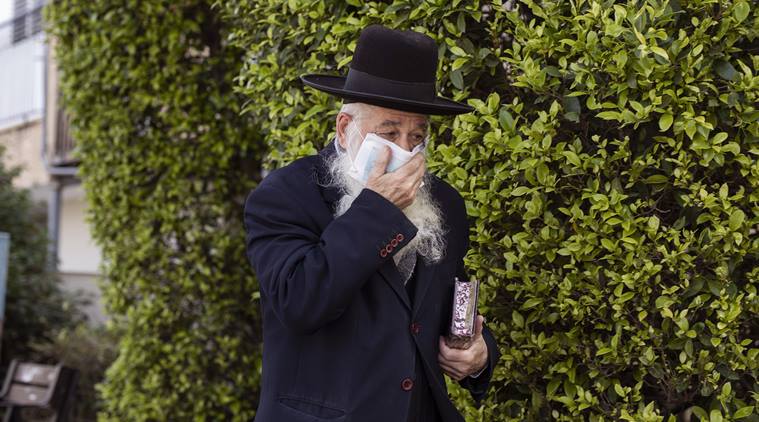 Israel marked its first COVID-19 infection on February 21. (File Photo)
What are the reasons behind the hostility towards Israel’s government?
The hostility towards Israel’s government is, in fact, long-standing. Members of the ultra-Orthodox Jewish community, says Brown, are anti-Zionist and according to their religious belief, they believe they are prohibited from following a secular government.
“They believe that only the Messiah can establish Jewish sovereignty. Anything the government does, they think it is to stop the religious commandments. They then have clashes with the police,” explains Brown.
Hence, many in the community have believed that government regulations that have enforced closures of synagogues, shuls and mikveh, Jewish ritual baths etc, post the outbreak of COVID-19, have interfered with religious beliefs and practises that are important to them.
However, Brown emphasizes that only the most radical among the Orthodox and ultra-Orthodox Jews have been engaged in these violent altercations between the communities and police and security forces that have been highlighted post the outbreak of COVID-19, and they are a relatively small minority.
There have been other instances of conflict between the Israeli government and these communities in the past, on other issues such as compulsory military conscription in the country.
Are there other reasons for greater numbers of infections in these communities?
Brown says that there are some socio-cultural factors that are also rooted in the spread of infections in Orthodox and ultra-Orthodox communities. An average Haredi family will have seven to 10 children. Since men spend their time focusing on religious studies, they usually have low income and are sometimes not employed.
They also tend to live in small apartments, in close proximity, increasing the chances of spreading infections. Concepts like social-distancing and self-isolating are not feasible within this social structure.
Also, COVID-19 couldn’t have arrived at a worse time. Pesach or Passover, which just went by in March, is an important religious festival that requires the families to engage in a lot of preparations and cleaning of homes.
📣 Express Explained is now on Telegram. Click here to join our channel (@ieexplained) and stay updated with the latest
Having to follow these government-imposed restrictions particularly during this time, was a challenge for many in the community. This outbreak has been unprecedented for people around the world, and for religious leaders within these communities, the consequences of it were even more unexpected and unusual, particularly for the older Haredim.
“Weak communication with the government and the lack of sensitivities to the peculiarities of the community and you’ve got the results,” says Brown. “In the US, the government itself acted slowly and did not know what to do. In Israel, the delays infected many people. Infections among radical Haredim are higher in communities in Israel and New York,” he adds.
Will ultra-Orthodox communities be forced to make changes to religious practises post COVID-19?
The outbreak of COVID-19 has changed the way people practise their faith around the world for the foreseeable future. The clash between these communities and government officials and the general suspicion that they have, is not a matter of religious belief, believes Brown. However, he does not believe that COVID-19 will change much for the community.
“Many people expected that after the leaders messed up in alerting the community to COVID-19, there would be skepticism towards them and discard their faith in religious leaders, choosing to communicate more using modern media etc, become more trusting of the government and the army,” explains Brown.
Since government regulations prevented the community from going out and bringing food and other essentials, the army stepped in to help. Although many would think that this outbreak would have been responsible for bridging existing divides, Brown is not very hopeful. “Because the Haredim are satisfied with their lives. This way of life works for them. There are exceptions, such as COVID-19, where it didn’t work and it led to deaths of people. But the damage was not as severe, at least in Israel, where we haven’t reached 300 deaths.”
“People forget quite rapidly and life is going on as it had.” Will the failures of religious leaders in guiding the community during these unprecedented times impact the faith the communities have in them? Brown doesn’t believe it will. “They aren’t judging religious leaders for this, and are thinking that this was what providence wanted. This isn’t going to change my way of life.”
This outbreak may lead the modernised Haredim, who are already using the Internet and are more open to social and cultural changes and technological advances.
“Any changes that may happen may be rooted in any economic crises that develop as a result of coronavirus because the government will have to cut welfare budgets and financial help that it gives to the weaker strata of the population,” explains Brown, referring to the economic assistance that the government provides to the Haredim.
“Half of the Haredi men go to work and the other half continue religious study all their lives. But once poverty becomes (challenging) and the government reduces financial support, the Haredim will have to go to work and adapt to modern ways of life. And that may change them,” says Brown.

 Share


