
 Richard Henderson (L), Joachim Frank (C), Jacques Dubochet (R).
The 2017 Nobel Prize in Chemistry was on Wednesday awarded to Jacques Dubochet, Joachim Frank and Richard Henderson “for developing cryo-electron microscopy for the high-resolution structure determination of biomolecules in solution”.
The electron microscope was designed in the early 1930s by the German physicist Ernst Ruska, for which he was awarded the 1986 Nobel Prize in Physics (along with Gerd Binnig and Heinrich Rohrer who shared the other half of the Prize). Four years earlier, the 1982 Chemistry Nobel had gone to Aaron Klug “for his development of crystallographic electron microscopy and his structural elucidation of biologically important nucleic acid-protein complexes”.

Through much of the first half of the 20th century, the determination of the structure of biomolecules — proteins, DNA and RNA — had appeared as a significant challenge in the field of biochemistry. Scientists’ knowledge evolved steadily over the last six decades — beginning with the pioneering crystallographic studies of the structures of globular proteins that fetched Max F Perutz and John C Kendrew the Chemistry Nobel in 1962, to mastering cryo-electron microscopy (cryo-EM) for which the 2017 Prize has been awarded.
In the 50s, X-ray crystallography (exposing protein crystals to X-rays) was used to develop models of biomolecules for research and development; in the 80s, nuclear magnetic resonance (NMR) spectroscopy was also employed to this end. The use of both techniques was, however, subject to limitations imposed by the nature of biomolecules. X-ray crystallography required well-organised crystals — biomolecules are usually never organised as crystals. And NMR worked for only a relatively small set of proteins.
The winners of the 2017 Prize employed three different approaches that together overcame these challenges, taking, as the Nobel Committee said, “biochemistry into a new era, making it easier than ever before to capture images of biomolecules”.
X-ray crystallography to electron microscope
Richard Henderson abandoned X-ray crystallography and resorted to imaging proteins using transmission electron microscopy — in which, instead of light, a thin beam of electrons is sent through the specimen. However, while the electron microscope is good to obtain the atomic structure of, say, a membrane protein, the intense electron beam necessary for high resolution images incinerates biological material. And a reduction in the intensity of the beam means a substantial loss in contrast, and the image becomes fuzzy.
Additionally, the requirement of vacuum for electron microscopy meant the deterioration of biomolecules with the evaporation of surrounding water.
Henderson worked with bacteriorhodopsin, a purple-colour protein embedded in a photosynthesising organism’s membrane. To keep it from getting incinerated, he left the sensitive protein in the membrane, and blasted a weaker electron beam through the sample. Pictures were taken from many different angles of the same membrane under the electron microscope to produce a rough 3D model of bacteriorhodopsin’s structure.
This was in 1975. As electron microscopy evolved with better lenses and the development of cryotechnology (in which samples were cooled with liquid nitrogen to about – 190 degrees Celsius in order to shield them from the electron beam) his technique managed to produce, in 1990, a bacteriorhodopsin structure at atomic resolution.
Mathematical image processing of 2D electron microscopic images
Also in 1975, Joachim Frank prepared a theoretical strategy to merge together whatever information is carried in the two-dimensional images from a electron microscope, to generate a high-resolution three-dimensional whole. His mathematical method sifted through 2D images to identify recurring patterns, and sort them into groups to merge their information, producing sharper images. This model helped circumvent the less-than-sharp images produced due to the weaker electron beams used for biomolecules. The mathematical tools for image analysis were compiled as a computer programme suit.

Preparing the sample
The core challenge of ensuring that the biomolecule samples were not dehydrated, and did not collapse in the vacuum of cryo-EM imaging under the electron beam, was resolved by Jacques Dubochet.
The natural solution to the problem was freezing the samples. Since ice evaporates slower than water, it should have worked. However, crystalline water fuzzed the images as the electron beams were diffracted through water crystals.
Dubochet solved the problem by rapid cooling that didn’t allow water molecules to arrange into crystalline form; they instead turned into vitrified water that would act as glass for the electron beam. His research developed a technique of sample-preparation where biomolecules are shielded under vitrified water. The technique is used in cryo-EM.
The Latest Use
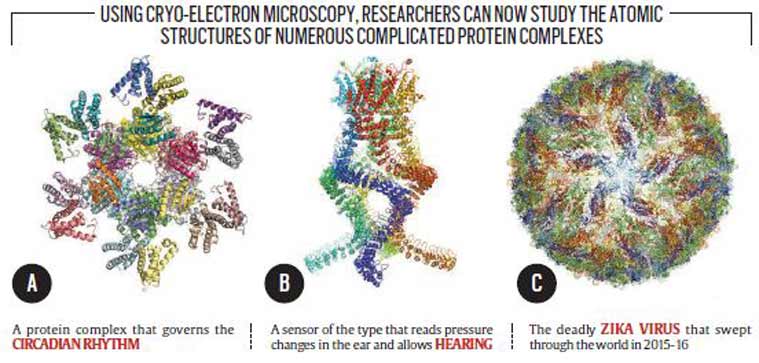
Latest technical developments like the introduction of new electron detectors — Direct Electron Detectors — in electron microscopes helped further improve the resolution of images captured under low-beam cryo-EM for biomolecules. The introduction of Direct Electron Detectors in electron microscopes in 2012-13 turned out to be a powerful tool for scientists as they encountered the challenge of the Zika virus that spread rapidly across various countries in 2015-16.
JACQUES DUBOCHET
Was born in 1942 in Aigle, Switzerland. He completed his PhD in 1973 from the University of Geneva and University of Basel, Switzerland. He is Honorary Professor of Biophysics, University of Lausanne, Switzerland.
JOACHIM FRANK
Was born in 1940 in Siegen, Germany. He completed his PhD in 1970 from the Technical University of Munich, Germany. He is Professor of Biochemistry and Molecular Biophysics and of Biological Sciences, Columbia University, USA.
RICHARD HENDERSON
Was born in 1945 in Edinburgh, Scotland. He completed his PhD in 1969 from Cambridge University, UK. He is Programme Leader, MRC Laboratory of Molecular Biology, Cambridge University.
2016 WINNERS: JEAN-PIERRE SAUVAGE, SIR J FRASER STODDART and BERNARD L FERINGA for their development of nano-machines, made of moving molecules, which may eventually be used to create new materials, sensors and energy storage systems.
 Share


