
Nepal: Top-down Constitution-making and assertion of identity
Aspirations of ethnic federalism are powering movements of the kind that exploded in the killing of eight policemen in Tikapur this week.
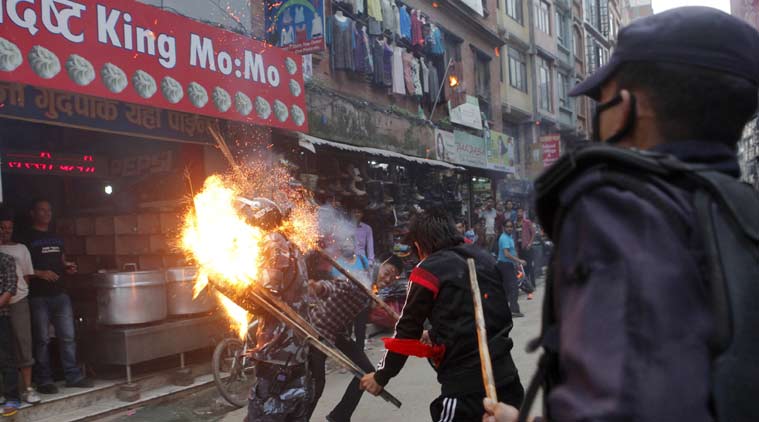 Nepalese protesters hit a policeman with a torch during a rally in Kathmandu, Nepal, Saturday, Aug. 15, 2015. Supporters of small opposition parties protested to oppose the constitution drafting process. (Source: AP photo/file)
The frenzied mob that killed eight policemen and wounded scores in Tikapur in Western Nepal’s Kalali district on Monday was demanding Tharuhat, a separate province for the 17 lakh-strong Tharu people — Nepal’s fourth largest indigenous group, more than 50 per cent of whom live in four districts in that part of the country.
The four major political parties that constitute more than two-thirds of the Constituent Assembly have dropped the initial idea of federating Nepal into 14 provinces, half of them on the basis of ethnicity. Many ethnic communities — there are 103 ethnic groups and as many languages in the country — including the Tharus, are unhappy over being denied what had been promised.

[related-post]
The many movements currently raging across Nepal have two dominant themes: recognition of identity and ethnic federalism, and demands for a Hindu Nepal in view of the fact that over 85 per cent of the population is Hindu. Both have taken militant shape at times.
The government has deployed the army in four districts, giving it sweeping powers to contain the situation in the aftermath of the gruesome murders and the clear challenge to the authority of the state. Clashes have broken out at places other than Tikapur too, with more than two dozen deaths having been reported in four districts in the past 10 days, all in the course of protests against the six-province model agreed upon by the four major parties.
Nepal has always been administered centrally. An organised movement in Nepal’s plains, often referred to as the Terai Madhes, within months of the Maoists joining the democratic process, pushed ‘federalism’ to the top of the national agenda. That movement lasted for weeks, resulted in 53 deaths, saw the blockade of highways that are the lifelines of the pampered capital and finally, in March 2007, Prime Minister G P Koirala signed an accord with the leaders of the movement, conceding “Madhes Pradesh”.
The plains consist of 22 districts, nearly 17 per cent of Nepal’s area, and 51 per cent of its population. The soil is fertile, and the area — which shares a border with India — has more than 50 (mostly medium-scale) industries. But socio-economic and gender disparity are rampant. The plains have attracted people from all over Nepal, including from the Hills, for generations, and especially since the early 50s. Many people have moved from India as well.
The older population initially welcomed the new settlers as contributors to development. However, the movement for federalism and ‘One Madhes, one Pradesh’ produced a regionalist sentiment that split national parties like the Nepali Congress and the Communist Party of Nepal-Unified Marxist Leninist (CPN-UML), and led to the formation of regional parties. The new slogan was “inclusion”, and rights for the “sons of the soil”. Despite internal rivalries, the emerging regional forces agreed on the anti-Hills sentiment, claiming that the “Hills rulers” in Kathmandu had for centuries denied plains dwellers their rightful dues. Some even called Madhes an internal colony that must strive for its “right to self-determination”.
Regional parties won nearly 90 seats in the election to the first Constituent Assembly of 601 members in April 2008. It was seen as an endorsement of federalism, but a series of splits in these outfits led to their losing more than half these seats in the second Constituent Assembly election in November 2013. Moreover, Madhes parties had occupied key positions in the government from April 2006 onward, but failed to contribute effectively towards defining the basis of federalism. Their discredited leaders have now been taking more aggressive postures.
On June 16, top leaders of three major parties — all led by Hills people — and the Forum Loktantrik, that has Bijay Gachedar of the Tharu community, signed an agreement to have six provinces, which infuriated the plains masses. Madhesi leaders, including a Parliamentarian from the ruling Nepali Congress, gave a call in Tikapur to the Tharus and others to form guerrilla groups and attack the “Hills people”. And because, in their view, the state is controlled by the Hills, the police became the target of Monday’s attack. “Violence is something we will not encourage. As original settlers of this country, we want unity and accord among communities and it is time we moved in that direction, even suspending the Constitution-making process for now,” Dilli Bahadur Chowdhary, a Congress Parliamentarian, says.
India’s Prime Minister Narendra Modi has urged Nepal’s Prime Minister Sushil Koirala to make the process of Constitution-making more inclusive. Nepal is more vulnerable to violence as the draft Constitution not only recognises violence as the means of political change, but also glorifies the success it has achieved in bringing about radical change in the past.
ghimire.yubaraj@gmail.com
 Share


