The merchant discount rate (MDR) regime for UPI transactions was announced on Tuesday (September 15). MDR is the fee merchants pay to the entities that help facilitate a digital transaction: banks, payment service providers, and third-party apps.
It will be levied if you make a payment to a merchant above Rs 2,000, at a uniform rate of 0.4% (with a few exceptions). This is supposed to be a charge “within the merchant payment ecosystem” — and not on customers making UPI payments.
The government has “advised” banks to ensure that merchants do not pass MDR charges to customers. UPI application providers are “expressly prohibited from imposing platform fees or hidden charges”, the Finance Ministry said.
No such levy will be made on person-to-person payments — that is, if you pay a friend or family member — irrespective of the transaction amount.
The announcement comes a day after the government exempted all UPI payments up to Rs 2,000 and RuPay debit card transactions from any bank charges.
When do the updated MDR provisions take effect?
The finalised MDR framework and threshold structure will be effective from October 15. According to the NPCI, this provides acquiring banks, payment aggregators, fintech applications, and corporate accounting platforms “adequate lead time to update their software engines and billing systems”.
How much MDR will be charged on payments?
UPI will continue to remain “completely free for all person-to-person transactions, irrespective of the amount transferred”, NPCI said. This means that payments made to individuals, family, friends, and personal contacts will remain completely free for the sender as well as the receiver.
Payments to merchants, or person-to-merchant (P2M) transactions, of up to Rs 2,000, will remain free, but payments above this threshold will attract o.4% MDR. For high-value UPI payments to merchants exceeding Rs 75,000, the 0.4% MDR will be capped at Rs 300 per transaction.
Payments for essential services like railways, telecommunications, insurance, fuel, utility bill payments (including electricity, water, piped gas), educational transactions and agricultural inputs will attract a flat MDR of Rs 5 per transaction, instead of the 0.4% levy.
Payments relating to mutual funds, securities, stockbrokers, and dealers will attract an MDR of 0.02%, capped at Rs 300 per transaction.
Monthly utility bills, OTT subscriptions, recurring investments, etc paid through automated recurring standing instructions — UPI Mandates or AutoPay — won’t face MDR charges.
Will consumers have to pay any fee on UPI?
No, according to the government. The Finance Ministry said on Tuesday that it has “advised” banks to ensure that merchants do not pass on the additional MDR cost to consumers. UPI application providers are expressly prohibited from imposing platform fees or hidden charges.
Despite that, there is a likelihood that merchants — particularly those that are relatively small or in the informal sector — will pass the incidence or simply ask for cash.
 How India pays via UPI.
According to NPCI, “market dynamics and historical payment trends show that merchants absorb nominal digital processing costs to drive higher business volume.”
“Because the proposed UPI MDR is significantly lower than credit card fees and applies only above specific transaction thresholds, shopkeepers have no economic incentive to inflate retail shelf prices. Consumers will continue paying the exact listed price for goods and services,” the NPCI said.
How does UPI MDR compare to debit and credit Card MDRs?
UPI MDR is lower than traditional card-based transaction fees, which typically range from 1.5% to 2.5% per transaction; debit card MDRs are capped up to 0.90%. The baseline UPI MDR will be 0.4% on transactions above Rs 2,000, and capped at Rs 300 for high-value purchases.
What about micro merchants and small vendors?
Small merchants, including street vendors, receiving up to Rs 1 lakh per month through UPI QR codes into their personal bank accounts will not be subjected to MDR charges.
These small merchants are part of a special category — Person-to-Person-Merchant (P2PM). According to the NPCI, small merchants aren’t required to replace or re-register their QR codes under the new MDR framework.
Banks and payment service providers use transaction velocity check for P2PM merchants to monitor their Rs 1-lakh-per-month inflow threshold. The NPCI on Tuesday said that merchants with inward credit of aggregate UPI payments of over Rs 1 lakh per month, consecutively for 3 months, get moved to the regular merchant category — P2M, or person-to-merchant — that attracts an MDR charge of 0.4% on transactions above Rs 2,000.
Why charge MDR on UPI transactions?
UPI’s costs have been borne by banks and other payments industry players. For years now, they have sought to be compensated for bearing this cost, which is as high as Rs 20,000 crore every year and goes towards maintaining the payments infrastructure, which includes cloud storage, the payment app itself and customer support features. The government says MDR will, therefore, be used to invest in the digital payments infrastructure.
But critics argue that the UPI transactions could have continued for free given the benefits for the public at large. According to them, UPI is one of India’s greatest digital achievements and should remain a no-cost public good. There are fears that this could potentially reverse the digital payments momentum and lead to the use of more cash.
Also, while transactions above Rs 2,000 accounted for only 4% of person-to-merchant (P2M) UPI payments by volume in 2025-26, these made up around two-thirds of merchant UPI payments by value. In 2025-26, more than 24,000 crore UPI transactions worth Rs 314 lakh crore were made.

 The announcement comes a day after the government exempted all UPI payments up to Rs 2,000 and RuPay debit card transactions from any bank charge. (Unsplash)

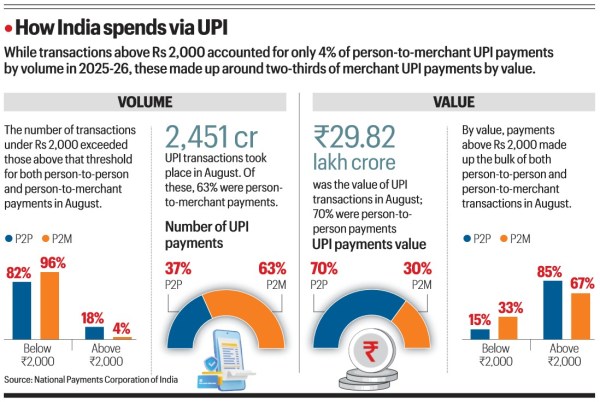 How India pays via UPI.



 Share


