Two years ago, researchers infected mosquitoes with bacteria and released them into parts of an Indonesian city. On Wednesday, they announced the results of their unique experiment: In areas where such mosquitoes were deployed. dengue incidence was 77% lower than in areas where they were not.
These findings have implications for combating dengue on a larger scale, and possibly other mosquito-borne diseases.
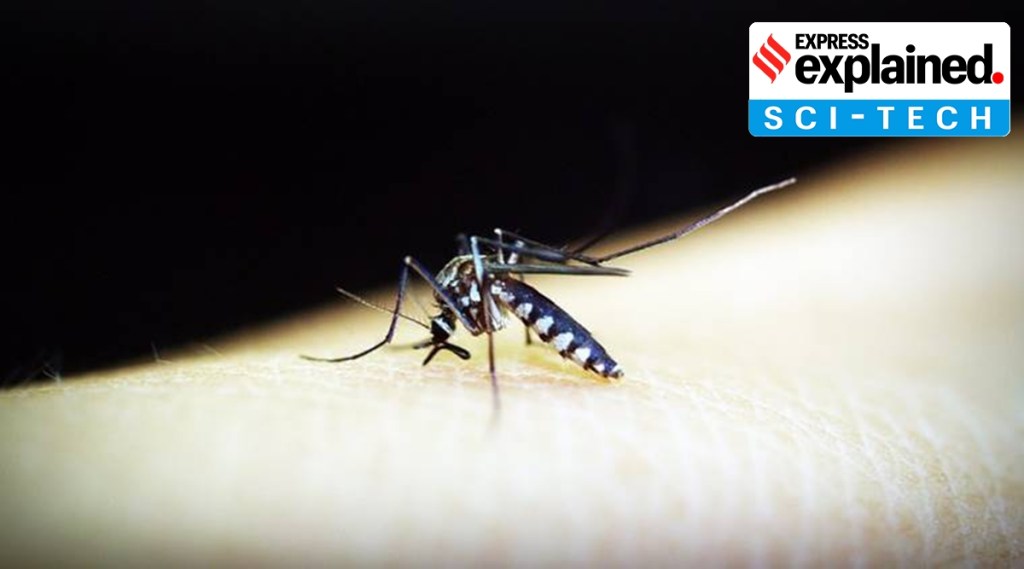
The key to this is a bacterium, Wolbachia, which occurs naturally in some species of insects. While such insects include some mosquitoes, Wolbachia does not occur naturally in Aedes aegypti, the mosquito species that spreads dengue and other diseases such as chikungunya, Zika and yellow fever.
In 2008, the Australian-based research group World Mosquito Program (WMP) discovered that Aedes aegypti mosquitoes can no longer spread dengue when they are carrying Wolbachia, This is because the dengue virus struggles to replicate inside the mosquito when these bacteria are present.

But will people not be infected when other mosquitoes bite?
The reasoning is that once you release mosquitoes carrying the Wolbachia bacteria, they will interbreed with the local wild mosquitoes. Over time, several generations of mosquitoes will be carrying Wolbachia naturally. A stage will eventually be reached when those carrying Wolbachia represent a large proportion of the local mosquito population, so that a bite is less likely to transmit the virus to humans.
Also Explained | Why does a zebra have stripes? Many old theories, some new findings
So, the Indonesia trial has now borne this assumption out?
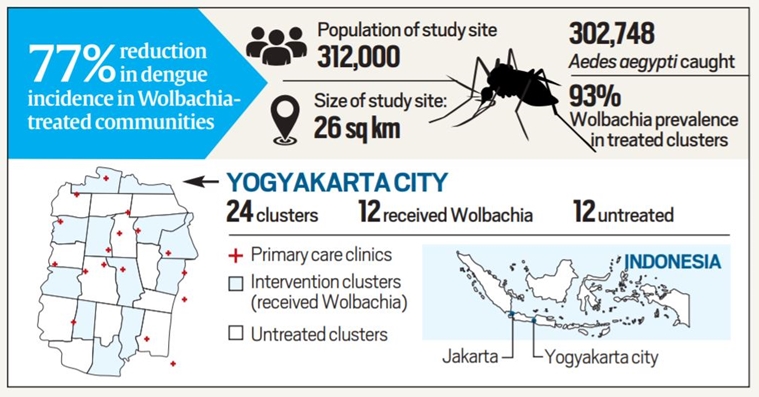
Yes, according to the results announced by WMP. The researchers divided the Indonesian city of Yogyakarta into 24 clusters. Over several months, they released Wolbachia-infected mosquitoes into 12 of these clusters, chosen at random. These mosquitoes bred with local mosquitoes, until nearly all mosquitoes in the area were carrying Wolbachia bacteria. At the end of 27 months, the researchers found that the incidence of dengue was 77% lower in areas where Wolbachia-infected mosquitoes had been released, as compared to areas without such deployments.
Previously, WMP had carried out experiments in Australia, and then in 11 other countries, on a smaller scale. What makes the Indonesian study significant is that the first randomised controlled trial of the strategy. WMP partnered with the Tahija Foundation and Gadjah Mada University of Indonesia.
How was the 77% lower incidence determined?
The 12 areas that received Wolbachia deployments also received routine dengue control measures. The remaining 12 areas, while without Wolbachia deployments, continued to receive routine dengue control measures. The trial area had a population of 3.12 lakh.
The researchers simultaneously monitored the incidence of dengue. They looked at people who presented with dengue-like symptoms at primary care clinics around the city. The trial enrolled 8,144 such participants, and checked where they lived, where they had travelled, and whether or not they eventually tested positive for dengue. Over 27 months, their findings showed that the incidence of dengue was 77% lower in areas treated with Wolbachia.
WMP said detailed results will be presented at an international scientific congress in November, and published in a peer-reviewed journal.
📣 Express Explained is now on Telegram. Click here to join our channel (@ieexplained) and stay updated with the latest
How significant are the findings?
Nicholas Jewell of the University of California–Berkeley, who designed the study and led the statistical analysis, described it as a huge breakthrough. “We’ve now shown that it works in one city. If this can be replicated and used widely, it could eradicate dengue from several parts of the world for many years,” Jewell said in a statement.
Incidence of dengue has grown dramatically around the world in recent decades, with a vast majority of cases under-reported, according to the World Health Organization. WHO estimates 39 crore dengue virus infections per year, of which 9.6 crore show symptoms. India registered over 1 lakh dengue cases in 2018 and over 1.5 lakh cases in 2019, according to the National Vector-Borne Disease Control Programme.
The researchers believe the strategy will likely work for other viruses transmitted by Aedes aegypti. “It not only blocks one virus, it blocks many flaviviruses. It is like a magic bullet,” Jewell said. “But would it work? Here, we finally demonstrated it worked in practice.”
Is this being tried on a larger scale?
The French company InnovaFeed, which produces insects to feed livestock, is partnering with WMP to develop the first industrial-level production of mosquitoes, according to a report by the news agency AFP. “The idea is to help cities on a large scale, with several million people,” AFP quoted InnovaFeed co-founder Aude Guo as saying.

 The warning signs in children are severe pain in the abdomen, frequent vomiting, bleeding from mouth/nose/gums, lethargy, restlessness, poor oral intake.(File)


 Share


