The idea and politics of social justice was intended to forge larger empathies and solidarities based on the constitutional promise of equality. That Mandal politics is now seen, in large sections of even its homeground, UP, as casteist and divisive, is proof not just of the BJP’s narrative dominance, but of the many critical failures of Mandal’s own flagbearers.
They allowed the platform to shrink to family rule, caste arithmetic and formulas of social engineering. Self-defeatingly, they used the same majoritarian arguments in caste that Hindutva used to much more powerful effect using religion. They failed to connect Mandal to an agenda of governance.
The Mandir project, on the other hand, has added layers to itself and grown more expansive, into Hindutva plus. In the process, successfully drawing attention away from its own in-built and essential divisiveness – the minority’s relegation and its exclusion from structures of power and representation. And the force-fitting of a diminished idea of Muslim citizenship — in which they are seen not as bearers of rights but only as equal recipients of government schemes.
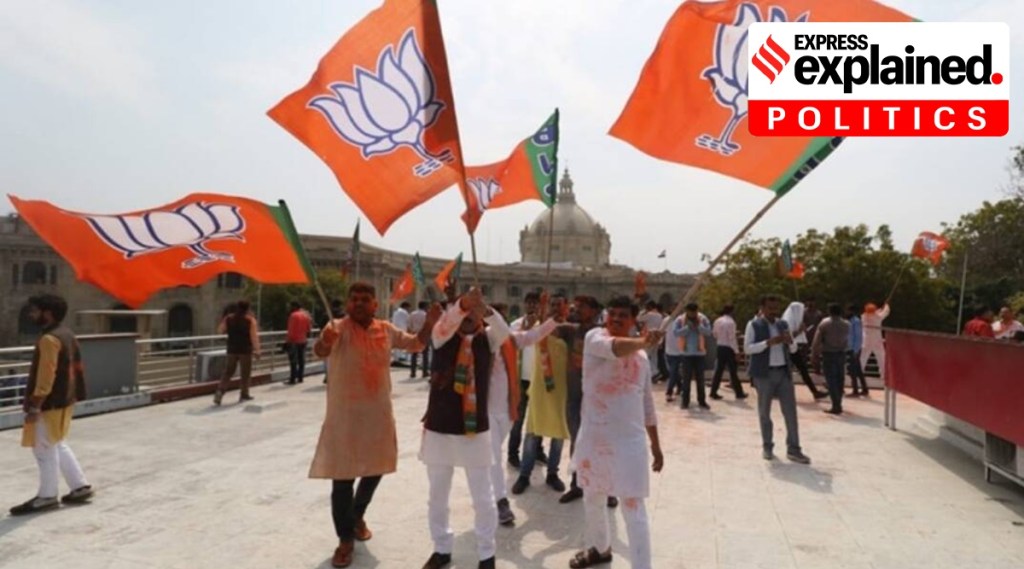
In a whole of many synced parts, Hindu assertion is the other side of Hindu insecurity, Hindutva is hitched to nationalism and national security, and a “labharthi” politics that harnesses the advances of governance and technology to convert citizens into beneficiaries, is added to the mix.
The end result, as the BJP’s great success in UP despite rampant berozgari (unemployment), raging mehengai (price rise), and unprecedented pandemic-induced distress shows, has been this: Hindutva can lift itself off the ground on the back of “desh (nation)” and “dharma (religion)” if a scheme misses the target, a policy goes wrong, and the ground reality becomes inconvenient and messy.
On the other side, its opponents remain grounded, scrambling to put themselves together in bits and pieces. They lack the transcendence of the larger idea or whole.
Mandal and Mandir are political projects with a past. But newbie Aam Aadmi Party’s breakthrough success in Punjab, its becoming the face of the yearning for an alternative in a state of gathering crises and congealed cynicisms, has affirmed that the impulse for change will find a way, once it acquires critical force.
The AAP’s journey has been spectacular – its success has come in a terrifically compressed time-frame. In its very first outing in the Punjab Assembly election of 2017, it made a bipolar polity into a three-cornered one. In its second election now, it has swept to power – in spite of the fact that it lacks feet on the ground, has made virtually no inroads in the rural architecture of power in comparison to its entrenched rivals in a predominantly rural state and has borrowed from other older parties many of its candidates.
The AAP’s success, for now, is in the air, and its challenge will be to build backwards – it has acquired power first, and must construct an organisation that takes it all the way to the ground later.
Lastly, the Congress. In 2014, it ruled nine states, it’s now reduced to only two – Rajasthan and Chhattisgarh. The Congress’s continuing diminishing will reshape the political contest at the national level – it is now the BJP versus regional forces, like those headed by Mamata Banerjee, MK Stalin. And Arvind Kejriwal.
If a democracy defines itself as a system that can throw up a riddle and spring a surprise, the Congress’s unchecked waning, the BJP’s second conquest of UP, and the twinning of the Yogi phenomenon with Modi – a first for a party which has so far revelled in painting Modi as larger-than-rest – may just have made democracy’s work ahead of 2024 more challenging.
Newsletter | Click to get the day’s best explainers in your inbox



 Share


