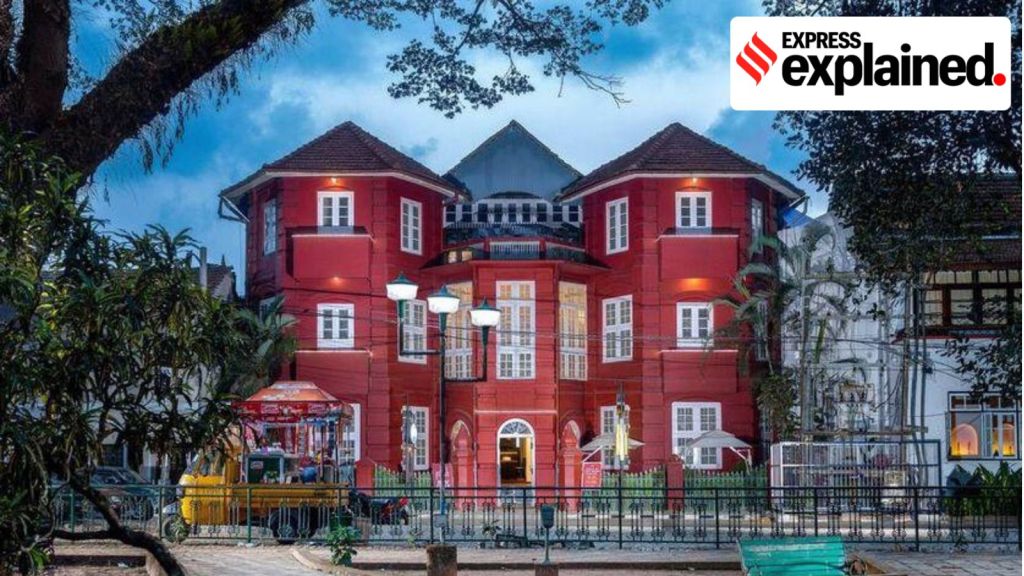
The Koder House, a key heritage landmark in Fort Kochi which was functioning as a luxury hotel, was gutted in a major fire on September 29. The building, which is believed to have been first constructed during the Dutch invasion of Kochi (from 1663 to 1795), was later bought and renovated by SS Koder, the patriarch of a Paradesi Jew family of Fort Kochi in the 19th century.
While heritage experts from Kerala say that the exact year in which the structure was built cannot be ascertained due to lack of documentation, those who have visited and studied the building said that it is at least two to three centuries old.

“The building is at least two centuries old,” said former Mayor of Kochi and member of INTACH Keralam chapter KJ Sohan told The Indian Express.
Meanwhile, another expert, Bony Thomas dated the building back to three centuries. “The structure seems to have born the signs of at least 300 years of history,” Thomas told The Indian Express.
While the hotel’s website claimed that it was a Portuguese structure, historians and heritage experts say it is more recent.
Who were the Koders
While it is not known why the Dutch (who were in Kochi between 1663 and 1795) built the structure, SS Koder renovated and used it as his family home. “The Koders were Paradesi Jews or Jews who have immigrated from outside India. Most of the immigration of the Jewish community was from Spain and other countries in the Europe,” Sohan said.
Thomas, however, said that the Koders are believed to have migrated from Iraq. “The family’s roots can be traced back to West Asia,” he said. Most of the Paradesi Jews, unlike the Malabari Jews of Kochi, immigrated to either their parent countries or Israel in the 1950s. However, Koder’s family never left Fort Kochi, Sohan said. “The family’s members are buried in Kochi,” Sohan said.
Story continues below this ad
The Koders were known to be one of the richest families in Fort Kochi. One of the Koders, Samuel Koder worked as Cochin princely state’s Honorary Consul to the Netherlands.“Samuel Koder was the municipal chairman of Fort Kochi back in the day,” Sohan said. The family brought electricity to Kochi’s shores through the Cochin Electric Company. “They burnt coal and produced electricity and supplied (transmitted) it to most of Fort Kochi and Mattanchery islands,” Thomas said.
Sohan said that the Koders were also traders who had connections with the rest of the world. “They used to run a textile and crockery store, which doubled up as a luxury house store,” Sohan said. Thomas said that the Koders were the go to people for anything luxurious in Fort Kochi. “Before liberalisation, foreign goods were not available in Kerala or India. Koders imported many luxury items during this time and sold to the local populace,” Thomas said.
How was the structure unique?
While the Koder House was built by the Dutch and renovated by the Koders, it has a simple architecture with balconies. But the Koder House has a Guest House at its rear end. “The two structures are connected by a wooden bridge,” said Thomas, who has studied the structure closely. “The guest house was where the Koders used to house their entrepreneur and business friends from across the globe,” Thomas said.
Besides, the guest house has a courtyard where there is a small pond or Mikvah where Jewish holy or ritualistic bath is taken. “This must be the only such Mikvah in Ernakulam,” Thomas said. When contacted, Kerala’s fire service officers said that only the top floor of the Koder House was gutted in the fire as the flames were prevented from spreading to the nearby historic structures of the guest house with the Mikvah and the bridge.
Story continues below this ad
What did the Koder House fire ruin?
According to Keralam’s fire service officers, it’s the top floor of the structure which caught fire, gutting its ancient roof and columns. The Koder House is not just a historic structure, but it had many historical artefacts inside, KJ Sohan said. “The history of the Koders, their photographs and paintings were all in this building which went up in flames,” Sohan rued. Each of furniture and tapestry inside the Koder House were brought to the structure from across the world, he added. “Definitely, it is a major loss of a heritage building,” Sohan added.
The Indian Express reached out to the current owners of the Koder House, who were unavailable to comment on the extent of the damage the structure has suffered.