The chief ministers of six states on Tuesday (September 15) signed a memorandum of understanding (MoU) to pave the way for the long-pending 422 MW Kishau Multipurpose Project.
What is the Kishau Multipurpose Project?
The Kishau Multipurpose Project is a proposed dam and hydropower project on the Tons River, a major tributary of the Yamuna, along the border shared by Himachal Pradesh and Uttarakhand. The project envisages a 232.6-metre-high concrete gravity dam that will generate 1,476 million units of clean hydropower.
The project site straddles Himachal Pradesh’s Sirmaur district and Uttarakhand’s Dehradun district. The two states signed an MoU to form a joint venture in June 2015, and Kishau Corporation Ltd was incorporated in January 2017. The project is intended to generate electricity, create irrigation potential of about 97,076 hectares, and provide drinking and industrial water to the beneficiary states, Haryana, Delhi, Rajasthan and Uttar Pradesh.
The Chief Secretaries of Himachal and Uttarakhand hold the position of Kishau Corporation Ltd chairperson in two-year rotations.
Why was the Kishau Dam required?
The Kishau Dam was one of three storage projects planned in the upper reaches of the Yamuna and its tributaries following a MoU signed on May 12, 1994 by the Yamuna basin States — undivided Uttar Pradesh, Haryana, Rajasthan, Himachal Pradesh, and the National Capital Territory of Delhi — regarding the allocation of Yamuna water.
The other two projects were Lakhwar and Renukaji, for which the MoUs have already been signed and are under implementation. These projects were required because there are no storage facilities constructed on the Upper Yamuna — from its source, Yamunotri glacier, in the lower Himalayas to the Okhla barrage in Delhi — a catchment area of about 30,000 square kilometres. As per the 1994 MoU, an interim seasonal allocation of the annual utilisable flow of river Yamuna was made among these five states.
Of the total 11.983 billion cubic metres (BCM) of annual utilisable water of the Yamuna, a maximum allocation of 5.730 BCM was made to Haryana, followed by 4.032 BCM to Uttar Pradesh, 1.119 to Rajasthan, 0.724 BCM to Delhi and 0.378 BCM to Himachal Pradesh. When Uttarakhand was created in 2000, the 4.032 BCM share of water of undivided Uttar Pradesh was allocated to UP and Uttarakhand as 3.721 BCM and 0.311 BCM respectively.
Earlier this year, a Detailed Project Report (DPR) of the Kishau project was circulated among the states concerned but it is yet to be finalised.
Why was the signing of the MoU delayed?
For eight years, Himachal Pradesh held out on signing the MoU for two key reasons — the project cost burden, particularly the power component, and concerns that the state would not enjoy proportionate benefits.
Under an earlier arrangement, the previous BJP-led Himachal government agreed to contribute about Rs 800 crore towards the project cost. The current Congress-led government rejected that arrangement, saying it was not in Himachal’s financial interest, and that it would suffer substantial land submergence and displacement.
Indeed, the project will result in substantial submergence in both Himachal Pradesh and Uttarakhand. According to a 2020 feasibility study, around 2,950 hectares of land would be submerged, affecting 17 villages and about 5,500 people, across the two states.
Himachal Pradesh argued that it should not be required to invest heavily in a project whose water benefits would largely go to downstream states such as Delhi, Haryana and Rajasthan.
How was a solution reached?
A breakthrough was achieved in June 2026 when the Centre announced that it would bear 90% of the project cost, with the six states sharing the remaining 10%.
“As per the MoU, the share of Himachal’s expense on the project will be borne by Delhi and Rajasthan in the ratio of 75% and 25% respectively because these two states will get the water supply. We also do not require power supply at this moment, and the state will receive the money for providing the power to the neighbouring states”, Additional Chief Secretary, RD Nazeem, who was present in the meeting along with CM Sukhu, told The Indian Express.
A senior Himachal Pradesh officer said: “This project will have a storage capacity of 1,786 (million cubic metres) MCM of water but will actually store 1,324 MCM. As per the joint agreements… Haryana will get 633 MCM water; Uttar Pradesh will get 411 MCM water, Rajasthan will get 124 MCM water, Delhi will get 80 MCM water, Himachal will get MCM water and Uttarakhand will get 34 MCM water for drinking and industrial purposes.”

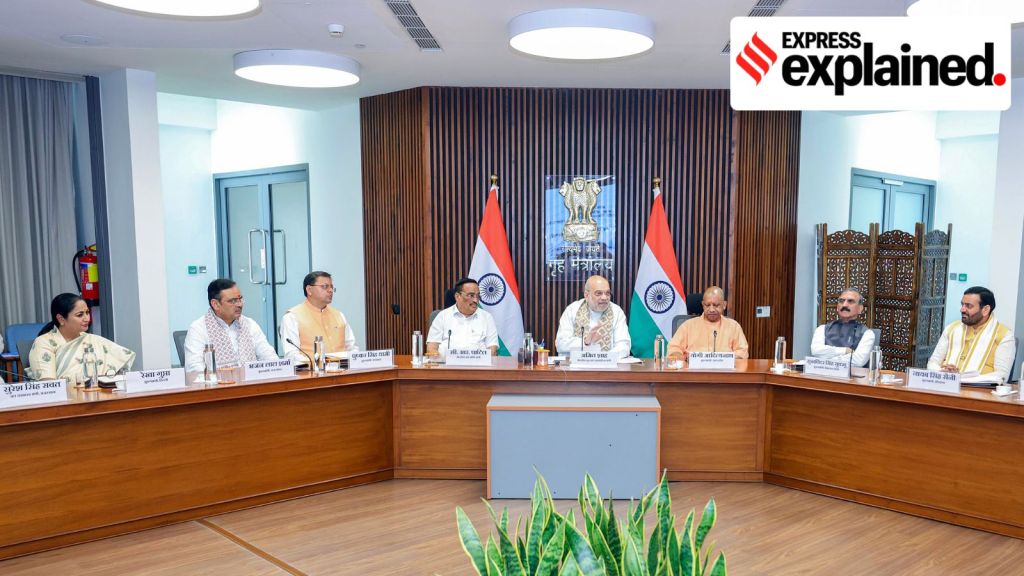 The chief ministers of six states signed an MoU for for the Kishau Multi-Purpose Project in the presence of Union Home Minister Amit Shah, Union Jal Shakti Minister CR Paatil, Minister of State for Jal Shakti Raj Bhushan Choudhary in New Delhi on Tuesday. (ANI Video Grab)



 Share


