
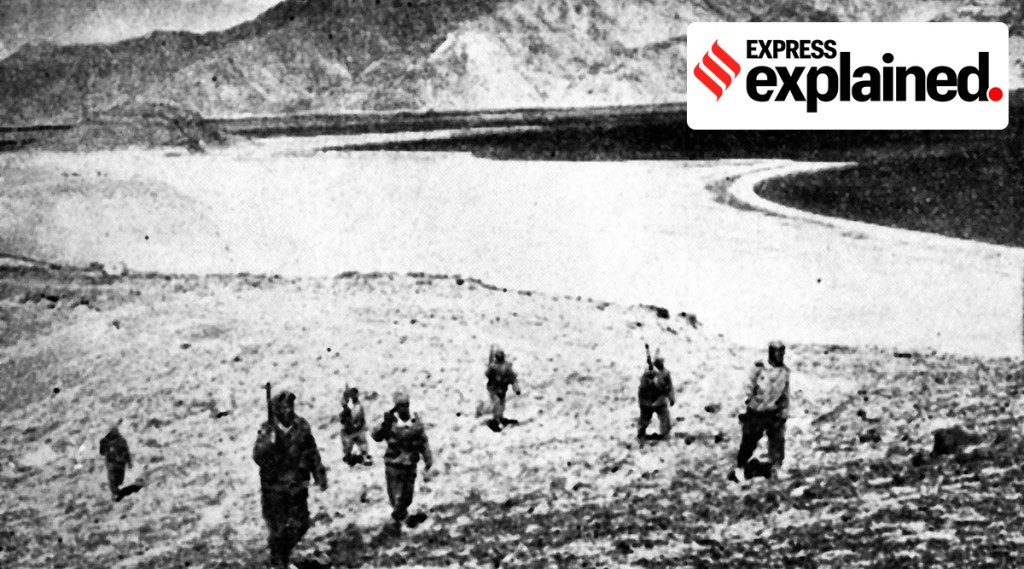
It was in early October 1962 that Chairman Mao Zedong decided to launch a large-scale invasion to severely punish India. While the main offensive was to be in the Eastern Sector, coordinated operations in the Western Sector were to be undertaken to capture areas up to the 1960 Claim Line in eastern Ladakh, which entailed elimination of 43 Indian posts. Gaining control over entire Aksai Chin was essential to guarantee security of the Western Highway, linking Kashgarh in Xinjiang to Lhasa in Tibet.
The People’s Liberation Army (PLA) offensive began on October 20, 1962, simultaneously in the Eastern and Western Sectors. The operations in Aksai Chin were executed in two phases. During Phase One (October 20-28, 1962) PLA went on to clear Indian posts at Daulat Beg Oldie, Galwan, astride both banks of Pangong Tso and Dungti-Demchok areas. Phase Two was launched after a tactical pause of three weeks on November 18, 1962 to capture the strategically important Kailash Range.

Reorganising India’s defences
The Karakoram Range ends on the northern side of the Pangong Tso. The Kailash Range originates from the southern bank and runs northwest to southeast for over 60 km. The Kailash Ridge is characterised by rugged, broken terrain with heights varying between 4,000-5,500m, and its key features include Helmet Top, Gurung Hill, Spanggur Gap, Muggar Hill, Mukhpari, Rezang La and Rechin La. The Ridge dominates Chushul Bowl; an important communications centre.
The lull following Phase One was utilised by the Indian Army to reorganise its defences. The 3 Infantry Division was raised at Leh on October 26, 1962 under Major General Budh Singh. The HQ of 114 Infantry Brigade was moved to Chushul, the 70 Infantry Brigade took over the responsibility of Indus Valley Sub Sector, and the I63 Infantry Brigade was inducted for the Defence of Leh.
Deployment at Chushul
The 114 Infantry Brigade responsible for Chushul area was holding a frontage of around 40 km, and was deployed as under:-
- 1/8 Gorkha Rifles covered the northern side of Spanggur Gap. Its two companies were deployed on the Gurung Hill, another company was deployed to the North, and a fourth company was in the Spanggur Gap itself with Battalion HQ along with an ad-hoc company at the Chushul airfield.
- 13 Kumaon was on the southern side of the Spanggur Gap with two companies on the Muggar Hill, one company at Rezang La, and a fourth company along with Battalion HQ south of it.
- Brigade HQ along with 1 JAT and two troops AMX 13 tanks of 20 Lancers were located at Chushul. 13 Field Regiment less a battery, equipped with 25 Pounder guns, was in support.
Chinese plan of attack
The plan duly approved by the Central Military Commission (CMC) envisaged capturing both Rezang La and Gurung Hill simultaneously. Troops comprising three battalions of the PLA’s 4 Infantry Division along with supporting units were concentrated in Retuzong area, about 40 km from the border. All these units had been in action during Phase One as well. As per instructions from the CMC, operations were to be confined to the positions on the ridge line only.
Battle of Rezang La
The C Company of 13 Kumaon, responsible for the defence of Rezang La, was deployed two platoons up (Strong Points 7&9 ) with a third platoon and Company HQ on Point 5150 (Strong Point 8) in the centre. Besides, there were supporting detachments of 3-inch mortars, heavy machine guns and rocket launchers.
The Chinese, having carried out detailed reconnaissance of Rezang La, planned to outflank the position at night and attack simultaneously from the northern and southern directions at first light. Accordingly, the attacking troops were divided into two task forces. One task force, composed of 3rd Battalion less company of 11th Regiment, was to attack Strong Point 9 from the south. The second task force, composed of two companies (one each from the 3rd Battalions of 10th & 11th Regiments), was to attack Strong Point 8 from the North. The 3rd Battalion less company ex-10th Regiment, and 3rd Cavalry less two companies, were to act as reserves.
The two task forces started from Retuzong at 8 pm November 17 and were in their respective firm bases by 6 am on November 18. Following brief artillery bombardment, the attack commenced from both directions at 9:15 am. A fierce battle ensued, with the defender beating back successive Chinese attacks. With communication snapped and the position encircled, leaving no possibility of the C Company being reinforced, it was “do and die” situation. Major Shaitan Singh, the Company Commander, even launched a local counterattack. Finally, by employing reserves, the Chinese did manage to break through and Rezang La fell by 10 pm November 18.
It was an epic battle, literally fought to the “last man, last round”. Of the total 141 personnel at Rezang La, 135 fought to the finish and 5 were taken prisoners, with one lone survivor. Major Shaitan Singh was posthumously awarded the Param Vir Chakra. The Chinese suffered 21 killed and 98 wounded.
Battle for Gurung Hill
Gurung Hill was held by two companies of 1/8 GR (Strong Points 16, 5 & 6) located northeast at Spanggur Gap. Strong Point 16, the most dominating feature, was at a height of 5,100 m. It was held by a company minus a platoon. The defences were well coordinated and covered by a protective minefield. The position was supported by a troop of AMX 13 light tanks.
The task to capture Gurung Hill was assigned to Ali Detachment, the holding formation. A force of eight sections was mustered and duly reinforced by a platoon each of engineers and flame throwers, one heavy machine gun, one 57 mm recoilless gun and twelve 82mm mortars for fire support. One company of 3rd Cavalry was to act as reserve.
The operation to capture Gurung Hill began at 9:22 am November 18, coordinated with the attack on Rezang La. It was preceded by brief artillery bombardment. In the face of stiff resistance from Gorkhas with tanks in a direct shooting role, the Chinese suffered heavy casualties and the attack was stalled. On regrouping and reinforcements joining in, the PLA resumed the offensive at 11 am. After repulsing repeated attacks with no reinforcements coming by, the position was captured by PLA towards last light on November 18. The intensity of fighting can be gauged from the casualties — 1/8 GR suffered 50 killed and several wounded while the Chinese sustained over 80 (killed and wounded). The PLA could not capture the remaining part of Gurung Hill i.e. Strong Points 5 & 6.
While only Rezang La and part of Gurung Hill had been captured, a decision was taken at the highest level to pull back from the Kailash Ridge and redeploy West of Chushul on the night of December 19. The Chinese did not follow the withdrawing troops or go for Chushul airfield. The PLA had only division-plus at their disposal for the operations in Aksai Chin, and hence were severely constrained to undertake any further operations. On the other hand, India’s 3 Infantry Division had the capability to launch a limited counteroffensive. After declaring ceasefire on November 21, Chinese troops fell back to depth positions due to logistics constraints.
August 2020: the present
The course of history was set to reverse 58 years later when. on August 30, 2020, the Special Frontier Force (SFF) troops secured Kailash Ridge as a pre-emptive operation, taking the PLA by surprise. This action proved a game-changer, neutralising gains made by the Chinese along the northern bank of Pangong Tso and rendering PLA positions east of Spanggur Gap-Maldo Garrison totally vulnerable. Why the PLA did not go for Kailash Ridge initially as part of its aggression in May 2020 could be because of two plausible reasons: first, paucity of infantry as 4 Infantry Division, now motorised, not suited to hold ground, and second, a presumption that Indian Army will not venture to undertake proactive counteractions.
In 1962, it was on the Kailash Ridge that Indian soldiers proved their mettle and made the PLA pay a heavy price, despite being poorly equipped and ill-prepared. Today, given a rich experience in high altitude-cum-glacial warfare, coupled with vastly improved equipment and infrastructure, the Indian Army is well positioned to hold the Kailash Range for good. The Chinese, on the other hand, are beginning to realise the harsh realities of winters at the Line of Actual Control (LAC).
Aware of the inability to regain Kailash Ridge with the current force level, and with the window for launching major operations already foreclosed due to the onset of winter, the Chinese may use all ploys to negotiate the Indian Army’s pull-back from south of Pangong Tso. India should be wary of past mistakes and avoid falling into the Chinese trap. The PLA’s current aggression, wherein it flouted a series of agreements signed between the countries over last three decades to unilaterally alter the status quo along the LAC, is a case in point.
The Kailash Ridge marks a tryst with history, a turning point, as it is the first piece of territory that has been recovered from Chinese illegal occupation, but definitely not the last one as India’s claim line is the Johnson Line of 1865. External Affairs S Jaishankar recently said that India was being tested in the seven-month-long standoff with China in eastern Ladakh. Therefore, it is time to convey a stern message to the Chinese leadership that India will not compromise on its sovereignty.

 Share


