A National Investigation Agency (NIA) court in Chhattisgarh’s Bastar district sentenced 10 Maoists to death on charges of criminal conspiracy and murder for their alleged involvement in the Jhiram Ghati attack.
In the deadly 2013 attack, armed cadres of the banned Communist Party of India (Maoist) surrounded and attacked a Congress convoy. At least 27 people were killed, and 38 people were injured in the attack that nearly wiped out the Congress leadership in the state.
The accused have been convicted under several sections of the Indian Penal Code (IPC) and the Unlawful Activities Prevention Act. The death sentence was awarded for criminal conspiracy (120-B) and murder (Section 302) of the IPC.
What was the Jhiram Ghati attack?
The attack took place on May 25, 2013, around 4.15 pm on a national highway in Jhiram Ghati, which is near the inter-district border of Bastar and Sukma.
The then state Congress chief Nand Kumar Patel and his son Dinesh were among those killed, along with former Leader of Opposition Mahendra Karma, former Union minister Vidyacharan Shukla, senior Congress leaders Uday Mudliyar and Yogendra Sharma, and others, including security personnel.
Mahendra Karma, who had been associated with the Salwa Judum anti-Maoist movement, was considered a key target of the Maoists.
According to the NIA chargesheet, the attack was planned as part of the CPI (Maoist)’s Tactical Counter Offensive Campaign (TCOC), with Maoist commanders holding meetings in early 2013 to target “class enemies”, specifically Mahendra Karma.
The banned Communist Party of India (Maoist) surrounded and opened fire on the convoy of Congress leaders, who were taking out a “Parivartan (change) rally” ahead of Assembly elections that were to take place later that year.
What happened in the investigation?
Two days after the incident, the NIA took over the investigation.
On September 25, 2014, the NIA submitted a chargesheet against nine arrested persons in the NIA Special Court in Jagdalpur city in Bastar. On September 28, 2015, the agency filed a supplementary chargesheet against 30 accused.
The trial lasted more than a decade, with at least 294 hearings. The court delivered its judgment on September 5, convicting 10 accused. The quantum of punishment, including the death sentence, was announced on September 16.
Of the 11 accused arrested in the case, one died during the trial. Another 28 accused named in the chargesheets remain wanted. Among them are Maoist leaders Thippiri Tirupathi alias Devuji and Barse Deva, who surrendered earlier this year, and Ganesh Uikey, who was killed in an encounter in December 2025.
What are the political developments around the case?
Congress leader Kawasi Lakhma, an MLA from Sukma, survived the attack and was later questioned by the NIA, but no proof of conspiracy was found against him.
The case has remained politically contentious, with the BJP and Congress making competing allegations over whether a larger conspiracy behind the attack was properly investigated. In 2025, BJP leader JP Nadda alleged, without naming anyone, that some Congress leaders had provided “inside information” to Maoists. Congress, meanwhile, has alleged that the names of two alleged key conspirators, Ramanna and Ganapathi, were removed from the case after the NDA came to power in 2014. BJP leader Raman Singh has rejected the allegation that the larger conspiracy was not investigated.
After the Congress came to power in Chhattisgarh in 2018, then chief minister Bhupesh Baghel announced a 10-member Special Investigation Team (SIT). The SIT registered a fresh FIR in 2020 based on a complaint alleging that the larger conspiracy had not been covered in the NIA probe. The NIA later approached the Supreme Court seeking transfer of the case to it, but the apex court refused to interfere.
The latest status of the SIT probe remains unclear.

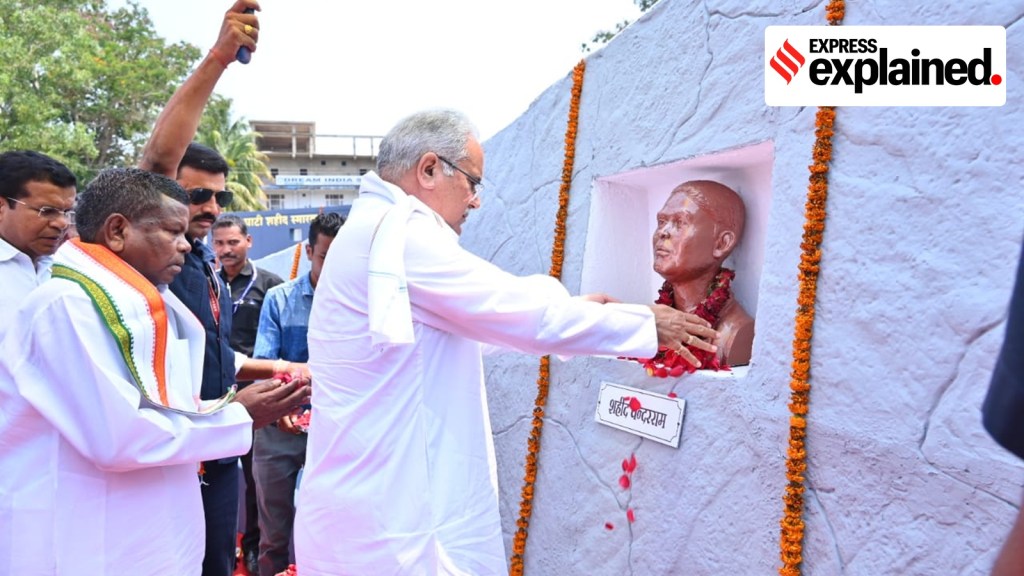 Former CM Bhupesh Baghel and former minister Kawasi Lakhma pay respects to those killed in the Jhiram Ghati attack on its 10th anniversary in 2023. (File)


 Share


