The twin-engine Boeing 737-800, arriving from Bangkok, had 175 passengers and six crew members onboard. Only two, both cabin crew members, survived the deadliest air crash in South Korea.
Belly-landings are risky and carried out only in an emergency. With the landing gear up, the wings are very close to the ground when an aircraft touches down. Therefore, the wings must be held absolutely ‘level’ (parallel to the ground). With even a slight left or right bank either by the pilot or a strong gust of wind, a wing could hit the ground, flip the jet, send it cartwheeling or break it apart.
Even if the landing goes well and everyone walks out alive, a belly-landing results in considerable damage to the plane, its engines and wings as the aircraft skids to a stop and can leave those onboard injured. The friction generated by the aircraft skidding on the runway can also create sparks or result in a fire.
A cockpit crew decides to land an aircraft on its belly in the following situations:
- Landing gear fails to deploy.
- A stricken aircraft cannot make it to an airport and landing is done in a field. The pilot considers skidding the aircraft to a stop safer than touching down on wheels.
- Ditching: when an aircraft makes an emergency landing on water.
- Any other situation a pilot considers a belly-landing safer than landing on wheels.
That said, there have been incidents where pilots, task-saturated or distracted during the extremely busy phase of landing, simply forgot to deploy the landing gear and landed aircraft on their belly. Pilots are also humans and fallible.
Landing gear fails to deploy
Jeju Air flight 7C2216’s pilots were warned by the air traffic controller (ATC) on duty at Muan of the presence of birds in the airport’s vicinity and possibility of a bird strike (birds colliding with the aircraft). Minutes later, the pilots declared a Mayday and were cleared to land from the opposite direction, a BBC report said.
“Cleared to land from the opposite direction” possibly means ATC cleared flight 7C2216 to land from a direction opposite of what the crew planned.
A runway has two ends. Let’s say a flight is cleared to land from a specific end of the runway but later, ATC requests the crew to land from the other end. ATC can make such a request for several reasons. In the Jeju Air crash, the crew had declared an emergency and needed to land at the earliest.
Why the pilots declared an emergency is not known yet. It has been speculated that the Boeing 737’s landing gear failed to deploy. Experts have questioned the theory. Rightly so.
Bird ingestion can disable an aircraft’s engines, dent the aircraft’s skin, damage navigation / communication antennas fitted around the aircraft or break the windshield / window glasses in rare cases. But a bird strike damaging an aircraft’s retracted landing gear — retracting into bays locked by hydraulically operated doors in flight — is unlikely.
Moreover, if a crew decides to carry out a belly-landing at an airport, there is a procedure for it. Fire trucks and emergency services must be ready to respond to a possible fire or evacuate passengers and crew after the aircraft comes to a stop. Foaming the runway with a chemical before belly-landings to suppress sparks and fire, which was in practice decades ago, is no longer required.
In the Jeju Air crash, it’s unlikely the landing gear malfunctioned and failed to deploy.
A more likely possibility is Jeju Air’s crew decided to carry out a belly-landing because they considered it safer than landing with the gear down. Why?
Landing long and fast
‘Landing long and fast’ is an aviation term that means an aircraft touches down far beyond the designated touchdown zone on the runway, leaving the crew with less runway length to stop the aircraft, and at a speed far exceeding the recommended landing speed.
From videos of the crash, the Boeing 737 appears to land ‘long and fast’. Experts and officials quoted by news reports too have said so.
It is possible that at some point during the approach, the Captain realised this: That the jet was coming in ‘long and fast’ and that they were going to ‘overshoot’, that is land far beyond the touchdown zone. A go-around — calling off the approach — was perhaps not possible. The Captain must have decided that landing on the belly was safer, offering better chances to stop the aircraft within the runway than landing on wheels. It’s only a conjecture but what actually went wrong will be known only from the official investigation report.
Why did the jet come in fast?
A passenger on flight 7C2216 texted a relative that a bird was stuck in the wing, according to Reuters and BBC reports, the clearest clue yet that the aircraft was hit by a bird or a flock of birds. Just how many birds and what type of bird, small or big, we don’t know yet. Did a bird get stuck in the wing, or was it many birds, and in what part of the wings were they stuck?
For landing, a pilot uses slats and flaps, retractable surfaces on the front and back of wings. You can see them from a passenger window, in extended position before landing. An aircraft needs to be slowed before landing but, at slower speeds, the wings cannot generate sufficient ‘lift’ — the upward, aerodynamic force generated by the wings that keeps a plane aloft. At slower speeds, the wings need help to generate extra ‘lift’. This extra ‘lift’ comes from the slats and flaps.
One of the possibilities investigators will examine is whether birds stuck in critical areas of the wings prevented the Jeju Air crew to deploy flaps before landing. If the crew was unable to extends the flaps, then landing at a slower and recommended speed was perhaps not possible. And the crew had no choice but execute a high-speed landing.
Here’s why.
But first a line about ‘stall’. A ‘stall’ is a condition when an aircraft stops flying forward and starts dropping from the sky like a stone. An aircraft can ‘stall’ if its nose is raised too high, which disturbs the smooth flow of air around the wings spoiling generation of ‘lift’. An aircraft also ‘stalls’ at slow speeds, which again spoils generation of ‘lift’.
Flaps & stall speed
With flaps, an aircraft’s ‘stall’ speed is lower. Without flaps, an aircraft’s ‘stall’ speed is higher. For example, suppose an aircraft’s ‘stall’ speed with flaps is 80 knots. For the same aircraft, without flaps, the ‘stall’ speed could be 120 knots. So, with flaps extended, the plane won’t ‘stall’ at speeds above 80 knots. But without flaps, a crew needs to fly the aircraft above 120 knots to prevent a ‘stall’.
This perhaps explains why the Jeju Air Boeing came in fast.
Braking
Modern jets are slowed down in broadly three ways: Using thrust reversers, spoilers and wheel brakes.
* Thrust reversers: Once an aircraft touches down, the thrust from the engines is redirected in the reverse direction, slowing down the plane.
* Spoilers or speedbrakes: Mounted on the wing’s surface and flushed during flight, the movable panels deploy after a plane lands, slowing it down with aerodynamic ‘drag’.
* Wheel brakes: Conventional (operated by pilots) and auto brakes.
Modern jets are highly automated. For example, an aircraft’s automation / computer might prevent auto brakes from deploying unless it ‘senses’ that the aircraft is in landing configuration, flaps are extended and the wheels are on the ground.
In the Jeju Air crash, investigators will look at what sort of braking was available to the crew with the landing gear retracted.
Last chance?
When they realised the Boeing 737 was not going to stop on the runway, did the crew try to swerve the plane into the huge, open space beside the runway and attempt a 180-degree turn using rudder? Perhaps, it was their last chance at survival. In the video, one can see flat, empty land on both sides of the runway.

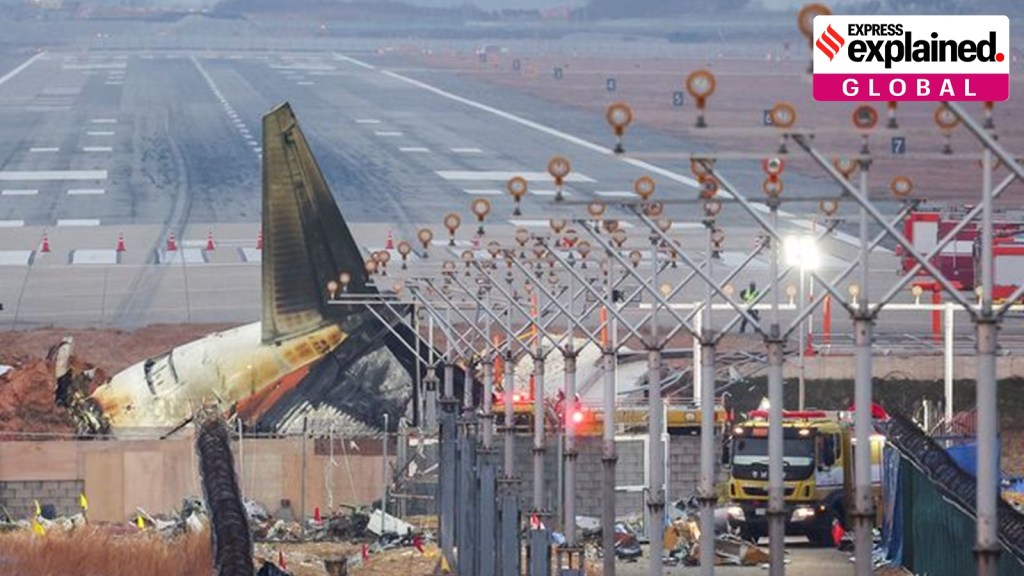 Jeju Aircraft Crash: The wreckage of the Jeju Air aircraft that went off the runway and crashed lies at Muan International Airport, in Muan, South Korea, December 30. (Photo: Reuters)


 Share


