
Understanding the Palestinian roots of intifada, and its context in Kashmir
Intifada is an Arabic word that means to shake off. It came into popular usage in December 1987 when the Palestinians used it to describe their uprising against the Israeli presence in West Bank and Gaza. In a 1989 essay titled Intifada and Independence, Edward Said, the scholar-intellectual who taught at Columbia University, described the […]
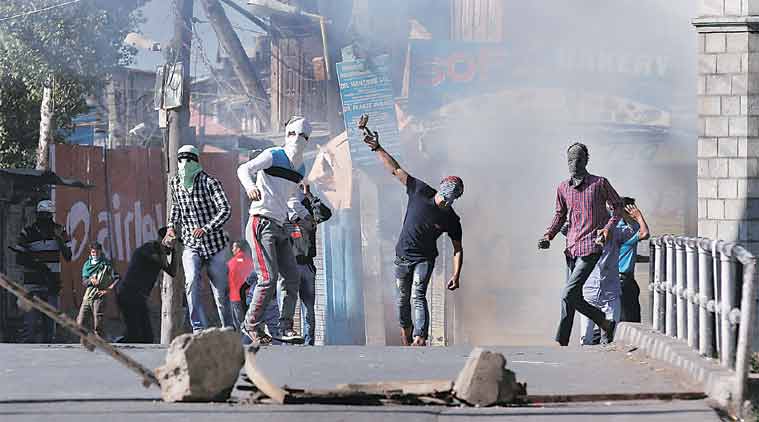 Stone-throwing protesters target security forces in Srinagar on Sunday. (Source: Reuters)
Intifada is an Arabic word that means to shake off. It came into popular usage in December 1987 when the Palestinians used it to describe their uprising against the Israeli presence in West Bank and Gaza. In a 1989 essay titled Intifada and Independence, Edward Said, the scholar-intellectual who taught at Columbia University, described the intifada as the response of a people pushed to the wall by the “bare-knuckled” Israeli attempt to rob them of their history, land and nationhood.
The trigger for the uprising was a car crash in which 4 Palestinians were killed by an Israeli driver at a checkpoint, an incident the Palestinians believed was no accident. Protests spread fast, taking even the Palestine Liberation Organisation (PLO) leadership by surprise, and continued until 1993. This was to be later called the First Intifada, to distinguish it from the Second, the uprising of 2000. The enduring image of both intifadas was of Palestinian youth and pre-teens throwing stones and pieces of concrete on Israeli soldiers in armoured vehicles.

Though throwing stones and Molotov cocktails may not meet everyone’s standards of non-violence, Palestinians did not see the intifada as “armed” resistance. Rather, stones in the hands of children seemed to underline the helplessness of Palestinians.
“[T]he symbols of the intifada — the stone-throwing children — starkly represented the very ground of the Palestinian protest, with stones and an unbent political will standing fearlessly against the rows of well-armed Israeli soldiers, backed up by one of the world’s mightiest defence establishments…, bank-rolled unflinchingly and unquestioningly by the world’s wealthiest nation, supported faithfully and smilingly by a whole apparatus of intellectual lackeys… The time had come to start trying to change realities, from the bottom up,” Said wrote.
In the same essay, he narrated how the November 1988 meeting of the Palestinian National Council, formally called the Intifada Meeting, adopted the resolution to declare the independence of the Arab State of Palestine, marking the transformation of the Palestinian struggle from a “liberation” movement to an “independence” movement, and the acceptance that an Israeli state and a Palestinian state could exist alongside each other.
Speaking at the Palestine Center in Washington DC in 2008, a year after her book, A Quiet Revolution: The First Palestinian Intifada and Nonviolent Resistance, was published, political scientist Mary Elizabeth King explained how the word intifada had previously been used by Palestinian students in the early 1980s against Israeli military orders that they saw as going against their academic freedom.
“The students chose a deliberately, specifically, linguistically nonviolent word with no connotations of retaliation or vengeance,” King said. In her book, she argued that the use of ‘intifada’ was a conscious decision by Palestinian intellectuals to move away from the aim of “liberation” and “revolution”, towards negotiation with the enemy — in the realisation that the clock could not be turned back to before 1948, and that Israel was there to stay.
She detailed the civil disobedience aspects of the uprising, including the non-payment of taxes, labour and trader strikes, boycott of Israeli-made goods, protest marches, and resigning of Israeli government jobs. The intifada was spearheaded by local committees under a Unified National Leadership of the Uprising, with Palestinian intellectuals such as Hanan Ashrawi and Murad Awad playing leading roles. The PLO supported the intifada but did not assume its leadership. The intifada also marked the coming out of women in public life.
By the end of 1988, the non-violence of the intifada broke down. UNC leaders were jailed, and Israel responded with force.
***
Kashmiris have used the term intifada for several years to describe their own protests against Indian forces. The new generation of protesters sometimes links it to the 2008 Amarnath land agitation, when stones flew for the first time in Kashmir. But mostly, it is the 2010 unrest, which came to be known as the “stone-pelting agitation”, that they describe as Kashmir’s first intifada.
Some in the national media and public intellectuals too have described the 2010 unrest — and the current uprising — as an intifada.
A Google search throws up at least one reference to the 1990s militancy as ‘intifada’ in a Pakistani journal. But it was the Lahore-based Kashmir Action Committee of Pakistan that perhaps used the word for the first time in 2010 to describe the protests following the Machil fake encounter. It quickly gained currency among Kashmiris, but was still not widely used in Pakistan at the time.
In fact, in 2010, Pakistan seemed to have hardly noticed the 5-month long stone-throwing in Kashmir. As many as 112 young children were killed in firing by the police and CRPF, but it caused hardly a blip on Pakistan’s Kashmir radar. The Pakistani government had problems of its own: massive rainfall had led to the Indus bursting its banks, flooding the plains along its entire route, killing nearly 2,000 people, and rendering some 4 million homeless. Also, Prime Ministers Manmohan Singh and Yusuf Raza Gilani had met at the Thimphu SAARC summit that April, and the post-26/11 frost in ties had begun to thaw at the edges.
***
Prime Minister Nawaz Sharif’s use of intifada in his Kashmir-dominated speech at the UN General Assembly last week was the first time that Pakistan used the word officially for any domestic or international audience. Said noted in his 1989 essay that it was “the only Arabic word to enter the vocabulary of 20th century world politics”. Still, it has never been used — other than sporadically for Kashmir — to describe a people’s movement outside the Arab world.
Sharif evidently meant to equate the Israeli state with the Indian state, the Palestinian suffering with the Kashmiri suffering, linking the two in a continuum of repression that the Muslim world in general has to deal with. To refer to the intifada was a way to internationalise Kashmir, to bring to it more global attention than it has received of late, and particularly to rally the Islamic word around it. Sharif may have even thought that using an Arabic word may give Kashmir a new cultural context distinct from its Indic moorings.
And yet, the Palestinian intifada had its own historical context, a secular goal, internal and external circumstances, and specific trajectory of evolution. Palestinians have not claimed proprietary rights over the use of the word, but it is now associated inseparably with their struggle. Also, despite the Hindutva fantasy/aspiration for India to become an ‘Israel’, for the world, the two countries are not in the same category of nation states.
For these reasons, intifada may never become the popular nomenclature for the stone-throwing in Kashmir. The foreign ministers of the Organisation of Islamic Co-operation countries meeting on the sidelines of the UNGA a day after Sharif’s speech backed the Kashmiri “right to self-determination”, but no one used the word intifada.
 Share


