Long anxious about China’s connectivity projects in the region under its decade-old Belt and Road Initiative, frustrated by Pakistan’s refusal to allow overland access and a futile quest for credible connectivity through Iran into the Eurasian landmass, India has finally found a formula to connect to both Arabia and Europa.
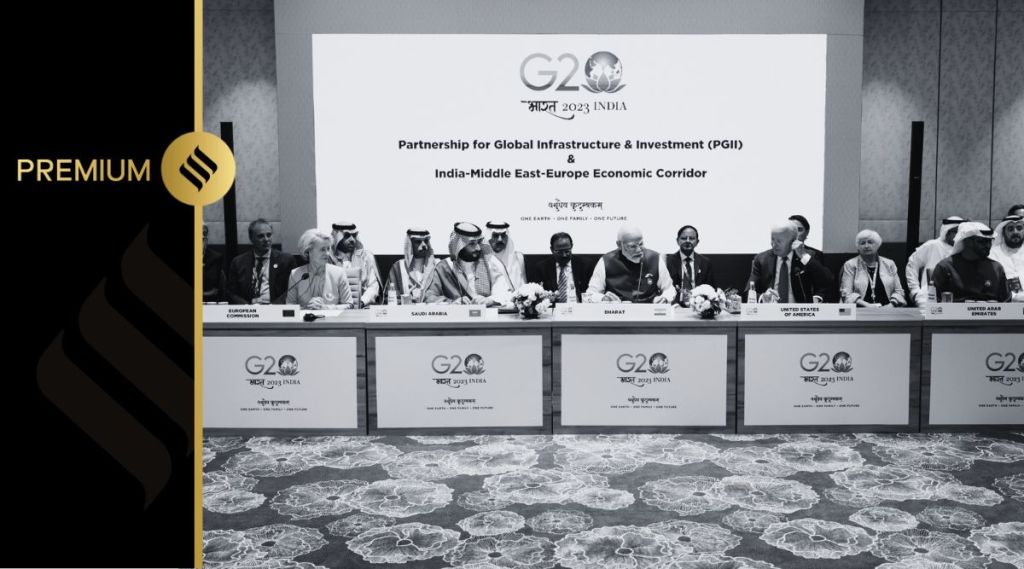
The idea of ship and rail connectivity between India and the Arabian peninsula came up when National Security Adviser Ajit Doval met his US counterpart Jake Sullivan in May this year. Since then, the idea has acquired much traction a lot faster than anticipated. The presence of all the key actors in New Delhi for the G20 summit, including the European Union, Saudi Arabia, the United Arab Emirates, and the United States, provided the opportunity to unveil the formal framework for pursuing this transformative project.
The project would involve the building of a railway line across the Arabian Peninsula through the United Arab Emirates and Saudi Arabia and develop shipping connectivity to India and Europe on either end of this corridor.
The corridor could be further developed to transport energy through pipelines and data through an optical fibre link. The project could include other nations like Israel when Riyadh and Tel Aviv establish normal relations.
The project underlines several new geopolitical trends.
First, just a few years ago, the conventional wisdom in Delhi said India and the United States might work together in the Indo-Pacific but had little in common in the Middle East. That myth was broken when India and the United States joined hands with Israel and the United Arab Emirates to set up the I2U2 forum to develop a few joint economic projects. The India-Arabia-Europa corridor could turn out to be far more consequential.
Second, it breaks Pakistan’s veto over India’s overland connectivity to the West. Since the 1990s, Delhi has sought various trans-regional connectivity projects with Pakistan. But Islamabad was adamant in its refusal to let India gain access to land-locked Afghanistan and Central Asia.
Third, Tehran is more open to India, but its confrontation with the West has cast a shadow over the commercial utility of corridors across Iran into Eurasia.
Fourth, the corridor will deepen India’s strategic engagement with the Arabian peninsula. The Modi government, which had rapidly elevated political and strategic links with the United Arab Emirates and Saudi Arabia in the last few years, now has an opportunity to build enduring connectivity between India and Arabia.
During the years of the British Raj, the subcontinent’s resources played a key role in linking India, Arabia, and Europa. The current project will restore India’s role as a driver in shaping regional connectivity.
Fifth, the mega connectivity project could, in the words of US officials, help “bring down’ the political temperature in the Arabian peninsula by promoting intra-regional connectivity. “Infrastructure for peace” has long been an alluring but elusive goal for the Middle East. It remains to be seen if the current corridor will break that jinx.
Sixth, it is no secret that the new corridor is being presented as an alternative to China’s Belt and Road Initiative, which a number of countries in South Asia, the Middle East, and Africa have embraced. A lot would depend on the speed at which the new corridor is implemented and its ability to avoid the problem of sustainability — financial as well as ecological — associated with the BRI.
Seventh, the corridor also marks the mobilisation of Europe into the infrastructure development in the region. The European Union had earmarked 300 million Euros for infrastructure spending worldwide during 2021-27. Its support for the new corridor will make the EU a major stakeholder in integrating India with Arabia and Europa.
Finally, the US and the EU have envisaged a plan to build a Trans-African corridor connecting Angola, the Democratic Republic of Congo, and Zambia. India, which has stepped up its engagement with Africa in general and especially with countries trying on the Indian Ocean coast, would want to team up with the US and EU in Africa.
(C Raja Mohan is a senior fellow with the Asia Society Policy Institute, Delhi and a contributing editor on international affairs for the Indian Express)



 Share


