
 The forest and wildlife activists argue that over 60% of forest-dwellers are landless, “which means only 40% are trying to control the entire land in contention”.
On February 28, the Supreme Court put on hold its February 13 order directing states to evict tribals and other forest-dwellers whose claims over encroached forest land had been rejected under the law that recognises these rights and provides a framework for recording them.
Following protests, the Union Tribal Affairs Ministry and the Gujarat government had sought a modification of the court’s February 13 direction. These protests are ongoing — on Tuesday, large demonstrations took place across the country for demands that included promulgation of an ordinance to overturn the Supreme Court’s order.

The February 13 order came on a challenge to The Scheduled Tribes and Other Traditional Forest Dwellers (Recognition of Forest Rights) Act, 2006 — commonly known as The Forest Rights Act (FRA) — filed by three wildlife NGOs. The court directed 17 states that had filed affidavits on claims rejected under the Act (adding up to a total of 11,91,327 claims) to ensure that in all cases “where rejection orders have been passed, eviction will be carried out on or before the next date of hearing”.
How did the claims process work?
The process of filing claims began in 2008. The FRA recognises both individual forest rights (IFRs) and community forest rights (CFRs), which are claimed by gram sabhas. Scrutiny takes place at four levels — gram sabha, sub-divisional level committee (SDLC), district-level committee (DLC), and state-level monitoring committee (SLMC). While the SLMC monitors the process, appeals under the law lie up to the DLC, whose decisions on the record of forest rights “shall be final and binding”.
Scheduled Tribe (ST) claimants had to furnish two pieces of evidence that they were in possession of the land in question before the cut-off date of December 13, 2005; Other Traditional Forest Dwellers (OTFDs) had to show that they had been residing in the village for 75 years prior to the cut-off date, and were dependent on it for their livelihood.
The disputes are mostly over IFRs. As per a statement issued by the Tribal Affairs Ministry on August 30, 2018, the total number of rejected claims are in the order of 19.34 lakh (of which 18.88 lakh are individual claims) — much more than the cumulative number in the affidavits filed by states in the Supreme Court. Some 18 lakh claims have been accepted.
Read | SC order on eviction: Rahul Gandhi writes to Baghel
What is the argument about the order?
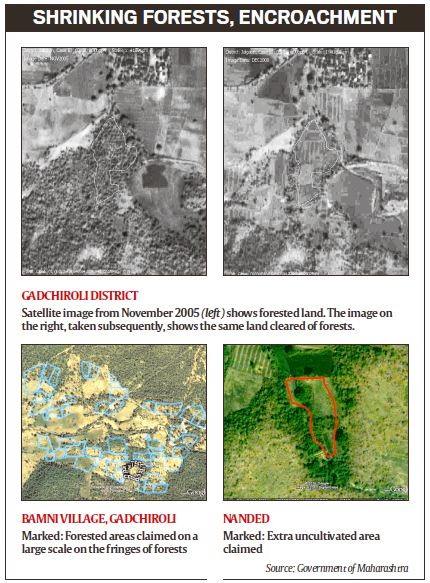
It is essentially about whether some claimants are being evicted unfairly. Both groups of activists — those who back the evictions and those who oppose it — have pointed to satellite pictures from before and after the December 13, 2005 cut-off date in support of their arguments. While tribal activists have claimed that pictures from Gujarat establish that most rejected claims were rejected unfairly, forest and wildlife activists have said satellite images prove that a large number of claims in Maharashtra and Gujarat were bogus.
What do forest and wildlife activists say?
According to the three petitioners, Praveen Bhargava of Wildlife First, Kishore Rithe of Nature Conservation Society, and Poonam and Harshavardhan Dhanwatey of Tiger Research and Conservation Trust (TRACT), “Of the over 19 lakh rejected claims, over 14 lakh were rejected at the gram sabha level itself. Tribal activists have always insisted that the gram sabha’s word would be final. So, why are they objecting to the rejections?”
Satellite images of “several bogus claims”, the petitioners say, “have proved that they were encroachments after the cut-off date”. Claims that the February 13 order would uproot tribals from their homes were tendentious, they argue: “Almost all those whose claims have been rejected already own legally-held lands. It is just that they have to give up the additional lands that they have encroached upon after the cut-off date.”
The forest and wildlife activists argue that over 60% of forest-dwellers are landless, “which means only 40% are trying to control the entire land in contention”. This illegally occupied land, they say, can be given to the village community under CFRs instead of IFRs. “It will provide the landless with additional income opportunities from the forest produce that they have traditionally gathered.”
What is the argument of tribal activists?
Ambarish Mehta and Trupti Parekh of the tribal NGO ARCH-Vahini cite opposite findings from Dediapada tehsil in Gujarat’s Narmada district. “Our study of 4,600 cases — 2,000 of them approved and 2,600 unapproved — shows that only 2% of cases were of encroachments after the cut-off date. Our findings were corroborated both by the Gujarat government’s forest research institute GEER Foundation and by the High Court, which ordered the grant of approval to the rejected ceases. But officials haven’t moved on it yet,” Mehta told The Indian Express.
According to Mehta, in many states, Forest Department beat guards steered the process at the gram sabha level. “Our satellite imagery study has also proved that not only were claims wrongly rejected, the area too, was wrongly reduced by an average of about an acre each.”
What study are the activists relying on?
The study, which the Supreme Court also considered, was conducted by the Maharashtra government’s Tribal Research and Training Institute (TRTI). It considered 40,428 finally approved IFR cases until 2007-08, 35,044 of which, covering an area of 51,600 hectares, were found to be properly measured. 570 ha were changed from forest cover to agriculture, and 641 ha from barren to agriculture after the cut-off date, the study found. A large number of cases were observed in Jalgaon (539) and Dhule (102).
Read | SC order on forest evictions: After Congress, BJP takes up cause of those affected by ruling
Another round of analysis of satellite imagery in 2011-12 showed that in six districts (Jalgaon, Nandurbar, Dhule, Nashik, Thane, Gadchiroli), the recognised area under cultivation had grown by 4% over the area under cultivation in 2007-08. Over the same period, forest and barren lands had come down from 910 ha to 433 ha and 5,476 ha to 4,605 ha respectively.
“This means the people have cleared forest cover and started cultivation there as well as in erstwhile barren land after the IFRs have been recognised on these lands,” the TRTI report said. “Further 406 cases in which forest/tree cover and 321 cases in which non-agriculture land is observed on images of 2011-12, same land had been allotted to more than one person and overlaps with more than 40% with adjacent land,” it said.
A study of satellite imagery carried out for the Maharashtra government by The Energy and Resources Institute (TERI) highlighted several instances in which cases of post-2005 encroachment had been granted rights. The TERI report, submitted in 2012, revealed that thousands of claims were of encroachments made after the cut-off date. An analysis of 66,300 cases covering 1,07,897 ha showed that 14,668 ha were encroached upon after the cut-off date. It also revealed that 1,466 cases were of claims made over lands measuring more than the permissible 4 ha.
So how reliable is the claims process?
In 2010, the N C Saxena Committee appointed by the Ministries of Tribal Affairs and Environment had pointed to several problems with the implementation of the FRA. A large number of cases had been disposed of without measuring the land, and there was an unnecessary rush to clear cases due to the elections in 2009, the Committee reported. Implementation was slow in Goa, Uttarakhand, Jharkhand, Himachal Pradesh, Tamil Nadu and the Northeast. There was inadequate representation of some sections in the Forest Rights Committees (FRCs) of gram sabhas in violation of rules. Claims had been rejected without adequate grounds, certain claimants had been helped with evidence, and some claimants had been summarily evicted without proper verification. There were also cases of forest-cutting after the cut-off date.
The report said that no state other than Maharashtra had used methods like GPS, GIS, and satellite imagery to decide on claims. Maharashtra, ironically, saw two massive morchas by farmers, one of whose demands pertained to the non-granting of IFRs despite a better record — over 2 lakh out of over 3 lakh claims — than other states.
Read | They do not understand us, our forest, say tribals in shadow of eviction
What is the area of forests at stake?
Bhargava of Wildlife First gave this estimate: The Tribal Affairs Ministry’s September 2018 report says that 18.88 lakh individual claims stand rejected after completion of due process. The total area for which individual titles have been granted is 18.87 lakh ha, or 1.03 ha per claim on average. If this average area per individual claim is applied to the 18.88 lakh rejected claims, the total area of forest land in possession of the claimants would work out to around 19.59 lakh ha.
“We have to also understand the difference between individual and community rights,” Bhargava said. “The latter doesn’t take away any forests. But by granting ineligible individual rights, we are not undoing the ‘historic injustice’ (as the FRA set out to do) done to tribals and OTFDs, but in fact doing historic injustice to precious forests that are already under grave threat from fast-accelerating climate change,” he said.
The TERI study worked with Cartosat-1 images of areas covered under 40,000 recognised forest rights cases in Jalgaon, Dhule, Nashik, Nandurbar, Gadchiroli, and Thane districts. “At least 8,104 ha, which is 20 per cent of the 40,000 ha average allotment in these cases, of ineligible forest land has been recognised,” the study said.
Said Rithe of Nature Conservation Society: “This study is up to 2012. If you consider cases in other parts of the state, and cases after 2012 as well, you can imagine the extent of ineligible allotments and claims.”
What is the way forward hereon?
The process in the Supreme Court is ongoing. Mohan Hirabai Hiralal, whose work on forests rights at Gadchiroli’s Mendha-Lekha village is reckoned as the harbinger of the CFR movement, said, “It’s true that large areas of forests were cleared after 2005, but studies like the one by ARCH-Vahini have proved that a huge number of claims have been wrongly rejected as well. Justice demands that claims are not rejected just because poor people are not able to produce sufficient evidence. Now that we have the technology to check the veracity of claims, why not use it?”
Mehta of ARCH-Vahini said he was open to the idea of revisiting not just the rejected cases but also the approved ones by using satellite imagery. “This will also weed out fraudulently approved cases,” he said.
Rithe, however, argued: “In Gujarat, the Bhaskaracharya Institute for Space Applications and Geo-Informatics had proved in 2012 that 80% of claims were bogus.”
Say Rithe, Bhargava, and the Dhanwateys: “Three Benches since 2017 have sought to know what action has been initiated against unauthorised possession. They have also sought to know details like areas and numbers of claimants in both the ST and OTFD categories. These orders have come after repeated reminders to the states to file factual affidavits. The latest SC order was based on these affidavits. Also, while everybody seems to be worried about IFR claims, nobody is serious about notifying Critical Wildlife Areas as mandated by the FRA. The logical step ahead is to free illegally occupied forest land from the possession of unauthorised claimants.”
 Share


