


Journalism of Courage
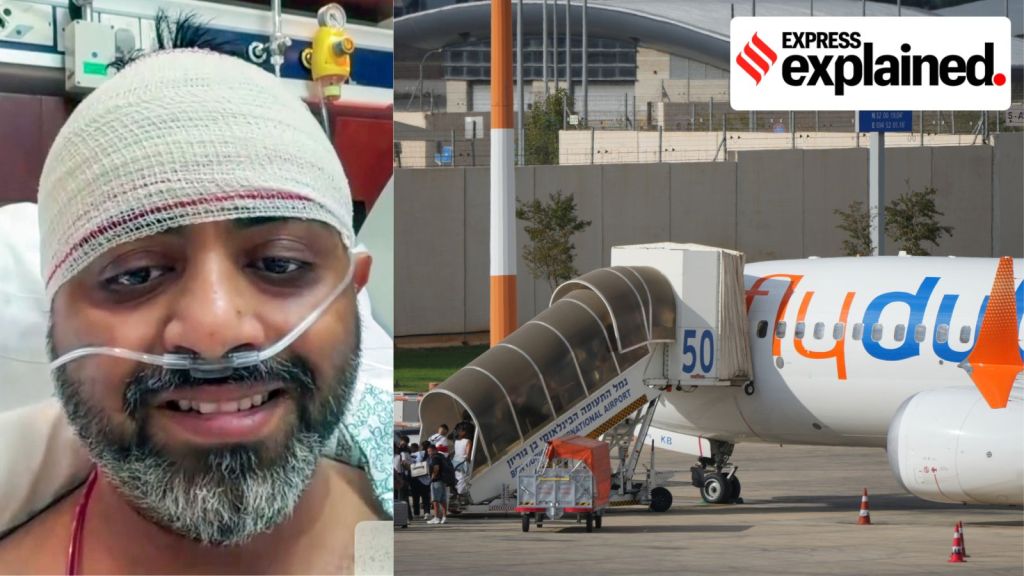 Injured Indian pilot Captain Smit Machchhar managed to open the cockpit door, alerting passengers who rushed in and helped subdue his attacker. (ANI, AP)
When the Omani co-pilot of the flydubai flight to Tel Aviv allegedly attempted to crash the aircraft on September 30, a chain of events proved crucial in landing the aircraft safely. Indian pilot Captain Smit Machchhar, bleeding from axe injuries, managed to open the cockpit door, alerting passengers who rushed in and helped subdue his attacker.
But none of this would have saved the aircraft had it not been for the fortuitous presence of two other pilots on board.
The two additional pilots took over and helped land the plane safely at 06:45 UTC in Tabuk, Saudi Arabia. The FZ1073 passengers were later transported to Tel Aviv aboard a flydubai rescue flight at 15:34 UTC the same day.
The UAE’s prosecutor has described the incident as an attempted “terrorist act” and alleged that the co-pilot, an Omani national since identified by Saudi media as Hammam al-Hammami, assaulted Machchhar inside the cockpit with a crash axe while attempting to take control of the aircraft mid-air. The circumstances and motive remain under investigation.
However, the presence of the extra pilots aboard proved fortuitous.
‘Deadheading’ pilots in the cabin
Flying with an extra set of pilots may seem counterintuitive, adding to flight costs by having to pay for two sets of pilots.
However, pilots routinely travel as passengers in the cabin while being “repositioned” for (or transported to) their next route ahead of their impending work assignment. This practice is called “deadheading”.
The term predates aviation. In 19th-century American usage, a “deadhead” was a non-paying passenger. It later came to describe transport employees travelling as passengers rather than working, the sense that eventually carried over into aviation.
Deadheading pilots travel on company assignment and under India’s DGCA rules, positioning is counted as duty. Airlines may separately compensate pilots for deadheading; IndiGo, for instance, provides a specific deadhead allowance.
Such pilots may be seated in the passenger cabin rather than operating the flight.
However, not all flights carry an additional set of pilots.
1. Long journeys
Additional pilots may be carried on long journeys for several reasons, including crew positioning and, separately, to augment the operating crew where duty-time limits require it.
National aviation regulators typically set limits on flying duty time and rest time for pilots.
In India, DGCA’s Flight Duty Time Limitation (FDTL) rules set maximum flight-duty periods (FDP) to limit fatigue.
Under the standard for two-pilot operations, the maximum FDP is 11 to 13 hours for flights with maximum flight times of eight to 10 hours, depending on flight time and number of landings. For example, an eight-hour maximum flight time permits an FDP of 11 to 12.5 hours, while nine- and 10-hour maximum flight times each permit an FDP of 13 hours.
DGCA also counts positioning, or “deadheading”, as duty; when positioning immediately precedes a flight the pilot operates, without intervening rest, it forms part of the FDP.
2. Turbulent regional conditions
According to The Jerusalem Post, the presence of the additional pilots was not necessitated by any specific security warning. More broadly, deadheading has become more prevalent among Gulf airlines amid the regional conflict, as carriers have had to reshuffle networks and capacity in response to disruptions.
Israel has been conducting an armed campaign against Palestine, with the stated aim of eliminating Hamas since October 7, 2023. And since February 28 this year, Israel and the US have been at war with Iran, a situation marked by the routine use of asymmetric warfare.
As a result, a routine 3:30-hour flight from Dubai to Tel Aviv could be delayed further by rerouting amid an active flare-up along the route, thus causing the active flight crew to operate beyond their mandated hours. Several airline carriers in the Persian Gulf have been forced to suspend, divert or cancel their flights amidst ongoing tensions.
For pilots in India, regulated working time is not limited to hours in the air. Under DGCA rules, the Flight Duty Period (FDP) begins when a pilot reports for duty and covers a flight or series of flights, ending when the aircraft comes to rest at the end of the last flight. Delays, rerouting and holding can therefore push a crew towards its maximum permitted FDP.
Thus, a longer rerouted flight can eat into the original crew’s permitted FDP even if the aircraft has spent some of that time taxiing, holding or delayed on the ground.