


Journalism of Courage
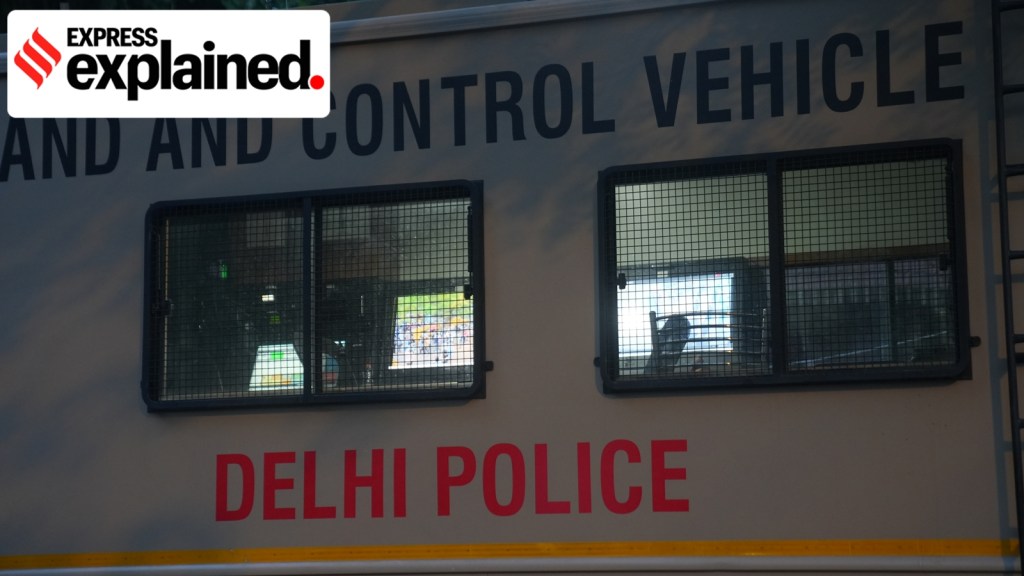 Facial Recognition System (FRS) in a Delhi Police van parked near the Jantar Mantar protest site in July-end. (Express photo by Abhinav Saha)
When the Supreme Court quashed all FIRs related to the exam leak protests by students on Tuesday (September 1), it also allowed the government to proceed against the 2,873 people who the Delhi Police claimed had criminal records and were identified by its facial recognition software at the main protest site in Jantar Mantar between July 20 and 26.
The police, meanwhile, have said that any action will be taken only after “field verification”, not merely on facial recognition.
Here’s how facial recognition systems work, why the results don’t necessarily count as proof of identity, and how the use of this technology has become increasingly common in modern policing.
Facial recognition systems analyse a person’s facial features from an image or video, convert them into a unique digital template, and compare that template against images stored in a database. If the similarity score crosses a predefined threshold, the system flags a potential match for further verification.
The Delhi Police’s facial recognition software places boxes around detected faces and compares them with images in police databases. In response to a Right to Information (RTI) request in 2022, the Delhi Police had revealed that it considered a match to be “positive” if its system showed an accuracy rate of 80 per cent.
In other words, the result is not, by itself, proof of identity.
Performance varies with the algorithm, camera angle, lighting, image quality, masks, and the database being searched. Testing by the US National Institute of Standards and Technology has found differences in error rates across demographic groups in many algorithms. Human verification, audit trails, and clearly defined thresholds are therefore the key in this regard.
Apart from the Jantar Mantar protest, Delhi Police has used the technology to identify people suspected to have been involved in the 2020 riots, the clashes that broke out at Red Fort in 2021 during the farmers’ protest and the Jahangirpuri riots in 2022.
Growing use
Across India, digital surveillance systems are increasingly becoming a key part of modern policing, with law enforcement agencies deploying networks of CCTV cameras, facial recognition technology, drone-based monitoring, automated number plate recognition systems and AI-powered video analytics.
While authorities argue that such tools improve public safety and policing efficiency, their growing use has also raised concerns among civil liberties groups over privacy, proportionality, transparency, and the absence of a comprehensive legal framework governing state-sponsored surveillance.


