Union Home Minister Amit Shah inaugurated the National Automated Fingerprint Identification System (NAFIS) on Wednesday (August 17), at the two-day National Securities Strategies (NSS) Conference 2022 held in New Delhi.
According to the Ministry of Home Affairs, NAFIS, which was developed by the National Crime Records Bureau (NCRB), would help in the quick and easy disposal of cases with the help of a centralised fingerprint database.

In April this year, Madhya Pradesh became the first state in the country to identify a deceased person through NAFIS, PTI reported.
What is NAFIS?
Conceptualized and managed by the NCRB at the Central Fingerprint Bureau (CFPB) in New Delhi, the National Automated Fingerprints Identification System (NAFIS) project is a country-wide searchable database of crime- and criminal-related fingerprints. The web-based application functions as a central information repository by consolidating fingerprint data from all states and Union Territories. According to a 2020 report by the NCRB, it enables law enforcement agencies to upload, trace, and retrieve data from the database in real time on a 24×7 basis.
NAFIS assigns a unique 10-digit National Fingerprint Number (NFN) to each person arrested for a crime. This unique ID will be used for the person’s lifetime, and different crimes registered under different FIRs will be linked to the same NFN. The 2020 report states that the ID’s first two digits will be that of the state code in which the person arrested for a crime is registered, followed by a sequence number.
By automating the collection, storage, and matching of fingerprints, along with digitizing the records of fingerprint data, NAFIS will “provide the much-needed unique identifier for every arrested person in the CCTNS (Crime and Criminal Tracking Network & Systems) database as both are connected at the backend,” former NCRB director Ram Phal Pawar had said in December 2020.
Is this the first time that such an automation project is being attempted?
Upon the recommendations of the National Police Commission in 1986, the Central Fingerprint Bureau first began to automate the fingerprint database by digitizing the existing manual records through India’s first Automated Fingerprint Identification System (AFI) in 1992, called Fingerprint Analysis & Criminal Tracing System (FACTS 1.0)
The latest iteration, FACTS 5.0, which was upgraded in 2007, was considered to have “outlived its shelf life”, according to a 2018 report by the NCRB and thus needed to be replaced by NAFIS.
Since when has India relied on fingerprinting as a crime-fighting tool?
A system of fingerprinting identification first emerged in colonial India, where it was tested before it spread to Europe and beyond. At first, it was used by British colonial officials for administrative rather than criminal purposes. William Herschel, the chief administrator of the Hooghly district of Bengal, from the late-middle 1800s onwards, used fingerprinting to reduce fraud and forgeries, in order to ensure that the correct person was receiving government pensions, signing land transfer deeds, and mortgage bonds.
The growing use of fingerprinting was deeply tied to how 19th century British officials understood crime in India. Entire social groups were categorized as racially distinct “criminal tribes” and were deemed to be “professional” criminals from time immemorial. However, the trouble that they faced was in identifying these groups from the ordinary criminals, something that the British found particularly difficult in such a diverse land.
Anthropometry, the measurement of physical features of the body, was used by officials in India, but was soon replaced with a system of fingerprints, which were seen to be more accurate as it was believed that no two people can have identical sets of patterns, wrote the historian Simon A Cole in his book ‘Suspect Identities: A History of Fingerprinting and Criminal Identification’.
How did the use of fingerprinting develop in crime fighting in India?
The uniqueness of every individual’s fingerprints was first proposed in Europe by the German anatomist Johann Mayer in 1788, and was confirmed through detailed studies by the Scottish doctor Henry Faulds around the same time that Herschel had begun to implement fingerprinting as a means of identification in Bengal.
Tracing a single set of fingerprints from a large collection of fingerprint cards required a workable system of classification, the historian Radhika Singha noted in her 2000 research article ‘Settle, Mobilize, Verify: Identification Practices in Colonial India’. While similar attempts were made in England and beyond, the Bengal Police were able to create fingerprint records which replaced the use of anthropometric measurements by 1897, when the world’s first Fingerprint Bureau was established in Calcutta, four years before a similar decision was taken in England, Singha wrote.
The Inspector General of the Bengal Police, Edward Henry, recruited two Indian sub-inspectors, Aziz-ul-Haq and H C Bose, for this task. Singha noted that it was Haq who first devised a system of primary classification and a system for indexing names in court conviction registers.
Henry, however, declined to acknowledge the crucial contributions of his Indian subordinates when he presented the so-called “Henry System of Classification” in England in 1901, and established a fingerprint bureau in Scotland Yard. It was only in 1925 that Henry admitted the invaluable efforts of Haq and Bose to the system of classification, for which the colonial state bestowed on them the titles of Khan Bahadur and Rai Bahadur respectively.

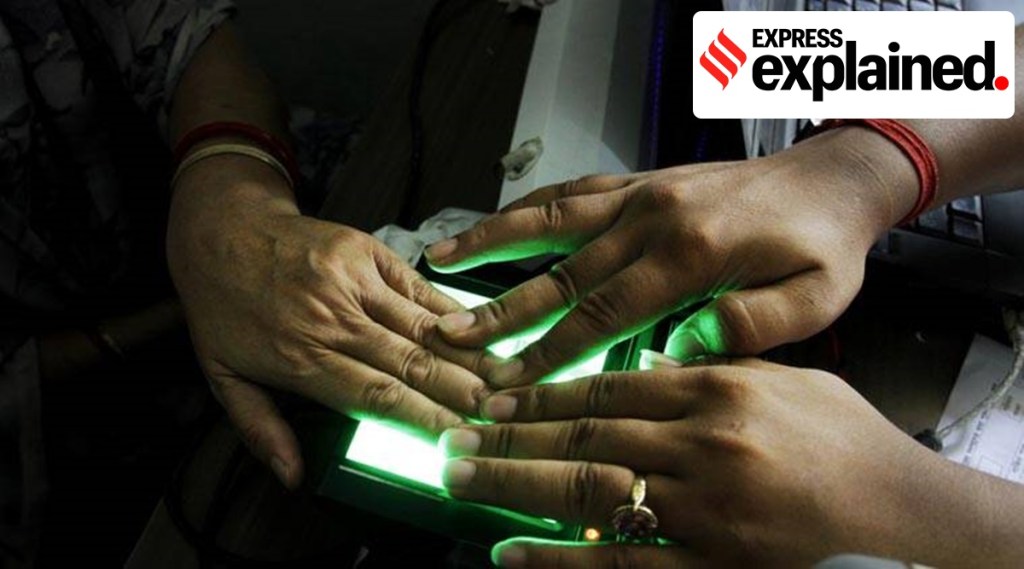 Conceptualized and managed by the NCRB at the Central Fingerprint Bureau (CFPB) in New Delhi, the National Automated Fingerprints Identification System (NAFIS) project is a country-wide searchable database of crime- and criminal-related fingerprints. (Representational image)

 Share


