A recent study has unveiled fresh details surrounding the Tanystropheus, a reptile that lived on Earth some 242 million years ago and had a remarkably elongated neck – longer than its body and tail combined.
Tanystropheus are believed to have lived around the Monte San Giorgio basin on the Swiss-Italian border during the middle Triassic period (247-237 million years ago), and were originally mistaken to be a kind of Pterosaur – a flying reptile.
However, other crucial aspects regarding the reptile were unknown. Questions such as whether it lived on land or water or both, or what its diet consisted of, had puzzled scientists ever since its fossil was first discovered some 150 years ago.
What does the new research say?
Earlier this week, in a study published in the journal Current Biology, a group of scientists studied two specimens of the reptile – a full adult and a smaller animal.
Scientists used a high-resolution computed tomography (CT scan) to reconstruct a three-dimensional (3D) prototype of the crushed skull.
“We three-dimensionally reconstructed a virtually complete but disarticulated skull of the large morphotype, including its endocast and inner ear, to reveal its morphology for the first time,” the study said.
The newly constructed prototype indicated the skull of the bigger Tanystropheus (named Tanystropheus hydroides) was structured in a way that hints it hunted underwater. “The skull is specialized toward hunting in an aquatic environment, indicated by the placement of the nares (nostrils) on the top of the snout and a “fish-trap”-type dentition,” the study said.
 A fossil of Tanystropheus at the Paleontology Museum of Zurich. (Source: Wikimedia Commons)
Dr Nick Fraser, a palaeontologist at the National Museums in Scotland and one of the co-authors of the research, told The Guardian that the animal is likely to have been aquatic most of the time, as its huge, stiff neck would have made survival on land difficult.
The mystery of the second fossil
Apart from establishing the fact that Tanystropheus were water-dwelling, scientists after studying the smaller specimen (called Tanystropheus longobardicus) came to the conclusion that it was not a juvenile, but a fully adult creature of a different species of the Tanystropheus.
Scientists also said that the skull of the smaller species was flattened and somewhat resembled a crocodile.
Research indicated that the two species coexisted in a similar habitat but consumed different things.
Fraser told The Guardian that while the smaller animal is likely to have eaten small crustaceans and fishes, the larger one was probably hunting bigger fishes and creatures like squids.
Also in Explained | Jurassic Park’s venom-spitting Dilophosaurus was fiction. What did it really look like?
Other conclusions
Researchers also concluded that Tanystropheus was a “ram-feeder”, its long neck allowing it to approach unknowing prey and then use its fang-like teeth to directly snap a bit off its prey. However, both the species were neither fast nor efficient swimmers, research indicated.
📣 Express Explained is now on Telegram. Click here to join our channel (@ieexplained) and stay updated with the latest
“That long neck wasn’t very flexible, it only had 13 vertebrae and it had ribs in it that further constrained mobility,” Olivier Rieppel, another palaeontologist who was part of the study, told CNN. However, said Rieppel, the study shows this “strange anatomy” was much more adaptive and versatile than thought before.
A similar fossil of Tanystropheus has been recently discovered in China, and scientists are trying to figure out if it is of the same species.

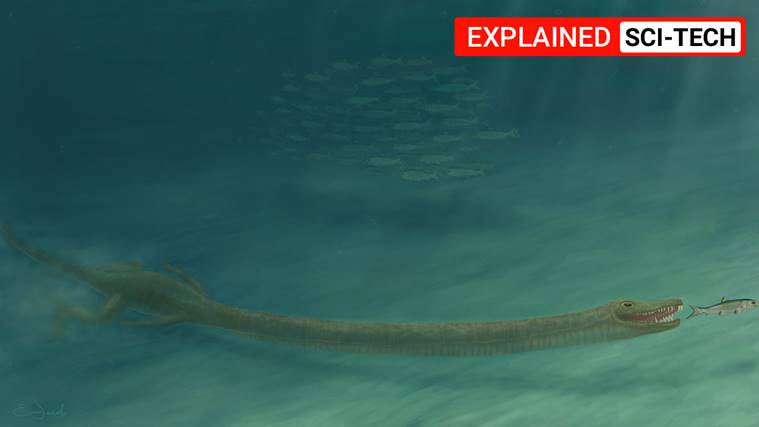 Researchers concluded that Tanystropheus was a “ram-feeder”, its long neck allowing it to approach unknowing prey and then use its fang-like teeth to directly snap a bit off its prey. (Photo: Source: Twitter.com/FieldMuseum)

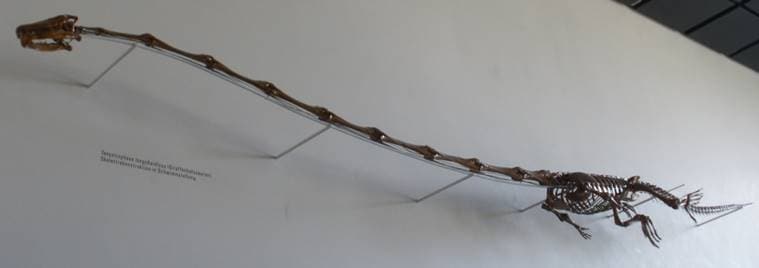 A fossil of Tanystropheus at the Paleontology Museum of Zurich. (Source: Wikimedia Commons)

 Share


