


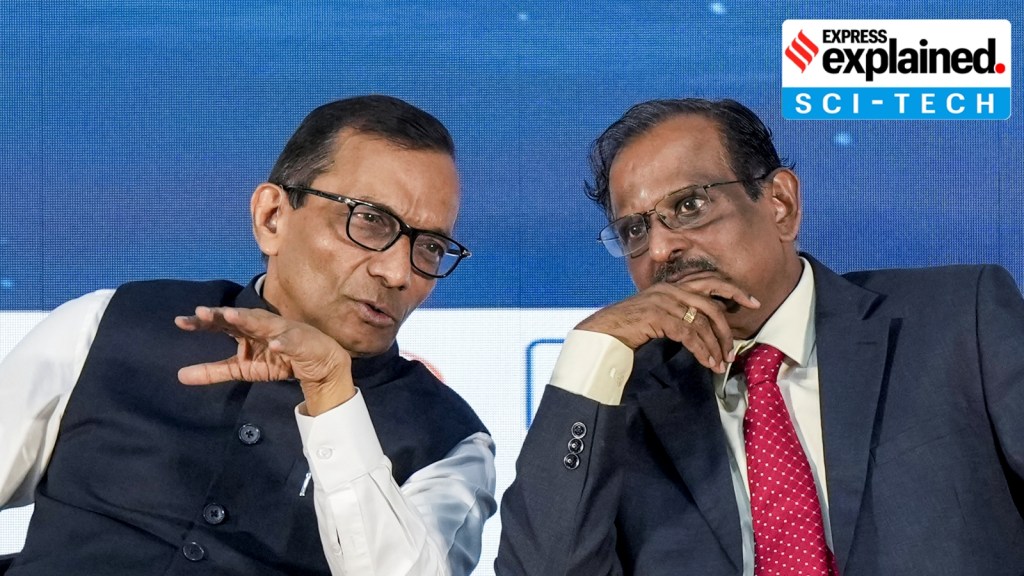
 ISRO Chairperson V Narayanan (right) with IN-SPACe Chairman Pawan Goenka during the inaugural session of the 9th Bengaluru Space Expo 2026, in Bengaluru on September 7, 2026. Photo: PTI
Several employee associations of the Indian Space Research Organisation (ISRO) recently questioned the private sector taking over the space agency’s core processes. The concerns were raised following IN-SPACe chairperson Pawan Goenka’s statement that the ISRO will eventually stop manufacturing all launch vehicles and stop operating the spaceport that is currently under development.
IN-SPACe, short for Indian National Space Promotion and Authorisation Centre, is an independent and autonomous nodal agency under the Department of Space that acts as an interface between ISRO and non-governmental entities (NGEs) and assesses how to utilise India’s space resources better.
ISRO has already started transferring several key technologies to the industry towards this end. So, employee associations asked for clarity on the space agency’s policy and the implications for the existing workforce. ISRO chairperson V Narayanan maintained that moving these activities to private entities was geared towards expansion of India’s space sector and not privatising ISRO itself.
Here’s what the space policy states, the technologies and processes being transferred by ISRO, and the reasons behind it.
After the space sector was opened up and IN-SPACe was set up in 2020, the “Indian Space Policy — 2023” was drafted to clearly define the role of ISRO, IN-SPACe, NewSpace India Limited (NSIL), and private entities.
ISRO: The space agency was to take on a research-oriented role, developing newer applications and systems, sharing the technologies with the industry, store and provide satellite data gathered, and “demonstrate human spaceflight capability and develop a long term road-map for sustained human presence in space”. It was to develop newer technologies but “transition out from the existing practice of being present in the manufacturing of operational space systems”.
IN-SPACe: The nodal agency was meant to promote private space activities, hand-hold industries, and create an enabling environment, besides providing authorisation for various activities keeping in mind national security as well as international and foreign policy obligations. It was meant to authorise the establishment of satellites, launch services, setting up of launch pads, establishment of ground stations, and proper use of orbital resources. The agency was also supposed to ensure access to various government testing and other facilities, transfer technologies, create industry-academia bridges, and create manufacturing hubs.
NSIL: NSIL, a public sector undertaking under the Department of Space, is ISRO’s commercial arm. It was to be responsible for commercialising the publicly developed space technologies and service space-based needs for users — this is where some of NSIL’s role overlaps with that of IN-SPACe. Now, NSIL mainly focuses on providing commercial launches to Indian and international clients.
Private entities: NGEs shall be allowed to undertake end-to-end activities in the space sector through establishment and operation of space objects, ground-based assets, and related services such as communication, remote sensing, and navigation, among others.
What key technologies and processes are being transferred?
The space agency has transferred or is in the process of transferring its key launch vehicles:
SSLV: After three development flights, the small satellite launch vehicle (SSLV) was operationalised in 2024. The vehicle was developed keeping the industry in mind — SSLV can be assembled in three days time by six people and costs around Rs 30 crore compared with ISRO’s bigger workhorse, the Polar Satellite Launch Vehicle (PSLV), which takes 70 days, 60 people, and costs Rs 100 crore.
The bid was won in 2025 by the government-owned aerospace and defence company Hindustan Aeronautics Limited (HAL) for Rs 511 crore, which will make at least two SSLVs end-to-end following ISRO procedures during the technology transfer phase of two years. After August 2027, the company would be allowed to start making changes to the design and suppliers for the launch vehicle. They will be able to manufacture and commercialise the vehicle on their own after the two-year period, with the company aiming for six to 12 launches a year.
While the technology transfer takes place, NSIL also plans to conduct at least 15 launches.
PSLV: In 2022, PSLV became the first launch vehicle to be commercialised when the contract for manufacturing five of these vehicles for ISRO was awarded to a consortium of HAL and Indian conglomerate Larsen & Toubro (L&T). Even after that, ISRO again released an “expression of interest” (EoI) document this year for transferring PSLV technology to the industry, wherein the space agency will hand-hold the chosen company for a period of 36 months or the end-to-end manufacture of two launch vehicles. Again, ISRO will be free to manufacture and offer launches after this period.
The first of the five launch vehicles manufactured by the HAL-L&T consortium will likely be launched later this year or early next year.
 ISRO started the process of commercialising its heaviest launch vehicle, the LVM3, in 2024, but the bid was never awarded. Photo: ISRO
LVM3: ISRO started the process of commercialising its heaviest launch vehicle, the LVM3, in 2024, but the bid was never awarded. Initially, NSIL planned to support the industry during the development phase for the first two years, after which the industry would manufacture four to six LVM3 rockets each year for the next 12 years. A new call for EoI was raised in 2026, with ISRO promising a support for a period of 42 months or until the realisation of at least two vehicles, after which the industry will be able to create its own market.
Satellite Launch Complex in Kulsekarapattinam: This year, IN-SPACe also called for an EoI in running the upcoming spaceport for small satellite launches in Kulsekarapattinam of Tamil Nadu’s Thoothukudi district. “In alignment with the space sector reforms announced by the Government of India and the Indian Space Policy–2023…. IN-SPACe through ISRO will facilitate the handing over of facilities established in SLC to Selected Party for operation and management,” the announcement said. ISRO will provide necessary technical guidance, operational support, training, and handholding for the period of one year or until the completion of three launches.
ISRO has also transferred the technology for several other launch vehicles and satellite systems and subsystems.
Why is this being done?
The vision behind opening up the space sector to private players was to expand India’s share in the global space economy. While India is one of the foremost space-faring countries, its share in the global space economy currently is less than 2% because ISRO’s main focus was national priorities rather than offering commercial services.
The private sector is meant to take over routine services and provide reliable and cost-effective launch services to Indian as well as international customers. The plan is to expand India’s space sector from $9 billion in 2026 to $40 billion to $45 billion over the next decade. There has already been a surge in investment in the private space sector, which increased sixfold from $100.5 million in 2021-22 to $618.5 million by March 31, 2026, according to the government.
“This was always the stated objective of opening up the space sector — the commercialisation of launch vehicles started in 2022. And, when we talk of expanding the space sector — and the statements by Mr Goenka — it is largely restricted to civilian space activities,” Ajay Lele, deputy director general at the Manohar Parrikar Institute for Defence Studies and Analyses, told The Indian Express.
“When it comes to the strategic needs of India — and we haven’t been able to fulfil it… the replacement satellite for EOS-03 could be launched only recently, five years after the initial failure — we need to preserve the in-house expertise. This expertise will also be needed for ISRO’s big-ticket science projects such as Chandrayaan 4 and 5, Gaganyaan mission, and Bharatiya Antariksh Station, among others,” he said.
“The private space sector is currently in a nascent stage and cannot compete with ISRO, but there is a need to preserve the expertise even in the future when some of these companies will be able to compete,” he added.
What are ISRO’s big-ticket missions?
Isro has several major scientific missions planned in the future. This will include the Gaganyaan mission — India’s first human spaceflight programme — under which even the first uncrewed flight is yet to take place. The mission will see at least six uncrewed and two crewed flights, including the launch of the first module of the Bharatiya Antariksh Station, which is India’s planned indigenous modular space station similar to the International Space Station.
The space agency also plans to build a permanent astronaut corps and create a sustained human presence in low earth orbit in its own space laboratory.
ISRO also plans to conduct at least two lunar sample return missions: Chandrayaan 4 and 5. This will be before sending a human to the moon by 2040.
The space agency plans to undertake another mission to Mars and a mission to Venus as well.