The Indian Space Research Organisation (ISRO) crossed an important milestone with the successful launch of the LVM3 M2/OneWeb India-1 mission on Sunday. The LVM3 rocket carried almost 6 tonnes of payload into lower-earth orbit, the most that any ISRO mission has delivered into space till date. The success of the flight not only re-validated the viability of the LVM3 rocket, ISRO’s most advanced launch vehicle, for keenly-awaited missions like the Gaganyaan, but also affirmed the agency’s claim as a serious player in the heavy satellite launch market.
Very few countries have the capability to launch satellites weighing more than 2 tonnes. Until recently, even ISRO used to take the services of Ariane rockets of Europe to launch its heavy satellites. The LVM3 rocket, which used to be called GSLV Mk-III earlier, is meant to end that dependence, and also become the vehicle for the more ambitious parts of India’s space programmes — manned missions, Moon landings and deep space explorations — in the near future.

India’s rockets
India currently has three operational launch vehicles — the Polar Satellite Launch Vehicle or PSLV, of which there are multiple versions; the Geosynchronous Satellite Launch Vehicle or GSLV Mk-II; and the Launch Vehicle Mark-3 or LVM3.
The PSLV has been the most commonly used, having carried as many as 53 successful missions since 1993. Only two flights of PSLV have failed.
The GSLV-MkII rocket has been used in 14 missions, of which four have ended in failures, most recently in August last year. The LVM3 has flown five times, including the Chandrayaan 2 mission, and has never disappointed.
In addition, ISRO has been working on a reusable launch vehicle (RLV). Unlike other rockets, the RLV would not end up in space as waste. Instead, it can be brought back and refurbished for use multiple times.
India currently has three operational launch vehicles — the Polar Satellite Launch Vehicle or PSLV, of which there are multiple versions; the Geosynchronous Satellite Launch Vehicle or GSLV Mk-II; and the Launch Vehicle Mark-3 or LVM3.
Heavier rockets
LVM3 is the culmination of more than three decades of efforts to indigenously develop a rocket that can carry heavier payloads, or venture much deeper into space. These requirements not only result in a massive increase in the size of the rocket, but also necessitate a change in the engines and the kind of fuel being used.
Compared to vehicles that ply on land, or even on water, rockets are an extremely inefficient medium of transport. The passenger (or payload) comprises barely 2 to 4 per cent of the weight of the rocket. Between 80 and 90 per cent of the launch-time weight of any space mission is the fuel, or the propellant. This is because of the unique nature of a space journey, which involves overcoming the tremendous force of gravity.
The LMV3 rocket, for example, has a lift-off mass of 640 tonnes, and all it can carry to lower earth orbits (LEO) — about 200 km from the Earth’s surface — is a mere 8 tonnes. To the geostationary transfer orbits (GTO) that lie farther ahead — up to about 35,000 km from Earth — it can carry much less, only about 4 tonnes. However, the LMV3 is not particularly weak when compared to the rockets being used by other countries or space companies for similar jobs.
The Ariane 5 rockets, frequently used by ISRO earlier for its heavy payloads, has a lift-off mass of 780 tonnes, and can carry 20-tonne payloads to lower earth orbits and 10 tonnes to GTO.
The Falcon Heavy rockets from SpaceX, supposed to be the most powerful modern launch vehicles, weigh over 1,400 tonnes at launch time, and can carry payloads weighing only about 60 tonnes.
The PSLV has been the most commonly used, having carried as many as 53 successful missions since 1993. Only two flights of PSLV have failed.
The constraints
The size of a launch vehicle is dictated by the destination in space it is headed towards, the kind of fuel — solid, liquid, cryogenic, mix — that is being used, and the size of the payload. The choice of any two of these variables places severe restrictions on the flexibility of the third, a predicament that is popularly referred to as the “tyranny of the rocket equation” in the space community.
Not surprisingly, most of a rocket’s energy is burnt in travelling to the lower earth orbit. This is because the force of gravity is the strongest here. The journey farther into space is much more smooth, and requires far less energy. In fact, it takes half as much energy for a rocket to travel to the Moon from the LEO (a journey of nearly 4 lakh km) compared to what it takes to travel to LEO from Earth (about 200 km). It is for this reason that it is often said that the giant leap for mankind was not setting foot on the Moon, but in reaching the LEO.
If a space mission is headed towards the Moon or Mars or any other celestial body, the gravity of the destination also enters the equation. More energy would be expended in reaching such a destination, compared to simply attaining a space orbit to deposit a satellite.
The efficiency of the fuel being used is the other constraint on the flight of the rocket. Several chemicals are used as rocket fuels. They deliver different thrusts. Most modern-day rockets use multiple sets of fuels to power the different stages of the flight to optimise the results. The LMV3, for example, has solid fuels in the boosters which provide additional thrust during liftoff, a liquid stage, and a cryogenic stage.
Engineering ingenuity
With dreams of setting up a permanent station on the Moon, and taking human beings to Mars and beyond, rockets would need to carry more and more stuff to space. But the capacity of rockets is severely limited.
There are two kinds of engineering innovations that can be employed to fulfill the objectives of future missions. The rockets can make multiple trips, carrying components of larger structures that can be assembled in space. This is how the International Space Station and other similar facilities were built.
The other is the possibility of the use of resources available in situ on the Moon and Mars. In fact, all future missions to the Moon are attuned to exploring this possibility.

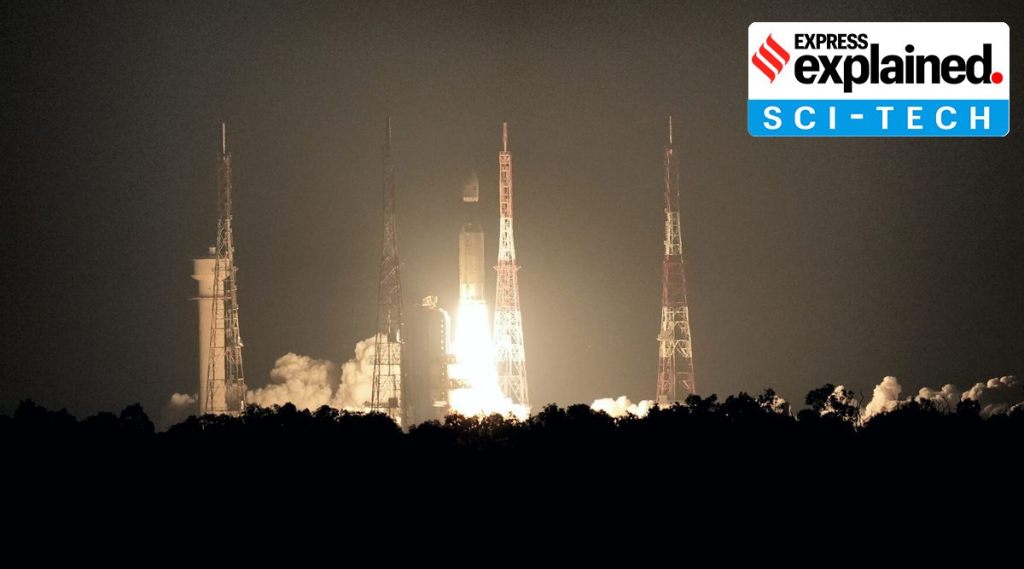 Indian Space Research Organisation (ISRO)'s heaviest rocket LVM3-M2 lifts-off from the second launch pad at the Satish Dhawan Space Centre in Sriharikota, Sunday, Oct. 23, 2022. (PTI Photo/R Senthil Kumar)

 India currently has three operational launch vehicles — the Polar Satellite Launch Vehicle or PSLV, of which there are multiple versions; the Geosynchronous Satellite Launch Vehicle or GSLV Mk-II; and the Launch Vehicle Mark-3 or LVM3.
 The PSLV has been the most commonly used, having carried as many as 53 successful missions since 1993. Only two flights of PSLV have failed.

 Share


