The Union Consumer Affairs Ministry on August 27 notified new rules that make Indian Standard Time (IST) the legally enforceable reference for official and commercial use. The Legal Metrology (Indian Standard Time) Rules, 2026 now require time-dependent systems in government and critical sectors to use a “traceable”, authorised IST reference, with 180 days for compliance.
But India has already followed IST for decades. Why were the new rules needed and what changes with them?
People obtain time from many sources, often indirectly from GPS. A telecom provider provides the time maintained in its data centre, but there may be a lag of seconds or even minutes as people and organisations refer to different sources.
“It is like each person establishing their own starting point; you then cannot properly compare events or measurements,” said Poonam Arora, Head of the Time & Frequency Metrology Division at the Council Of Scientific And Industrial Research (CSIR)-National Physical Laboratory.
What do the new rules do?
The Department of Legal Metrology enforces measurements such as mass and volume. Inspectors can check the gauges at a petrol pump or verify the weights used by an establishment. They did not have an equivalent capability for time — until now.
The new rules seek to give time a legal status and make it comparable to these physical measurements.
The broader purpose of the new rules, that call for “traceability”, is to make IST the country’s common legal time reference for commercial and other purposes, including the display of time. “This can also improve cybersecurity, reduce crime and make critical infrastructure more resilient,” said Arora.
In the context of time, traceability means showing that a clock or time source is ultimately linked to IST maintained by NPL.
Who maintains time in the country?
The CSIR-NPL is mandated to maintain the country’s scientific standards, such as mass and volume. Maintaining (or “realising”) and disseminating IST is also part of its mandate.
A bank of extremely precise atomic clocks helps the NPL maintain the country’s time within a few nanoseconds of the international reference, Coordinated Universal Time (UTC). According to the NPL website, these clocks are so accurate that they would lose or gain one second in about three lakh years.
“IST is a registered trademark of CSIR-NPL,” Arora said. “The NPL maintains UTC (NPLI), India’s realisation of UTC. Indian Standard Time is UTC (NPLI) plus five hours and 30 minutes.”
How is time ‘disseminated’?
Dissemination of time essentially refers to the transmission of the “realised” time scale across physical distances to external users and systems. There are different methods, with varying accuracy.
Your phone, for instance, shows you time indirectly derived from GPS.
Computers use network protocols, which synchronise the clocks of computers and devices over a network. The most common and accessible method — essentially how your computer shows you time — is a Network Time Protocol (NTP) server. The default server may be abroad, so it is not directly providing you the IST.
For more demanding applications, satellite links are used for highly precise time transfer. Given its strategic importance, ISRO has to be traceable to IST within nanoseconds.
Some Regional Reference Standards Laboratories now maintain secondary time scales traceable to IST, while ISRO also gets traceability from NPL, allowing IST to be disseminated from multiple locations, said Arora.
 The timescale at the CSIR-National Physical Laboratory of India. (Special Arrangement)
Traceability can be established through different technologies. NPL has an NTP service with a domain name. If you synchronise your computer with it, your computer becomes traceable to Indian Standard Time, said Arora.
In July 2026, the Union Consumer Affairs Ministry commissioned a White Rabbit Technology-based IST Dissemination Demonstration Network at the RRSL in Bengaluru.
White Rabbit is an open-source networking technology designed to synchronise computer clocks over fibre-optic networks.
Simply put, it sends a timing signal through a fibre-optic cable and measures how long the signal takes to reach another computer. Because that travel time can vary slightly, White Rabbit measures the delay and adjusts for it, allowing clocks in different locations to stay synchronised.
Who needs precise synchronisation?
Systems across multiple organisations — banks, telecommunications, power grids and even defence systems — need to coordinate. A unified time source helps establish the sequence of events, coordinate activities across locations and reconstruct failures, transactions or cyber incidents.
“At the very least, an organisation should be able to show that its systems are synchronised with IST,” Arora said.
The requirement is not only about display. There must also be synchronisation, so that the seconds start at the same time across applications and sectors.
Financial markets already operate under precise clock-synchronisation requirements. Since 2013, SEBI has directed stock exchanges to synchronise their system clocks with atomic clocks before the start of the market so that their clocks have precision of at least one microsecond and accuracy of at least +/- one millisecond.
This precision matters because financial systems can generate and process orders in fractions of a second. Accurate timestamps help establish the sequence in which orders and trades happened and can be important when regulators investigate unusual activity or disputes.
What changes for you?
Very little changes for the ordinary user. Arora noted that such changes would travel downstream as service providers comply with the rules, meaning the time supplied automatically to your device would be traceable to IST.
“Unless you have a business, you are unlikely to face any immediate requirement. But accurate time can matter if investigators or a court need to reconstruct events, for example in a fraud investigation,” Arora said.
Why is India now pushing for domestic timing infrastructure?
The push for IST uniformity comes along with India’s efforts to reduce its reliance on external satellite navigation systems and their timing signals.
Arora noted that most people currently obtain time through GPS, which the US owns and controls. A decision by the US to degrade or deny access to its services, as it did to India during the Kargil War, could pose a problem. That episode pushed India to build the Indian Regional Navigation Satellite System (IRNSS) or NavIC, providing regional satellite-navigation coverage over India.
Alongside this, terrestrial systems such as White Rabbit can distribute IST over fibre-optic networks. Together, these give India more than one domestic route to provide precise time to critical infrastructure.

 A unified time source helps establish the sequence of events, coordinate activities across locations and reconstruct failures, transactions or cyber incidents. (Image generated using AI)

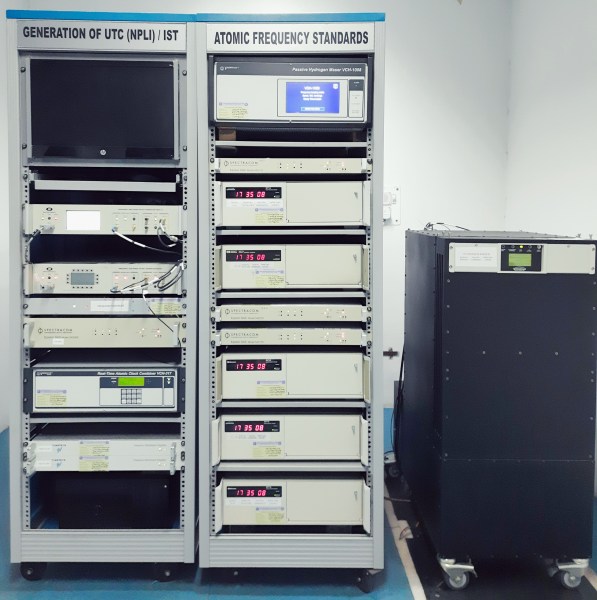 The timescale at the CSIR-National Physical Laboratory of India. (Special Arrangement)

 Share


