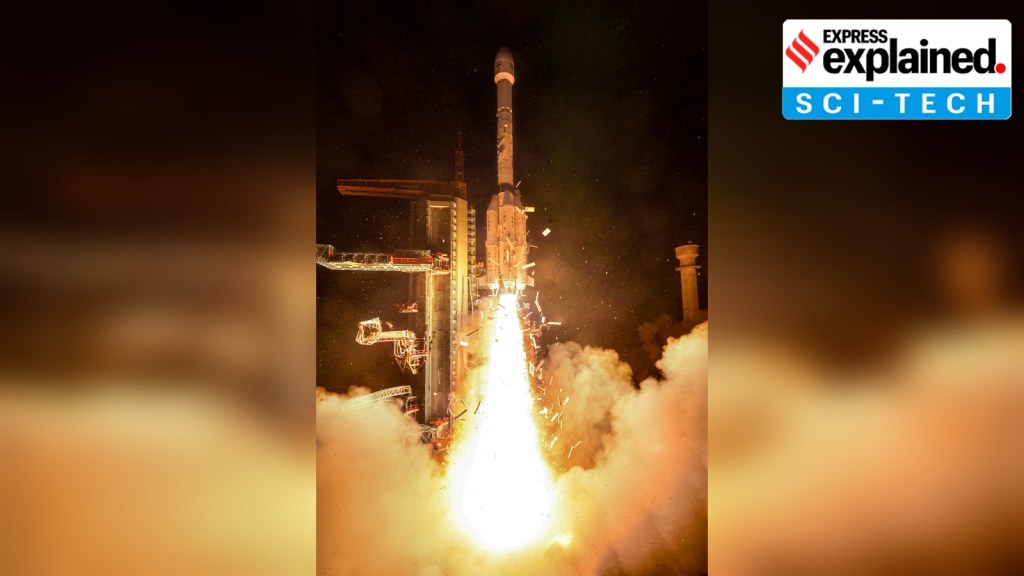
The Indian Space Research Organisation (ISRO) Friday launched India’s first dedicated imaging satellite (EOS-05), which will operate in geosynchronous orbit, about 36,000 km from Earth.
India has several other active earth observation satellites in the lower Earth orbits (LEO) which circle Earth and periodically capture imagery over India.

In the geosynchronous orbit, the satellite remains stationary relative to Earth, and is able to watch the same region continuously, without gaps.
What are the different types of orbit? What advantage does each plane provide? And why do we need a satellite so high above the Earth? We explain.
What are the different types of orbit?
The European Space Agency (ESA) defines “orbit” as the curved path that an object in space follows around another object owing to gravity. In the case of satellites, the curved path they follow is around the Earth.
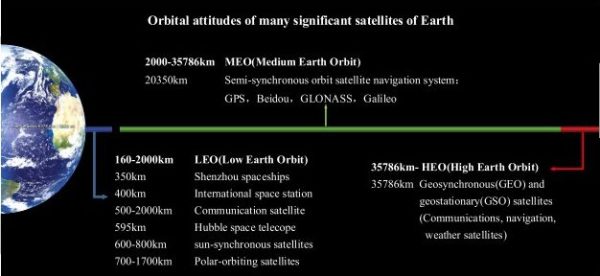
Scientists broadly categorise Earth’s orbits into three primary altitude classes. Each serves a different purpose.
The different types of orbit.
Low Earth orbit (LEO)
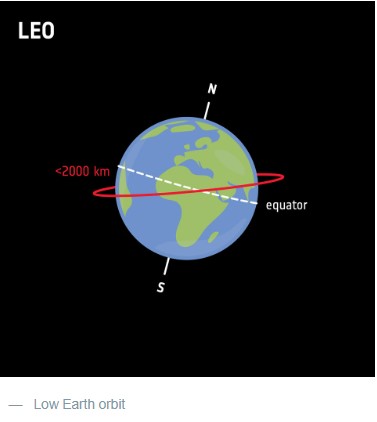
Low Earth Orbit, or LEO, is the zone immediately surrounding our planet. It is typically defined as the region between 160 km and 2,000 km above Earth’s surface.
The proximity to Earth reduces signal latency. This is why this orbital slice is densely populated by communications and observation satellites, as well as satellite constellations and mega-constellations (large groups of up to thousands of satellites working together). The International Space Station is also located in this zone.
“Even within LEO, there are subsets like VLEO (very low Earth orbit) and SSO (Sun-synchronous orbit). While VLEO satellites can offer higher image resolution because they are closer to the Earth, they are subject to much more atmospheric drag, increasing the fuel requirements,” Ashwin Prasad Rao, Staff Research Analyst at the Takshashila Institution’s Outer Space Programme told The Indian Express.
The extent of low Earth orbit. (European Space Agency)
Satellites in LEO generally take between 90-120 minutes to circle the planet but do not necessarily need to follow a permanent path.
According to Orbital Radar, a platform that tracks bodies in the Earth’s orbit in real time, there are 15,562 active payload satellites in LEO as of September 4. An April 2026 report by ISRO said India has 22 operational satellites here.
Medium Earth orbit (MEO)
MEO extends from 2,000 km up to 35,786km — just below the geosynchronous orbit. Like LEO, satellites are not confined to following a specific path around the Earth. It houses global navigation satellite systems such as Galileo (a constellation of 30 satellites) and provides a balance between low signal latency and a large coverage area.
Geosynchronous orbit (GSO)
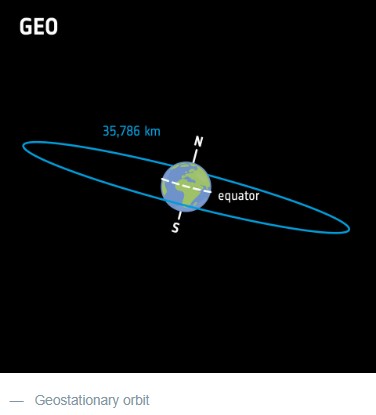
Satellites considered to be placed in GSO are positioned upwards of roughly 35,786 km. They fly over the Earth’s equator moving from West to East and exactly match the Earth’s rotation. This means that its position relative to Earth appears stationary.
“Within GSO, there is the subset called geostationary orbit (GEO). The novelty is that the satellite appears stationary relative to the Earth (unlike LEO and MEO) when placed in a circular orbit directly over the equator with a zero-degree inclination and an orbital period matching the Earth’s rotation”, Rao said.
Geostationary orbit. (European Space Agency)
According to the ESA, satellites in GEO cover large portions of the Earth. Just three evenly spaced out satellites can provide near-global coverage. India has 31 operational satellites in GEO (geostationary orbit).
Why can’t rockets place satellites directly in geosynchronous orbits?
The EOS-05 is a heavy satellite, weighing 2,367 kg. Directly launching it towards geosynchronous orbit would require immense amounts of fuel.
“Typically, ISRO takes satellites bound for GEO to a geosynchronous transfer orbit (GTO) — or, in some cases, a lower-energy sub-GTO — and leaves them there. The satellite then uses its own propulsion, rather than the rocket’s, to raise and circularise its orbit and reduce its inclination until it reaches its operational orbit”, Rao told The Indian Express.
The GSLV flight sequence. (ISRO)
The GSLV (which stands for Geosynchronous Satellite Launch Vehicle) on Friday deposited the EOS-05 satellite in sub-GTO, at an altitude of more than 190 km from Earth.
“ISRO used its second most powerful rocket whose published GTO capacity was below the mass of EOS-05, as opposed to the LVM3,” Prasad said.
After being released, the satellite uses its own propulsion system to reach the final geosynchronous orbit.
Why do we need satellites in geosynchronous orbit?
Traditionally, most imaging and observation satellites operate in lower Earth orbit.
There is, however, a caveat attached to LEO observation satellites. Due to their proximity to the surface, they must travel at breakneck speeds to counteract the effects of the Earth’s gravitational pull. As a result, they can only observe a specific patch of Earth for a brief window before they hurtle past. This creates significant gaps in coverage.
A simulation of a Starlink satellite megaconstellation. SpaceX/Starlink
Since satellites in geostationary orbit appear fixed relative to the Earth, “this constant persistence and area of coverage… are major benefits”, Rao said.
“The trade-off, however, comes in the image resolution due to the distance from the surface. Satellites also experience perturbations from the gravitational influence of the Sun and Moon, the Earth’s non-uniform gravity field and solar-radiation pressure, increasing the need for station-keeping and the fuel spend of the satellite to stay on path,” Rao said.
Lt General A K Bhatt (retd), Director General of Indian Space Association, an industry body, said: “The geosynchronous imaging capabilities of EOS-05 satellite will enable persistent, high-frequency observation of large regions rather than relying only on periodic satellite revisits, which is increasingly critical for India.
“This can be strategically valuable for tracking rapidly evolving weather systems, floods and forest fires, monitoring agriculture and natural resources, and strengthening situational awareness across India’s land and maritime domains. The real opportunity now lies in translating this rich, frequent satellite data into actionable intelligence through India’s private space and geospatial ecosystem,” he said.

 The GSLV-F17 rocket carrying EOS-05 satellite lifts off from the Satish Dhawan Space Centre in Sriharikota, Andhra Pradesh. @isro/X

 The different types of orbit.
 The extent of low Earth orbit. (European Space Agency)
 Geostationary orbit. (European Space Agency)
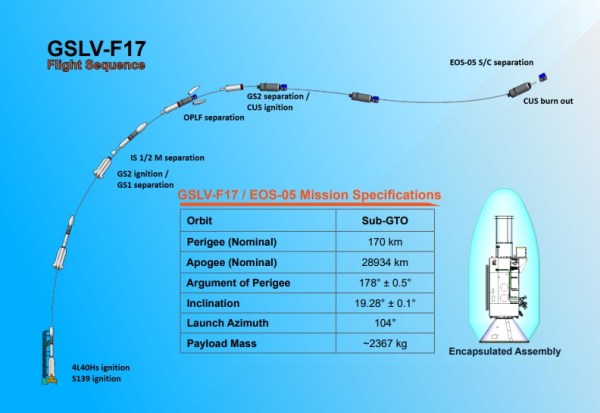 The GSLV flight sequence. (ISRO)
 A simulation of a Starlink satellite megaconstellation. SpaceX/Starlink

 Share


