


Journalism of Courage
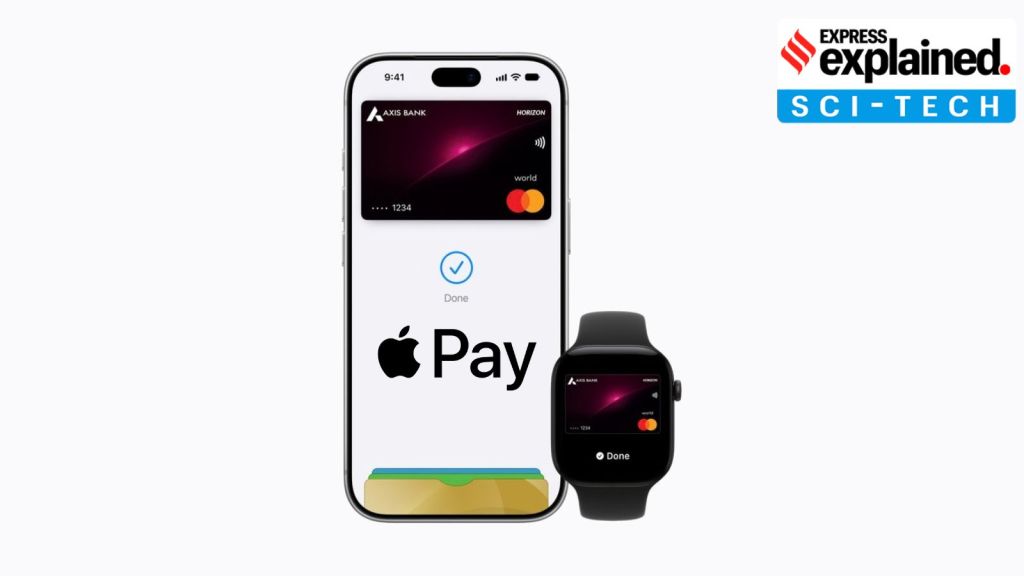 Apple Pay has launched in India, 12 years after its US launch. (Apple Newsroom, Wikimedia Commons)
Apple has debuted its payment service, Apple Pay, in India on Wednesday (September 30), 12 years after it was first launched in the US, with Axis Bank-issued Visa and Mastercard credit cards available on the platform initially.
The service allows users to make contactless card payments using Apple devices, as well as payments in apps and on the web. Its India entry comes into a market where contactless card payments are already available through rivals such as Samsung and Google, alongside the far more widely used UPI ecosystem.
For now, however, Apple Pay’s reach will be limited by its single-bank launch.
Apple Pay is a digital wallet and payments service that allows users to add eligible debit or credit cards to Apple devices and use them to make contactless payments in stores, as well as payments in apps and on the web.
Apple Pay is built into Apple Wallet on supported devices. Once a card is added, users can pay with an iPhone or Apple Watch in stores, and use Apple Pay for purchases in supported apps and websites.
For online purchases, users can authenticate the payment on their device instead of entering card details each time. Apple says users will continue to receive the rewards and benefits linked to their cards. If an iPhone is lost or stolen, payments from that device can also be suspended through Find My.
Instead of transmitting the actual card number to a merchant, Apple Pay uses a tokenised, device-specific number. The payment is then processed through the card network linked to the card.
For in-store payments, users can authenticate a transaction using Face ID, Touch ID or their device passcode before holding an iPhone or Apple Watch near a compatible contactless terminal.
In India, Apple Pay is available at launch on iPhone, iPad and Apple Watch, while support for Mac is coming soon.
Axis Bank is currently the only issuing bank on the platform. This limits Apple Pay’s addressable market at launch: the bank had 16.29 million credit cards outstanding in August, compared with 124.05 million credit cards across India, according to RBI data.
The wider market, however, is substantial. Credit-card spending stood at about Rs 2.02 lakh crore in August. Apple Pay’s potential user base could grow considerably if Apple adds more banking partners.
Reuters previously reported that Apple had held discussions with other major lenders, including HDFC Bank and ICICI Bank, but no agreements were finalised.
Fintech platform PayU has also added Apple Pay to its merchant network, allowing participating merchants to accept it online, in apps and in stores. PayU said it would also help merchants with technical integration and compliance.
Contactless card payments are not new to India. They use Near Field Communication (NFC), a short-range wireless technology that lets two devices exchange data when held in close proximity. In payments, it allows a phone, smartwatch or card to communicate with a compatible point-of-sale terminal without inserting or swiping the card.
Samsung launched Samsung Pay in India in March 2017, two years after its global launch. It allowed Samsung users to make payments by tapping registered debit or credit cards at merchant terminals. Its launch partners included Visa, Mastercard and several major banks, including Axis Bank, HDFC Bank, ICICI Bank and SBI Cards.
In September 2017, Google Pay launched in India, then known as Tez. In 2020, the platform added NFC-based, tokenised card payments, initially rolling out the feature to Axis and SBI Card users. The service allows users with supported cards and NFC-enabled Android phones to make contactless payments at compatible terminals.
After almost two years of regulatory delay, Meta’s WhatsApp Pay entered the digital payments ecosystem in 2020 after gaining approval from the National Payments Corporation of India (NPCI) — with a restriction of just one million users. Eventually, NPCI raised the limit to 100 million by 2022. From market concentration to data privacy concerns, its growth took a hit, while other competitors such as Google Pay, PhonePe and Paytm raced ahead.
In 2025, when most of its rivals had already gained much ground, the NPCI allowed Meta to extend its Unified Payments Interface (UPI) services to its entire user base of over 500 million in India. Effectively, the decision removed the previous cap of 100 million users.
Apple Pay works much like Samsung Pay or Google Pay’s tap-to-pay feature. Users add a card to their phone or watch and tap the device at a compatible payment terminal. The main difference is that Apple Pay is built into Apple devices, while Samsung Pay is built into Samsung devices and Google Pay’s tap-to-pay works on supported Android phones.
Apple Pay uses a linked debit or credit card, with the transaction processed through the card network. UPI works differently, moving money directly between bank accounts through participating apps.