
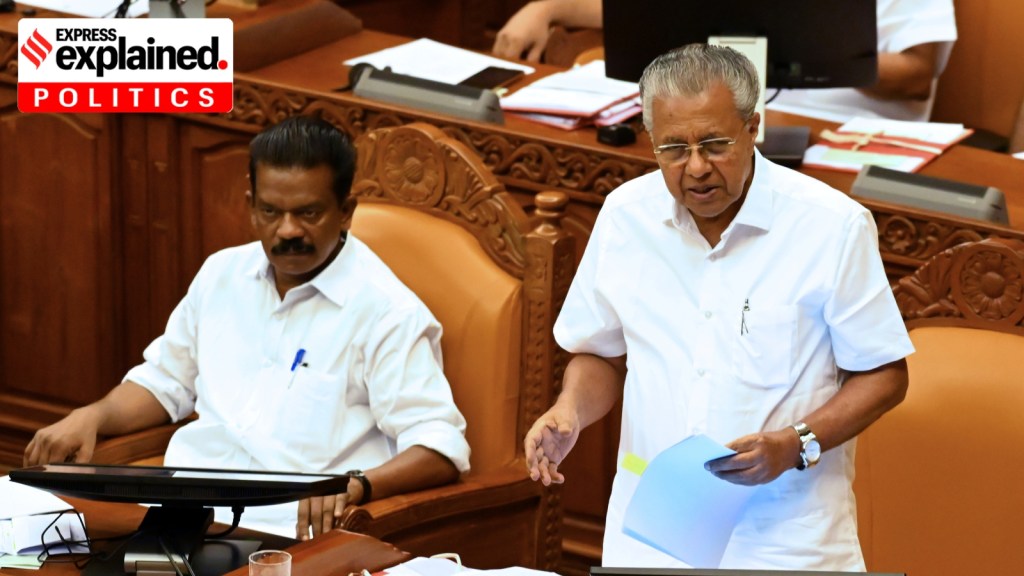
A single-judge bench of the Kerala High Court Friday directed the state Vigilance and Anti-Corruption Bureau to register an FIR against former chief minister Pinarayi Vijayan, his daughter T Veena, son-in-law Muhammed Riyas and others over alleged illegal payments to Veena’s IT firm.
The Enforcement Directorate (ED) is probing allegations that Veena’s firm, Exalogic Solutions, received illegal payments of around Rs 2.78 crore from Kochi-based Cochin Minerals and Rutile Ltd (CMRL) when the CPI(M) government was in power.

Here’s what to know about the case.
What is the CMRL-Exalogic case?
CMRL is a Kochi-based minerals and chemicals company operating in Kerala’s mineral-sand sector. Kerala State Industrial Development Corporation, a state enterprise, is one of the shareholders in the entity.
The case emerged in 2023 after Income Tax raids at CMRL, when Vijayan was Kerala chief minister. Investigators alleged that the company had paid about Rs 1.72 crore to Exalogic Solutions — the IT firm linked to Veena — between 2017-18 and 2018-19 under agreements for software development, management and consultancy services.
According to the Income Tax department, CMRL had falsely recorded these payments as business expenses — because Exalogic had not provided any such service. The department’s Interim Board of Settlement subsequently termed the transaction an “illegal payment”.
CMRL managing director Sasidharan Kartha was accused of allegedly making illegal payments to politicians, parties, police officials, media houses, journalists, trade unions and others to “ensure smooth running of business”.
The CMRL case came up before the Interim Board for Settlement after CMRL and Kartha moved a settlement application as a sequel to an Income Tax raid in 2019, which unearthed the illegal handing over of money to various sources, which were not related to the firm’s business.
Two more central agencies step in
The ED later launched a money laundering probe and questioned CMRL officials. The Serious Fraud Investigation Office (SFIO), under the Ministry of Corporate Affairs, also opened an investigation into Exalogic and examined wider financial transactions linked to CMRL.
During the probe, investigators alleged that CMRL had made substantial payments to several politicians whose identities were recorded through abbreviations in documents seized during the Income Tax searches. The alleged beneficiaries, according to investigators, belonged to multiple political parties.
The SFIO investigation estimated the alleged benefit to Exalogic at about Rs 2.73 crore.
The SFIO probe later widened into CMRL’s broader financial dealings. The ED, meanwhile, examined whether the transactions generated “proceeds of crime” under the Prevention of Money Laundering Act (PMLA).
Investigators were also examining whether the alleged payments were part of a broader arrangement linked to regulatory and operational clearances for the company.
In May, the ED searched Vijayan’s premises and eight premises linked to local CPI(M) leaders in Kozhikode district, claiming to have found evidence of money transfers through hawala routes.
How have Veena and the CPI(M) responded to the probe?
Veena and Exalogic have denied wrongdoing and maintained that the payments were part of legitimate business arrangements. The CPI(M) has repeatedly described the central agency probes as politically motivated.
Following the searches in May, the CPI(M) and other Left parties organised protests across Kerala, alleging that the ED action was politically motivated and aimed at targeting opposition leaders.
Opposition parties across India have repeatedly accused the ED of selectively targeting opposition leaders and state governments through high-profile investigations. The BJP and the Union government have rejected the allegation, saying the agency acts on evidence.
What has the Kerala High Court ordered now?
Last month, the ED recommended that the state police register an FIR against Vijayan and others, including Veena and Riyas, under the Prevention of Corruption Act. A former minister, Riyas is a member of the CPI(M) state secretariat.
Instead of registering an FIR, the Congress-led government ordered a preliminary inquiry by the state Crime Branch, with a decision on registration to be taken after the inquiry.
Challenging this decision, K M Shajahan, a former additional private secretary to former chief minister V S Achuthanandan, approached the high court. The ED also joined the proceedings.
After hearing all parties, including the state government, Justice A Badharudeen allowed the petition and directed that an FIR be registered. The ED argued that the Crime Branch could not conduct a preliminary probe and that an FIR should be registered based on its recommendation. The state government contended that the petition was not maintainable and that the investigating agency could conduct a preliminary inquiry before registering an FIR.
Another probe against Vijayan
If the state government proceeds with registering an FIR against Vijayan in compliance with the high court directive, it would be the second major corruption probe he has faced in his decades-long political career.
The CBI had previously investigated Vijayan in the alleged SNC-Lavalin corruption case, in which he was an accused.
This case stemmed from decisions taken by the electricity department between 1995 and 1997, when Vijayan was power minister in the LDF government. The state electricity board had entered into a contract with Canadian firm SNC-Lavalin to renovate hydel power projects in Keralam, allegedly causing a loss of Rs 374.50 crore to the state exchequer. CBI had charge-sheeted Vijayan and others in this case, but in 2015 the court allowed his discharge petition. The CBI’s petition challenging the trial court verdict is pending before the supreme court, which had postponed the matter several times over the years.


 Share


