
How a challenge to 1937 Shariat Act frames inheritance law as a civil statute vs religious instrument question
Citing the Uttarakhand UCC passed in 2024, the petition argues that two Muslim women of identical faith, family, and citizenship now receive different property rights because of their postal code.
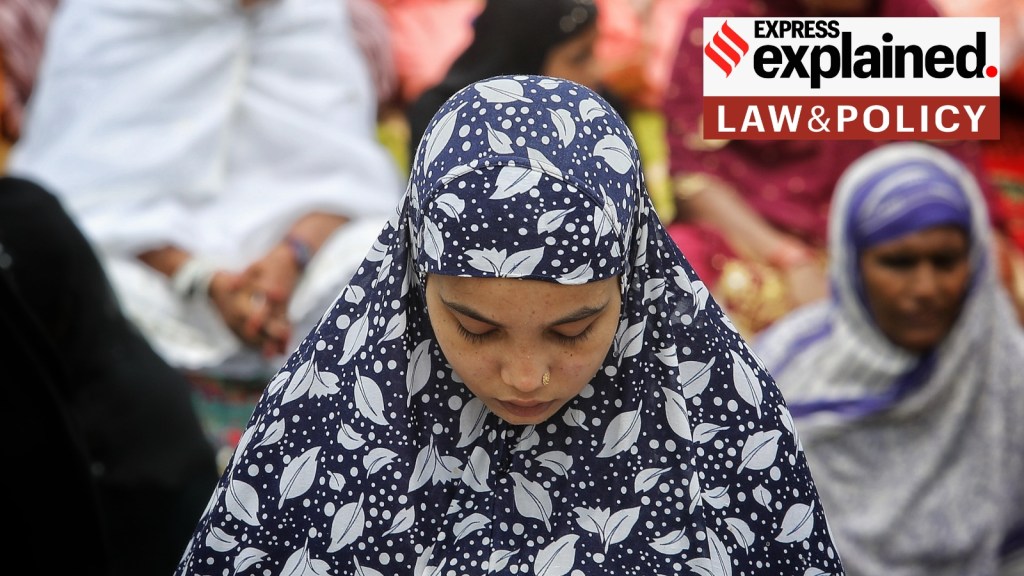 Muslim women offer prayers in Ahmedabad on June 28, 2023. Photo: Nirmal Harindran
What determines how much a Muslim woman inherits when her father dies — her faith or her address? A writ petition filed before the Supreme Court last week argues that the answer, in India today, may be her address. The bench that heard it was not sure whether it disagreed.
Calling Uniform Civil Code (UCC) “the most effective answer”, Chief Justice of India (CJI) Surya Kant, along with Justices Joymalya Bagchi and R Mahadevan, heard a challenge to the Muslim Personal Law (Shariat) Application Act, 1937. The petition calls for the extension of Uttarakhand’s UCC nationally, stating that “the Uniform Civil Code of Uttarakhand, 2024, has rendered the continuing application of the Muslim Personal Law (Shariat) Application Act, 1937, elsewhere arbitrary, irrational and discriminatory as far as inheritance is covered”.

The bench questioned whether courts can adjudicate the constitutionality of personal law practices. It also raised concerns that striking down the inheritance provisions could create a legal vacuum, as there is no separate statutory law governing Muslim succession.
CJI Surya Kant observed that “in our anxiety of over anxiety, we may ultimately land in a situation where we deprive them of whatever they are getting”, cautioning that removing the 1937 Act without an alternative framework could leave Muslim women without legal protection. The court asked the petitioners to amend the plea to indicate possible remedies if the provisions are invalidated and adjourned the matter.
What the petition says
The petition’s argument is based on constitutional principles, not theology. It confines itself to inheritance and testamentary rights, and rests entirely on the premise that the Uttarakhand UCC has broken the uniformity that once shielded the 1937 Shariat Application Act from constitutional challenge.
“Once uniformity has ceased to exist, the Muslim Personal Law (Shariat) Application Act, 1937 cannot claim to be purely religious in character and inviolably applicable to all Muslims in India, but stands as a civil statute subject to the equality code of the Constitution,” the petition says.
The petition argues that the moment that gap opened, the Act stopped being a religious instrument and became a civil statute, and civil statutes can be tested against Articles 14, 15, and 21 of the Constitution.
Under the Shariat Act, a Muslim man cannot will more than one-third of his estate freely — the rest passes to his heirs as prescribed in the Quran. Under the Uttarakhand UCC, that restriction is eliminated. “The same religion, the same lineage, and similar property are therefore governed by two entirely different civil consequences within one Republic,” the petition states.
Challenge under Article 14 is the sharpest. The 1937 Act’s original purpose was uniformity: one law for all Muslims across British India. It states that “the distinction is no longer religious pluralism; it is arbitrary legal pluralism. Once the Union of India permits Muslim women’s equality in one state, its refusal to extend the same elsewhere creates inter-religious discrimination under Article 14 and intra-religious discrimination under Article 15.”
The petition argues that two Muslim women of identical faith, family, and citizenship now receive different property rights because of their postal code.
Article 14 prohibits the state from treating equals unequally, unless there is a reasonable basis for doing so. This is known as reasonable classification. For this classification to pass muster, it must be based on a real difference that’s relevant to the law’s purpose. Here, the petitioners say that there is no intelligible basis for that distinction and no rational connection between where a woman lives and what she should inherit.
On Article 25, the religious freedom guarantee that has historically protected personal law from exactly this kind of challenge, the petition states that inheritance belongs to “muamalat” (the domain of civil transactions) and not “ibadat” (acts of worship). It categorises inheritance as social interactions and civil transactions, and succession does not fall under acts of worship. By doing so, it claims property succession as a secular civil contract and not a core tenet of faith. And bringing it under the civil framework, the state gains power to refer civil matters under Article 25(2)(b).
The application of Shariat Act outside of Uttarakhand “constitutes state complicity in economic violence”. This, it says, is not a denial of religion but of a “dignified life under Article 21”.
The Uttarakhand UCC was passed in February 2024 by the BJP government months before the 2024 Lok Sabha election, making it the first Indian state to enact one after Independence. The UCC has featured in the BJP’s manifestos since 1998.
The state’s UCC applies to everyone except the Scheduled Tribes. Its provisions on live-in relationships that require one to register with the state officials, or face jail for non-compliance, are being challenged in the Uttarakhand High Court.
The 1937 Shariat Act
The Shariat Act was not imposed on Muslims. Religious organisations in pre-independence India had long argued that regional customs denied women even the shares that the Quranic inheritance law entitled them to. In parts of Punjab, Bengal, and southern India, local custom had displaced Quranic rules entirely.
The 1937 Act repealed those customs with Sharia, which grants women fixed shares. It was the first legal floor many women had. Sharia prescribes inheritance as “faraid”, derived from the teachings of the Quran and Islamic jurisprudence. These shares are fixed and mandatory. A single daughter receives one-half the estate; two or more daughters together receive two-thirds. A widow receives one-eighth if there are children, and one-fourth if there are none. A will cannot override these shares. The wasiyyah, or testamentary will, is capped at one-third and can only direct property to non-heirs.
This is the system the petition underscores. And the petitioners are right that it results in women receiving less than men do. But the picture, as the All India Muslim Personal Law Board (AIMPLB) and Islamic scholars are quick to point out, is more layered than a single ratio suggests: the 2:1 ratio that sits between sons and daughters within a larger financial structure.
A man who inherits more bears “nafaqah”, the legal obligation to maintain his wife, daughters until they are married, and dependent female relatives. A woman’s inheritance, on the contrary, is entirely her own. She has no obligation to contribute to the household. The “mehr” she receives at marriage is also hers alone. “Faraid” also guaranteed Muslim women the right to inherit at all since, in pre-Islamic Arabia, women were considered property that passed to others.
AIMPLB’s spokesperson, Syed Qasim Rasool Ilyas, stated the board’s position after the petition was filed: “The responsibility of maintenance and all household expenses rests upon the man, while the woman is exempt from such obligations. Whatever a woman receives from her parents as inheritance, or earns through employment, she is not required to spend on household expenses. She may spend her personal income entirely at her own discretion.”
The 75-year-old precedent
At the heart of the issue lies the State of Bombay v. Narasu Appa Mali (1951) judgment. Personal laws, the Bombay High Court had held, are not “laws in force” under Article 13(1); they derive authority from the scripture, not legislation, and cannot be challenged as violating fundamental rights. In the Supreme Court’s 2018 Sabarimala judgment, Justice D.Y. Chandrachud had called the 1951 judgment based on “flawed premises”. The judgment, however, has not been formally overruled.
The 2017 triple talaq ruling in Shayara Bano worked around it: since the Shariat Application Act had codified Sharia into statute, it qualified as “law in force” under Article 13, and the instant triple talaq was struck down as an arbitrary statutory provision.
The present petition follows the same route for inheritance. This difference is essential, as triple talaq had divided the Muslim community itself, AIMPLB had called it “undesirable” before the court’s verdict. Faraid carries no such internal dissent: it is drawn directly from the Quran and observed across jurisprudential schools as a divine command.
The bench’s concern last week was practical. If the 1937 Act’s inheritance provisions are struck down and Parliament does not act, what governs Muslim succession? Advocate Prashant Bhushan, appearing for the petitioners, said the Indian Succession Act fills the gap. Justice Bagchi was not persuaded, saying that striking down a law could “create an unnecessary void” and that it may be better to “defer to the wisdom of the legislature”.
Courts have seen how judicial intervention in personal law can produce consequences beyond the courtroom. In 1985, the Supreme Court ruled in Shah Bano that a divorced Muslim woman was entitled to maintenance under the Code of Criminal Procedure. Within a year, Parliament passed the Muslim Women (Protection of Rights on Divorce) Act, 1986, in response to the judgment, limiting its effect. Shah Bano herself was reportedly persuaded to publicly reject the verdict given in her favour. Its substance was not restored until 2001, through a separate case.
The larger question
The petition says that it “is not a theological or religious challenge. It does not seek reinterpretation of the Quran or invalidation of faith-based norms. This is a secular, not a theological, question.”
For the Muslim community, that distinction does not hold. The faraid system and the 1937 Act are not two different things; the statute is the state’s recognition of a divine command.
AIMPLB described the petition as “mischievous” and a violation of the constitutional guarantee of religious freedom. The board’s position rests on several planks.
First, the Narasu Appa Mali judgment, not yet overruled, already settles the question of whether personal law can be constitutionally challenged. Second, faraid are not a policy preference; they are derived from specific verses of the Quran and are considered by Muslim scholars to be divinely mandated and not amenable to modification by a legislature or court.
The petition’s strongest rhetorical moment is also its most philosophically ambitious. It says: “Once equality has been constitutionally realized within one part of the Republic, it cannot be denied elsewhere under the guise of religious pluralism. Constitutional morality demands extension, not limitation, of equality.”
Moreover, the petition’s geographic argument cuts both ways. If the existence of the Uttarakhand UCC creates an unconstitutional inequality between Muslim women in Uttarakhand and those elsewhere, the remedy could theoretically be rolling back the Uttarakhand UCC for Muslims, not extending it nationally. The petition does not entertain this possibility, but it illustrates that the geographic logic is not as clean as the petition suggests.

 Share


